
Why this works
The wide-shot framing and “dynamic perspective” give the robot and holographic interface room to read as a spatial interaction rather than a flat portrait. “Warm amber and teal lighting,” reinforced by the dominant black-and-orange palette, creates a warm high-tech contrast, while “softer volumetric glow beams” and “subtle dust motes” temper the energy into a more cinematic atmosphere than sharp effects would. The phrases “high-detail metallic materials” and “realistic photorealistic sci-fi CGI” anchor the glowing amber-blue circuit overlays in a tangible lab environment.
FAQ
→How do I make the robot more central and prominent?
Replace “wide-shot” with “medium-wide hero shot,” and change “reaching toward a glowing holographic interface” to “robot centered in frame, torso and outstretched hand dominating the composition, interface hovering beside its hand.” Keep “dynamic perspective” for motion, but add “sharp focus on the robot’s face, hand, and reflective armor.”
→How do I make the scene darker and more suspenseful?
Replace “Warm amber and teal lighting” with “low-key lighting in deep blue-green shadows with isolated amber rim light,” and change “softer volumetric glow beams” to “narrow shafts of amber light cutting through heavy darkness.” Replace “subtle dust motes” with “sparse dust particles suspended in the beam,” preserving the realistic volumetric look while reducing the bright orange dominance.
→How do I build a variation with a different setting?
Replace “Futuristic lab-like environment” with a specific location such as “flooded orbital control room with curved observation windows” or “abandoned underground robotics facility with exposed cables.” Retain “semi-transparent amber-blue translucent overlays with flowing circuit patterns” to keep the series visually connected, and change “humanoid robot” to “damaged maintenance android” or “sleek exploration robot” for a distinct subject variation.
Learn the technique behind this
- Why can't AI spell, and how do I get readable text in an image? — Older diffusion models had no character-level representation of text, so they produced letterform-shaped texture instead of words.
- How should a prompt be structured, and does word order matter? — A prompt that behaves predictably names one subject first, then what it is doing, then where, then the light, then the lens or medium, then the style.
- Do negative prompts work, and what should go in one? — Negative prompts work on models that support a separate negative conditioning channel — mainly Stable Diffusion and FLUX-family models.
Related prompts

Teal-Violet City Pin Close-Up

Cyan Hologram, Sleek Robotic Hand

Four Robots on Bench Beside Navy-Suited Man
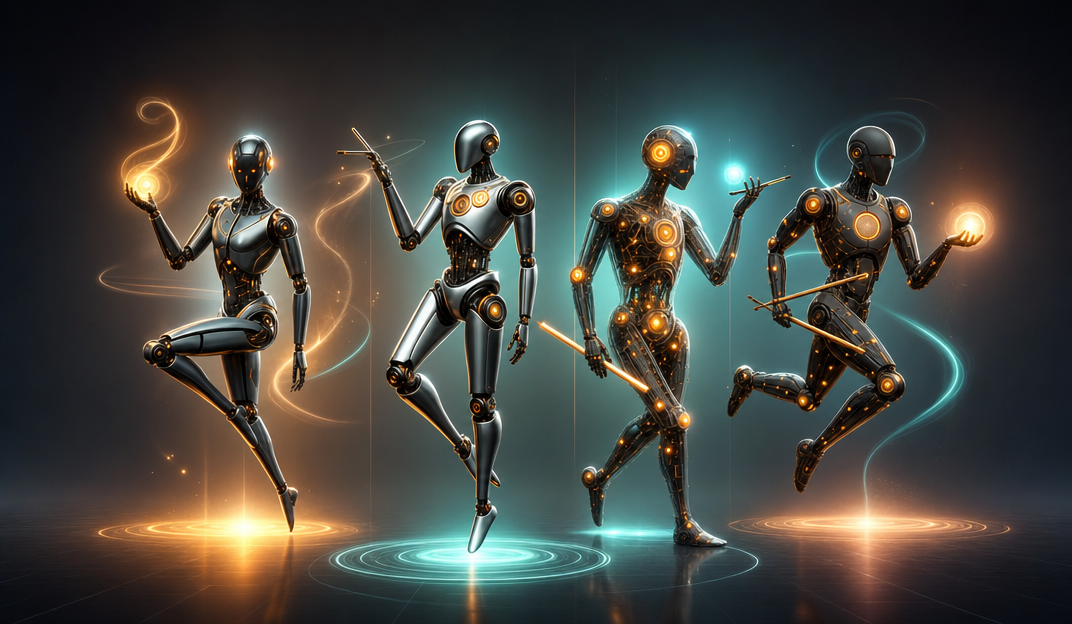
Four Robots Balancing With Amber Glowing Circuits