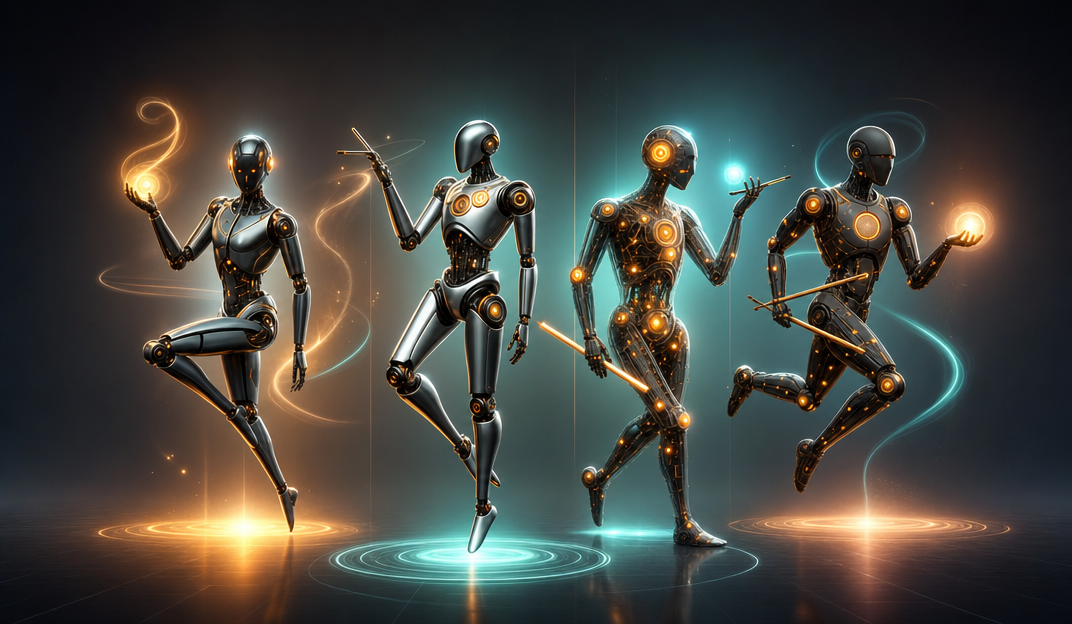
Why this works
“Four futuristic humanoid robots” in “dynamic balancing stances” gives the wide shot a clear multi-subject rhythm, while “dynamic wide cinematic framing” preserves the sense of coordinated movement. The mood comes from “dramatic cinematic studio lighting,” “softer teal light trails,” and “warm amber-orange” circuitry, which produces the observed teal, gold, and black contrast without relying on the replaced neon swirls. “Shallow depth of field” and “crisp reflections on the metal surfaces” separate the robots from the studio while keeping their sleek armor visually sharp.
FAQ
→How do I make one robot the clear central subject?
Replace “Four futuristic humanoid robots posed in dynamic balancing stances” with “one central futuristic humanoid robot in a powerful balancing stance, with three smaller robots receding behind it.” Change “dynamic wide cinematic framing” to “wide cinematic framing with the central robot placed on the vertical centerline,” and add “strongest amber highlights on the central robot.”
→How do I make the scene darker and more ominous while keeping the teal and amber palette?
Replace “vibrant blue-green plus amber palette” with “deep black and desaturated teal palette with restrained amber accents.” Change “dramatic studio lighting” to “low-key cinematic lighting with narrow teal rim lights and isolated amber highlights,” and replace “energetic high-tech atmosphere” with “tense, ominous high-tech atmosphere.”
→How do I create a series of variations without losing the robots’ visual identity?
Keep “sleek metallic armor,” “faint glowing circuitry,” “photorealistic sci-fi digital art,” and “crisp reflections on the metal surfaces” unchanged. Vary only the setting and action phrase, such as replacing “inside a high-tech sci-fi studio” with “on a rain-slick orbital landing platform,” “in a zero-gravity maintenance bay,” or “inside a fractured holographic arena,” while changing “dynamic balancing stances” to “synchronized landing poses,” “slow-motion floating poses,” or “defensive formation.”
Learn the technique behind this
- Why can't AI spell, and how do I get readable text in an image? — Older diffusion models had no character-level representation of text, so they produced letterform-shaped texture instead of words.
- How should a prompt be structured, and does word order matter? — A prompt that behaves predictably names one subject first, then what it is doing, then where, then the light, then the lens or medium, then the style.
- How do I keep the same character across multiple images? — Text prompts alone won't hold a face across images — a description defines a type, not a person.
Related prompts
Open-Frame Futuristic PC With Blue LEDs
Magenta-Cyan Hands Nearly Touch

Magenta-Cyan Holographic Control Room

Blue holographic cube on server room pedestal