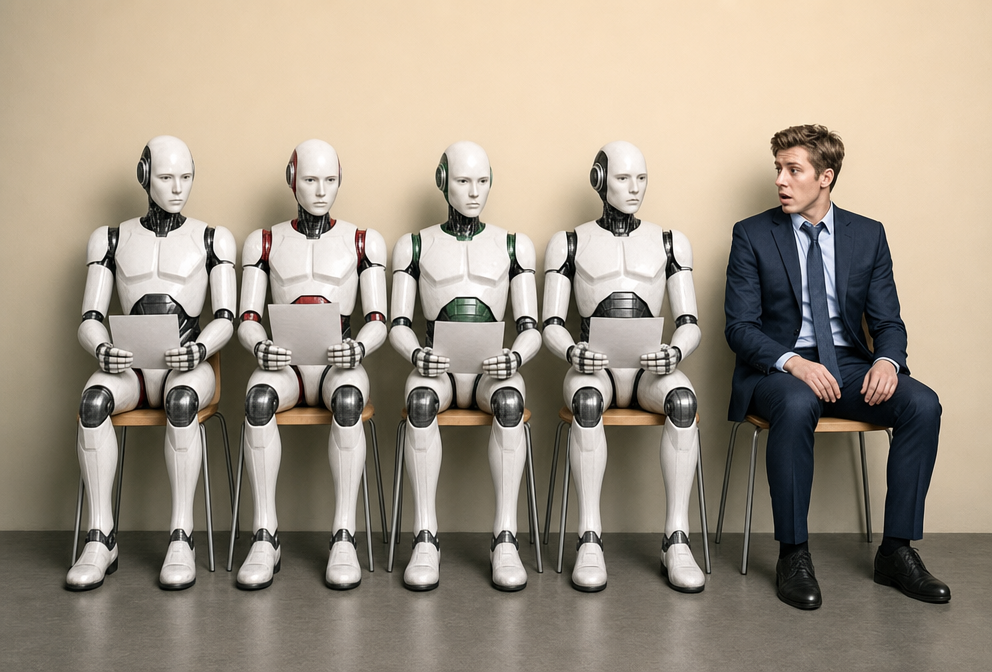
Why this works
The wide-shot framing and the phrase “keeps the four robots seated on the bench beside the man” make the absurd interview lineup readable as one dry visual joke, while “realistic proportions” and “photorealistic cinematic realism” keep it grounded. “Pale beige wall,” “matte floor,” and “soft studio lighting with gentle shadows” produce the restrained beige, white, blue, and black harmony and an understated corporate mood; the navy suit and the robots’ “red” and “green” panel accents provide controlled points of contrast. “Subtle surreal tension” supplies the unease, but the loosened tie and varied robot accents prevent the scene from becoming sterile.
FAQ
→How do I make the robots feel more central and dominant in the composition?
Replace “beside the man” with “the suited man pushed to the far edge while the four humanoid robots occupy the center foreground,” and change “wide-shot” to “medium-wide group shot from a slightly low angle.” Keep “seated on the bench” so their shared lineup remains clear.
→How do I shift this from understated corporate humor to a darker, more tense interview?
Replace “soft studio lighting with gentle shadows” with “cold overhead fluorescent lighting with hard downward shadows,” and change “subtle surreal tension” to “quiet dystopian unease.” Replace “pale beige wall” with “desaturated gray corporate wall” and keep the “loosened tie” to preserve the man’s anxious vulnerability.
→How do I create a series of variations without losing the original visual identity?
Keep “minimalist corporate office interior,” “matte floor,” “realistic proportions,” and “photorealistic cinematic realism” fixed, then swap only the interview scenario and accent colors. For example, replace “job interview” with “performance review” and “red” and “green” accents with “amber” and “violet” accents, while changing the man’s pose to “holding a clipboard with forced confidence.”
Learn the technique behind this
- How should a prompt be structured, and does word order matter? — A prompt that behaves predictably names one subject first, then what it is doing, then where, then the light, then the lens or medium, then the style.
- Why can't AI spell, and how do I get readable text in an image? — Older diffusion models had no character-level representation of text, so they produced letterform-shaped texture instead of words.
- How do I keep the same character across multiple images? — Text prompts alone won't hold a face across images — a description defines a type, not a person.
Related prompts
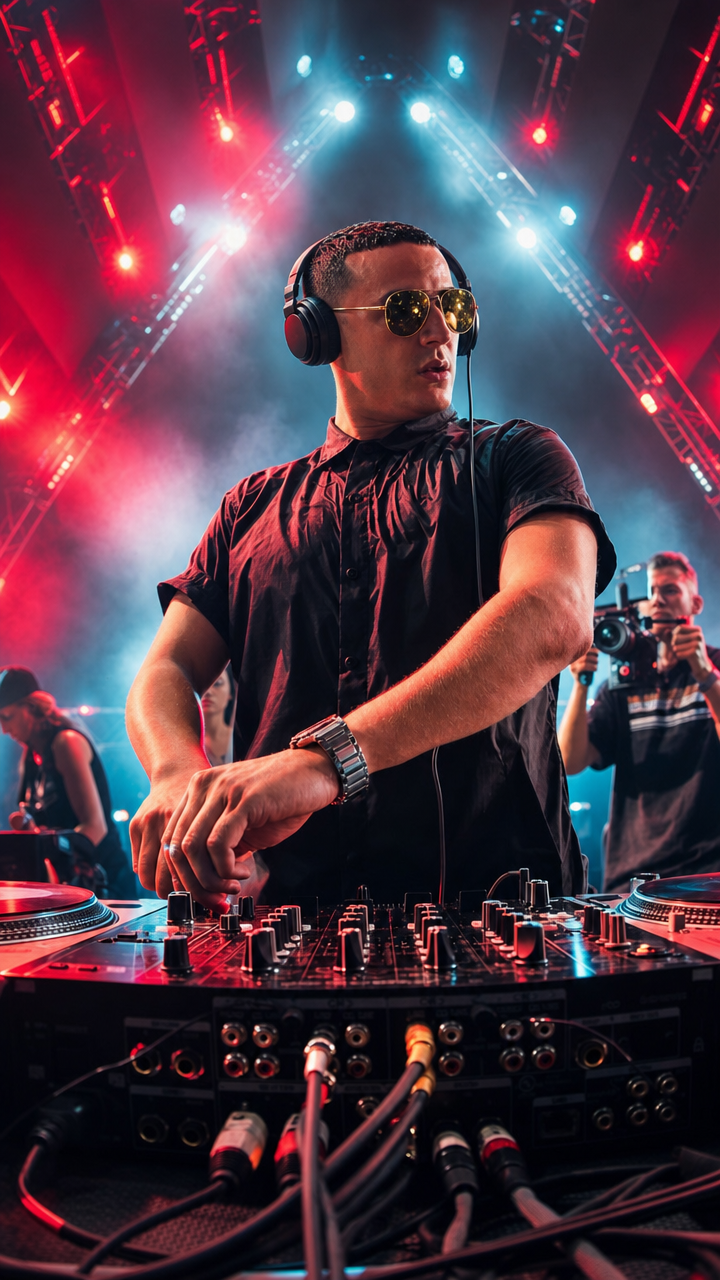
DJ in neon haze at low angle

Glowing Fiber-Optic Cables With Purple Data Lines

Cyan Hologram, Sleek Robotic Hand
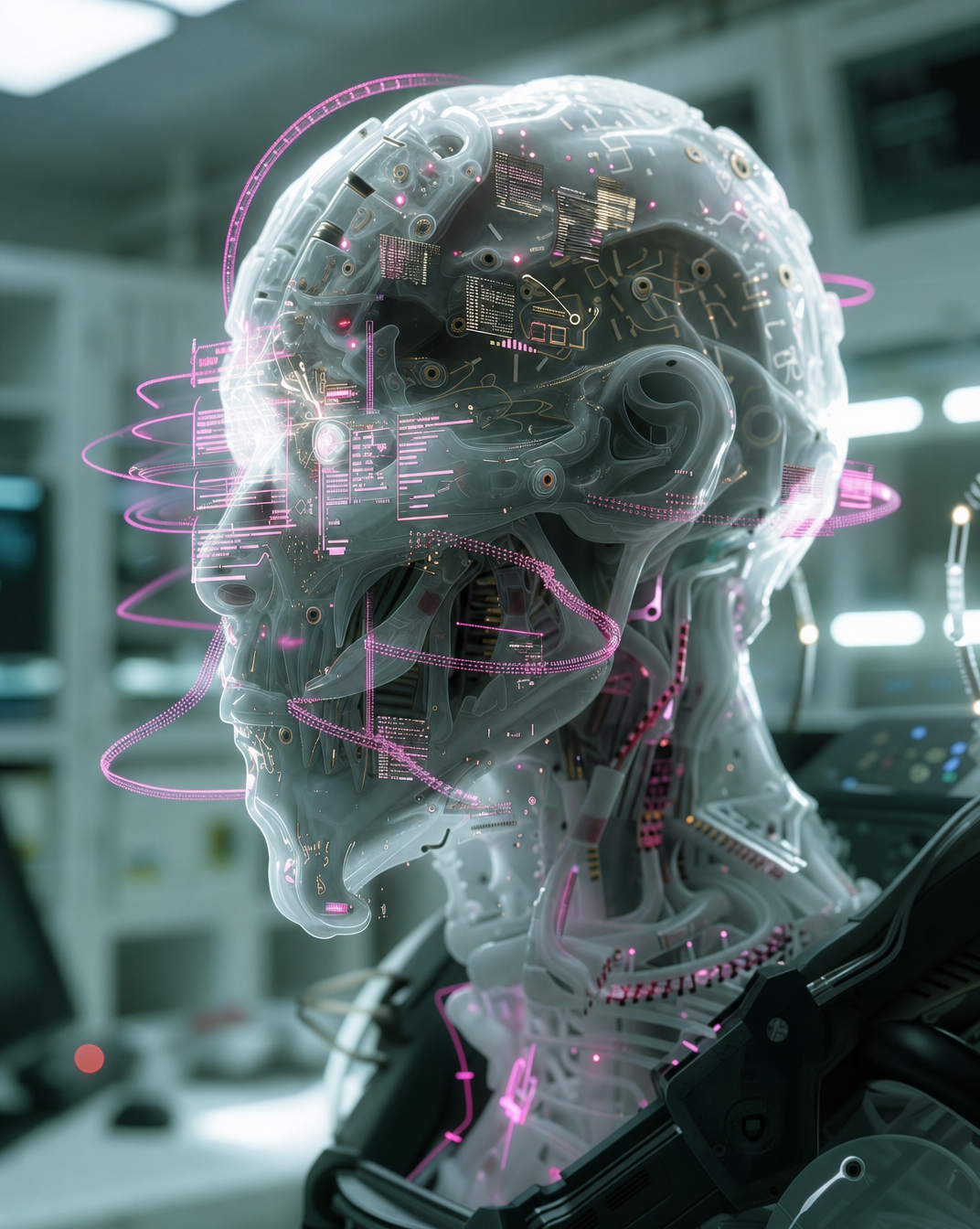
Cyborg head with magenta holograms and translucent skull