
Why this works
The “slightly higher over-the-shoulder angle” makes the laptop, notebook, and writing hand the visual path, while “blurred potted leaves and a ceramic mug in the foreground” builds layered portrait-closeup depth. “Soft afternoon daylight” and “gentle highlights and shadows” keep the focused, calm mood restrained, with warm wood and green leaves balancing the dominant black, tan, gray, and green palette. The “85mm lens look” plus “shallow depth of field” is load-bearing for keeping the man and notebook sharp while turning the office behind him into creamy blur.
FAQ
→How do I make the notebook and handwriting more prominent than the laptop?
Replace “working at a laptop while writing in a notebook” with “writing prominently in an open notebook, laptop pushed to the side,” and change “the man and notebook stay sharp” to “the notebook, pen, and writing hand stay tack sharp while the laptop softens.” Keep the “slightly higher over-the-shoulder angle,” but specify “camera angled downward toward the notebook.”
→How do I make this scene feel more energetic and less calm?
Replace “soft afternoon daylight” and “gentle highlights and shadows” with “crisp directional late-morning sunlight with stronger contrast and defined shadows.” Add “active writing motion, scattered papers, and a half-open laptop screen” after “desk clutter and stationery” to introduce movement without losing the office setting.
→How do I create a matching series with different professionals and workspaces?
Keep the structural phrases “cinematic realistic photography,” “slightly higher over-the-shoulder perspective,” “85mm lens look,” and “shallow depth of field” unchanged. Swap “a focused man working at a laptop while writing in a notebook” for roles such as “a designer reviewing color swatches beside a tablet” or “a researcher annotating printed documents,” and replace “warm wooden desk in a bright office” with settings such as “a cool concrete studio table” or “a sunlit library desk,” while retaining “foreground elements for depth.”
Learn the technique behind this
- Why can't AI spell, and how do I get readable text in an image? — Older diffusion models had no character-level representation of text, so they produced letterform-shaped texture instead of words.
- How should a prompt be structured, and does word order matter? — A prompt that behaves predictably names one subject first, then what it is doing, then where, then the light, then the lens or medium, then the style.
- Why does the model ignore parts of my prompt? — Ignored instructions are almost always conflicts, counts, or spatial relationships — three things current models handle badly — rather than the model failing to read you.
Related prompts

Magenta-Cyan Holographic Control Room

Blue holographic cube on server room pedestal
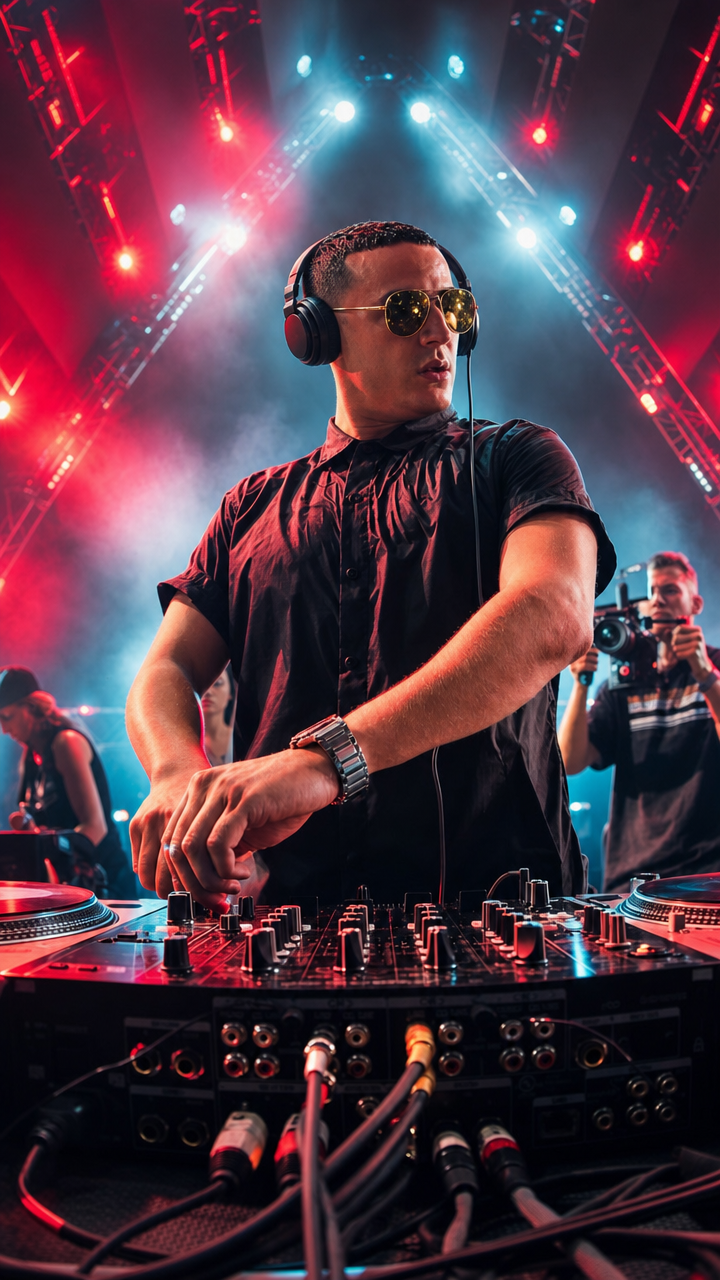
DJ in neon haze at low angle

Glowing Fiber-Optic Cables With Purple Data Lines