Why this works
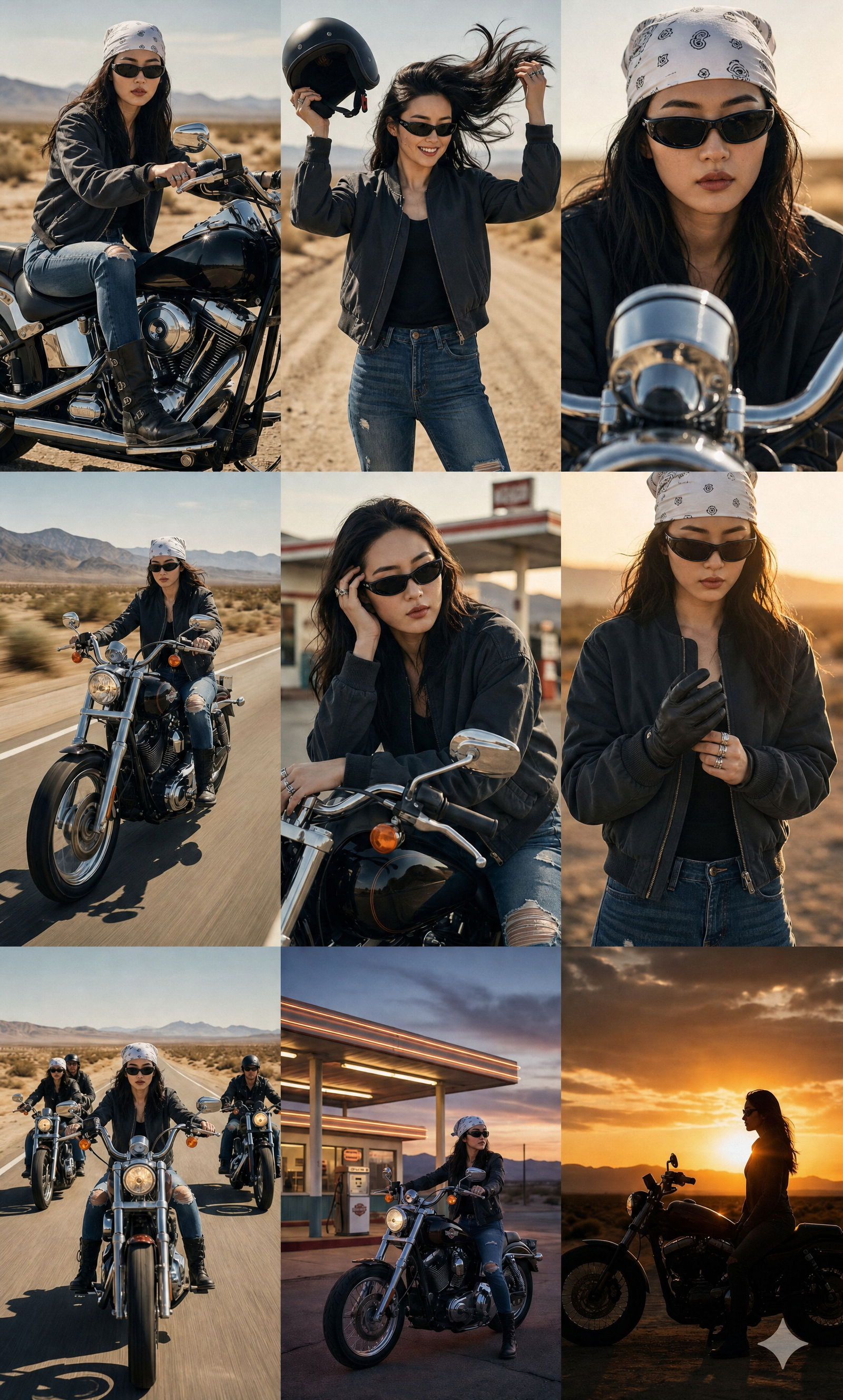
The phrase “cinematic collage...shown across multiple angles and moments” gives the wide composition a built-in visual sequence, balancing the desert highway, rider, and motorcycle instead of isolating a single portrait. “Cinematic golden-hour lighting with warm highlights at ground level” supplies the brown and beige warmth, while “cooler neutrals in the shadows” accounts for the gray contrast. “Crisp focus on the subject with subtle background blur” keeps the biker and chrome readable against the open road, and “dust lightly kicked up from the rear tire” adds motion without overwhelming the editorial framing.
FAQ
→How do I make the rider more prominent than the motorcycle and landscape?
Replace “wide-shot” and “shown across multiple angles and moments” with “medium close-up editorial portrait as the dominant frame, rider occupying most of the composition, motorcycle partially visible as supporting context.” Keep “crisp focus on the subject,” but change “subtle background blur” to “strong background separation with the desert and gas station reduced to soft shapes.”
→How do I shift this from rugged adventure to a darker, more nocturnal tone?
Replace “cinematic golden-hour lighting with warm highlights at ground level” and “sunset silhouette near the horizon” with “blue-hour lighting, hard gas-station fluorescents, deep indigo shadows, and isolated warm reflections on the chrome.” Change “rich golden highlights” to “muted amber highlights,” while retaining “cooler neutrals in the shadows” to preserve the gray-brown palette.
→How do I create a matching series with a different setting but the same visual identity?
Keep “photorealistic editorial photography,” “cinematic collage with multiple angles,” “realistic skin texture,” and “detailed motorcycle chrome and engine parts.” Replace “desert highway with a gas station stop and open-road riding” with a specific setting such as “rainy coastal road, weathered roadside diner, and forested mountain pass,” and replace “dust lightly kicked up” with “fine road spray and wet tire reflections.”
Learn the technique behind this
- Why can't AI spell, and how do I get readable text in an image? — Older diffusion models had no character-level representation of text, so they produced letterform-shaped texture instead of words.
- How should a prompt be structured, and does word order matter? — A prompt that behaves predictably names one subject first, then what it is doing, then where, then the light, then the lens or medium, then the style.
- Why does AI get hands and faces wrong, and how do I fix it? — Hands fail because they're small in frame, extremely variable in pose, and self-occluding — the model has less usable signal per pixel than for any other body part.
Related prompts
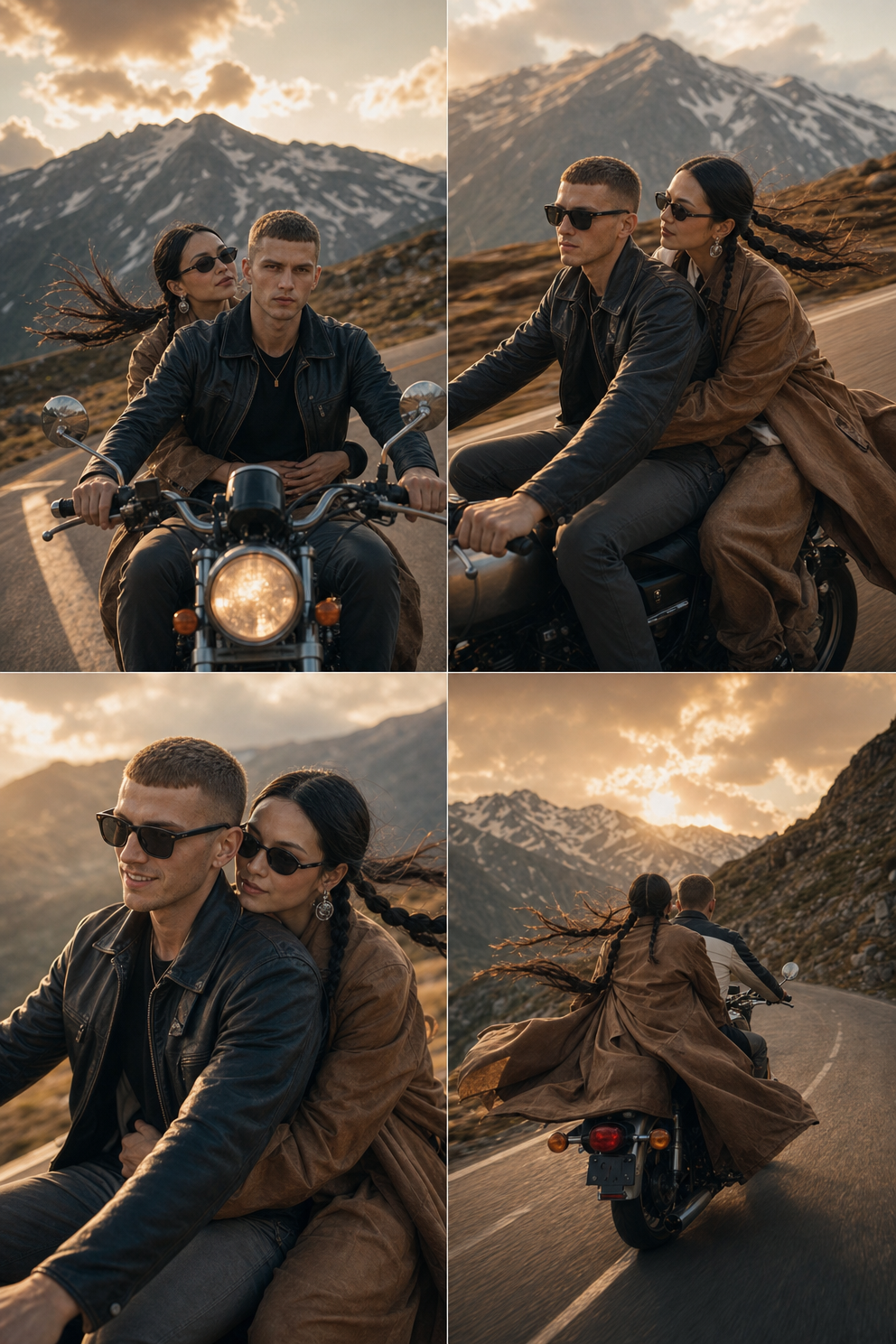
Golden-hour couple rides a classic bike
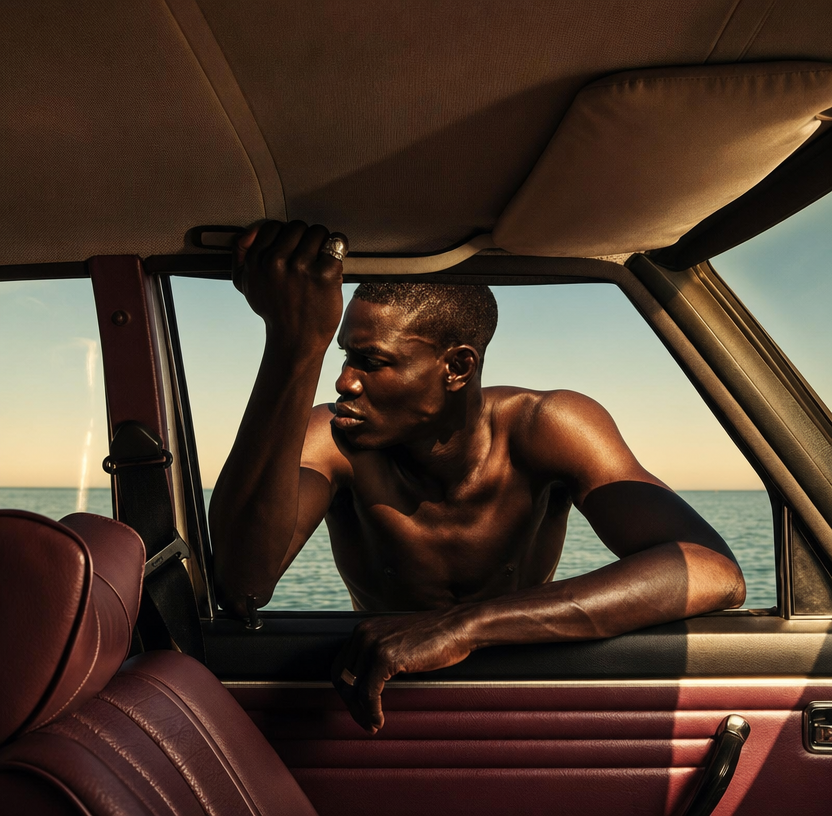
Shirtless Man, Vintage Car, Coastline Light
Glossy black Porsche with small rear spoiler
Golden-hour Matcha Sips in Luxury SUV