Why this works
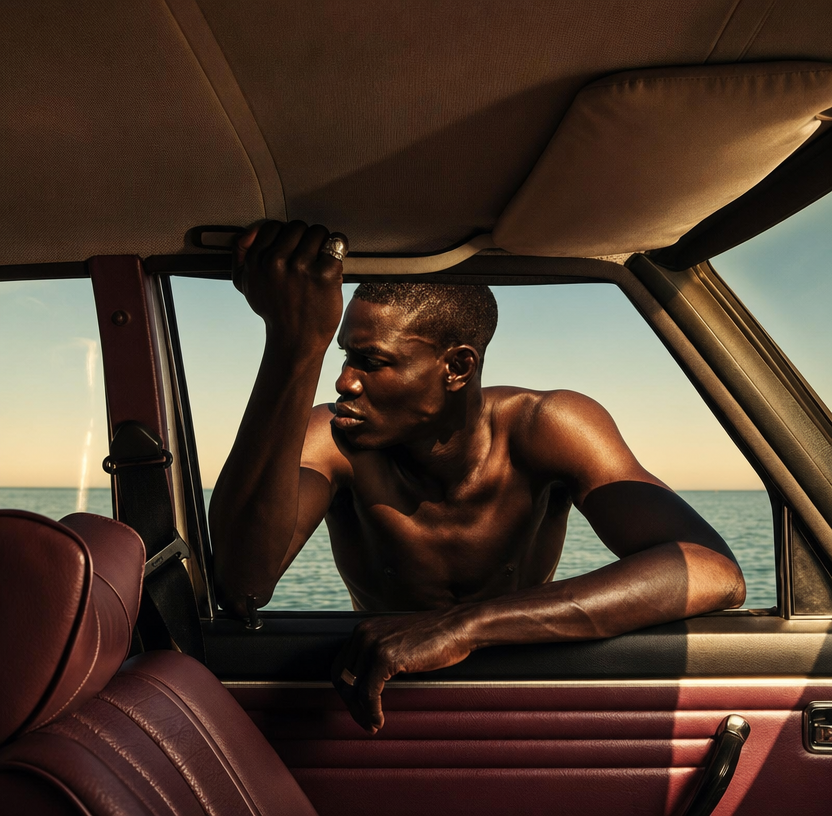
The phrase “side-profile portrait” and the “portrait-closeup” composition keep the man’s face, shoulder line, and hand-on-latch gesture dominant, while the open window supplies a clean frame around him. “Late-afternoon golden sunlight casting long dramatic shadows across his shoulders and the seat” creates the moody contrast, with “lighter turquoise” ocean, burgundy leather, and brushed metal adding controlled color accents against the image’s dominant black, beige, blue, and gray. “Sharp facial and skin texture,” “high contrast,” and “crisp realism” make the editorial effect depend on tactile detail rather than heavy stylization.
FAQ
→How do I make the ocean and coastline more central instead of keeping the portrait as a close-up?
Replace “portrait-closeup” and “side-profile portrait” with “medium environmental portrait, three-quarter profile,” and change “ocean visible through/around the open car window” to “wide coastal vista filling the background, horizon clearly visible beyond the car.” Keep “one arm resting on the door” to preserve the gesture while giving the setting more visual weight.
→How do I shift this from moody editorial drama to a brighter, carefree coastal mood?
Replace “late-afternoon golden light casting long dramatic shadows” with “bright early-morning sunlight with soft, short shadows,” and change “high contrast” to “low-contrast luminous exposure.” Swap “moody, dramatic” for “sunny, relaxed, spontaneous,” while retaining “lighter turquoise” ocean to strengthen the open-air feeling.
→How do I build a series of variations without losing the recognizable visual identity?
Keep “shirtless man leaning through the open window of a vintage car,” “side-profile composition,” “editorial fashion photography look,” and “sharp facial and skin texture” unchanged. For each variation, replace only the setting and palette phrases: use “rocky Mediterranean cove” with “cream leather and oxidized brass,” “foggy northern coastline” with “charcoal vinyl and chrome,” or “desert road overlooking the sea” with “tan leather and blackened steel.”
Learn the technique behind this
- Why can't AI spell, and how do I get readable text in an image? — Older diffusion models had no character-level representation of text, so they produced letterform-shaped texture instead of words.
- How should a prompt be structured, and does word order matter? — A prompt that behaves predictably names one subject first, then what it is doing, then where, then the light, then the lens or medium, then the style.
- Why does AI get hands and faces wrong, and how do I fix it? — Hands fail because they're small in frame, extremely variable in pose, and self-occluding — the model has less usable signal per pixel than for any other body part.
Related prompts
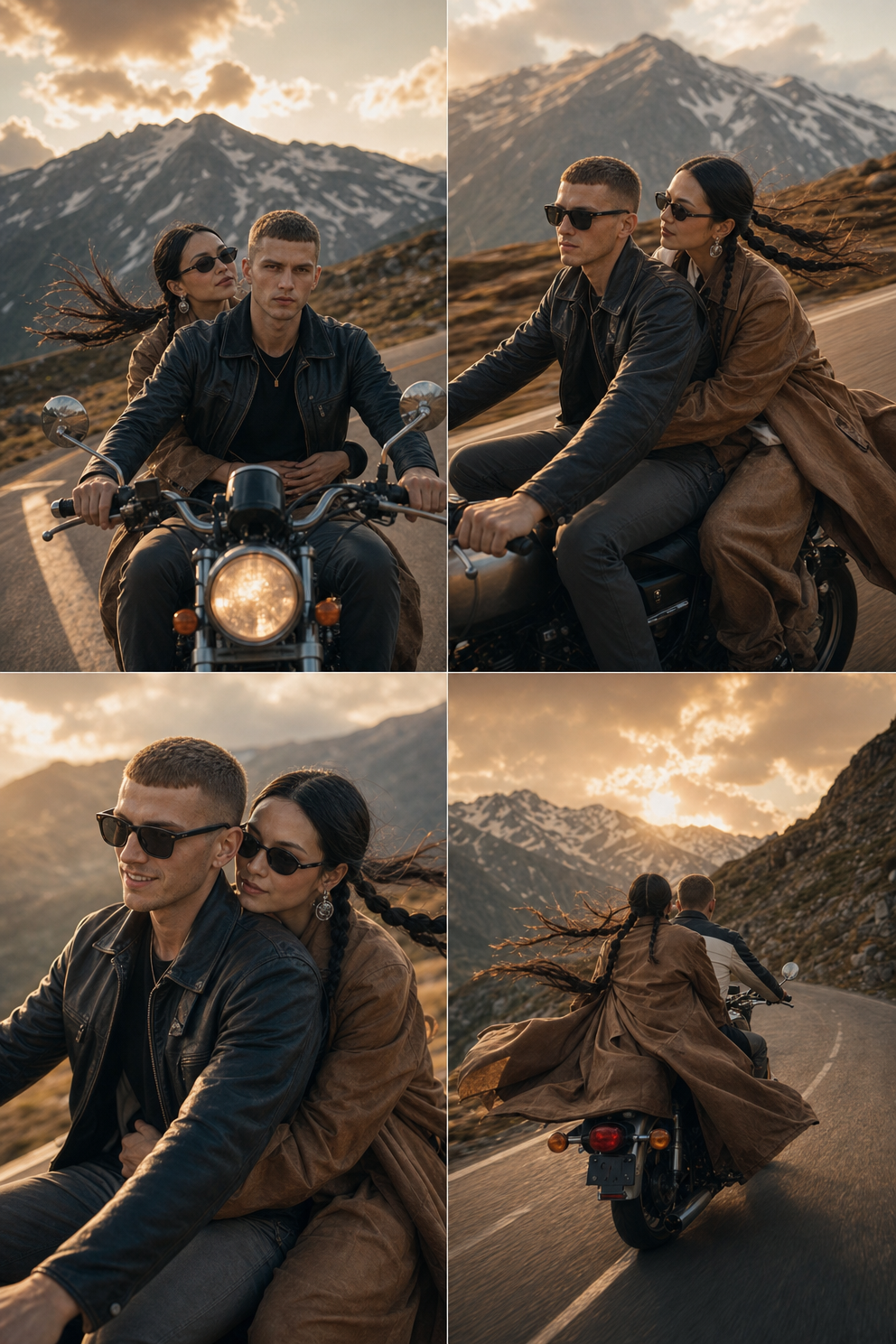
Golden-hour couple rides a classic bike
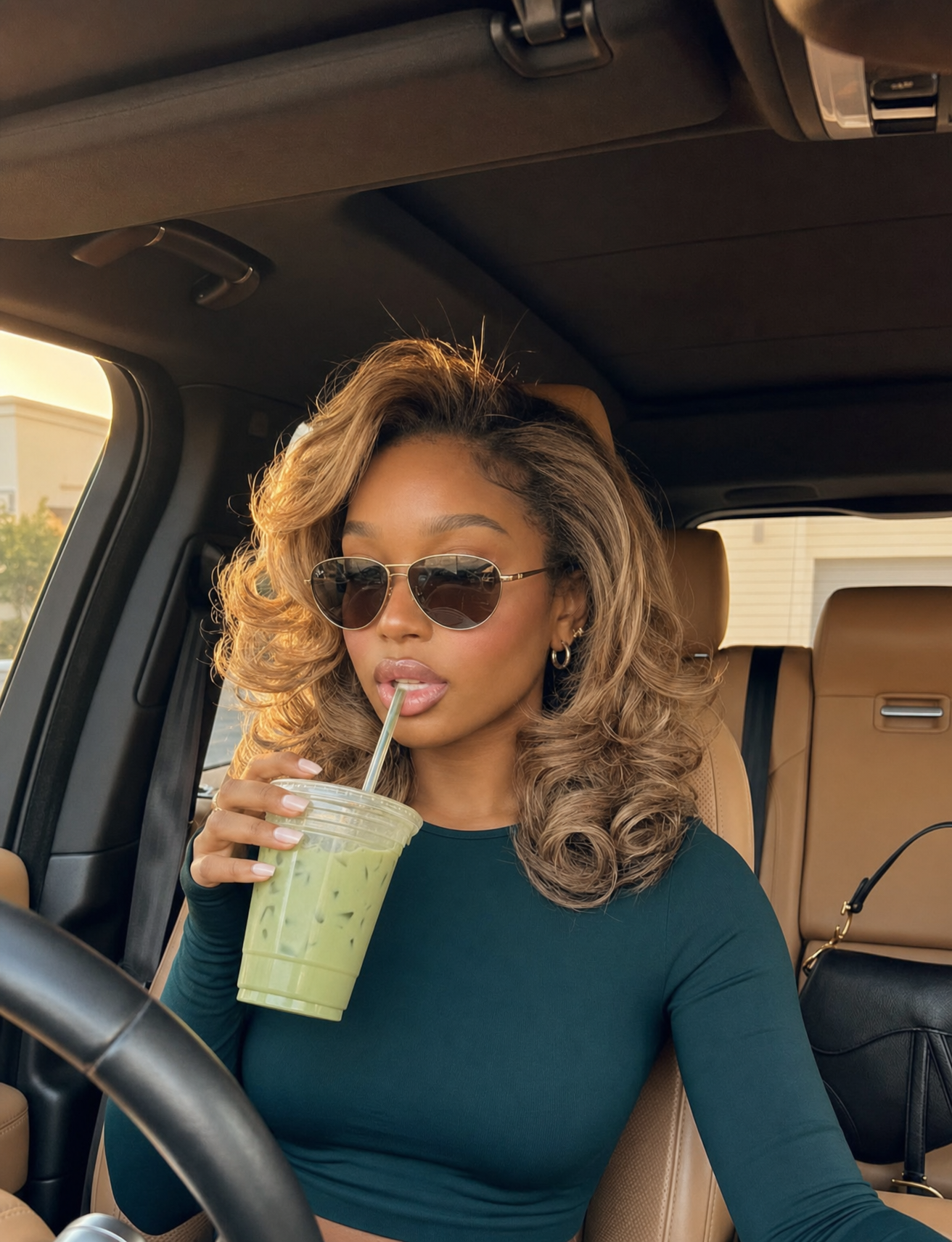
Golden-hour Matcha Sips in Luxury SUV
Top-Down Yellow Porsche GT2 RS
Red endurance race car with blue silver accents