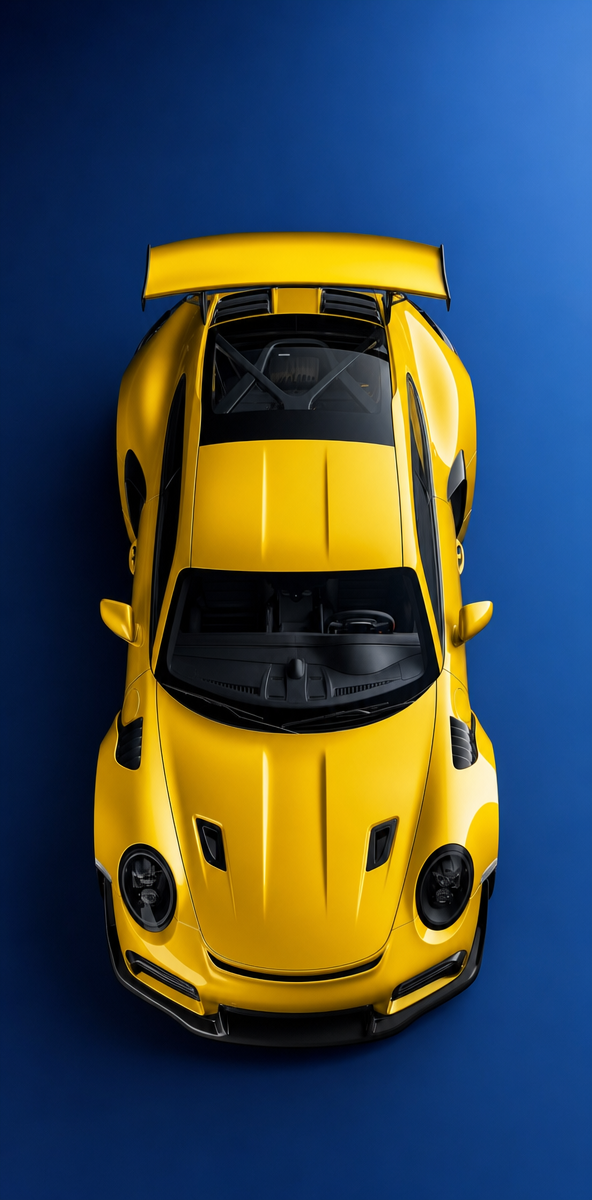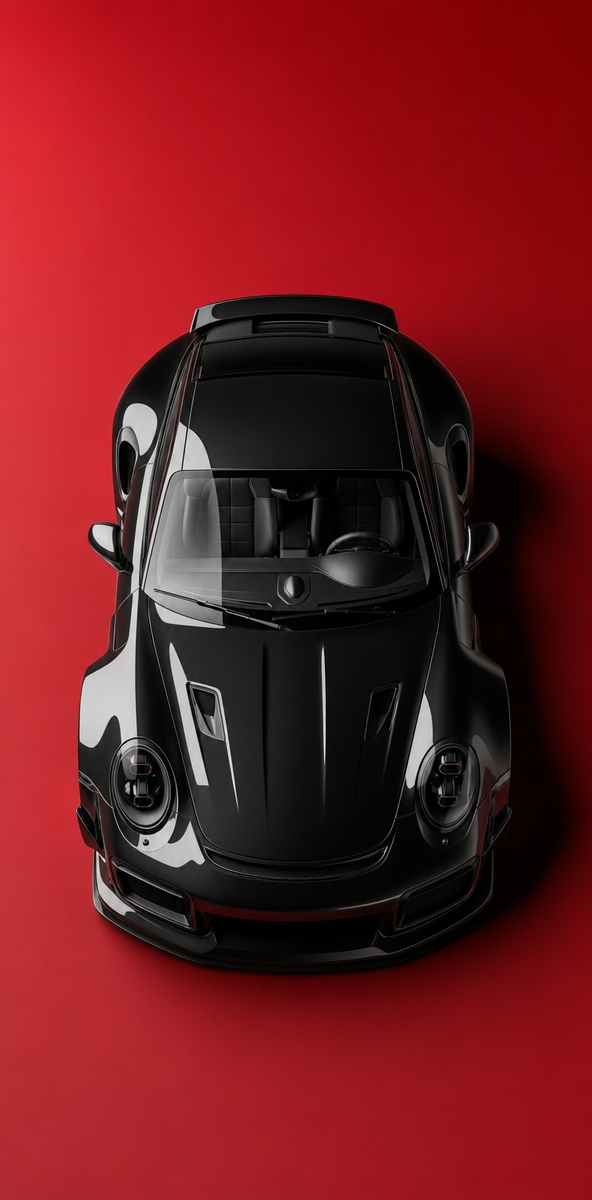
Why this works
“Top-down” and “centered in frame” make the Porsche read as a precise graphic object, while the “seamless dark charcoal background” removes distractions and reinforces the dominant black palette. “Glossy black,” “dramatic softbox reflections,” and “crisp highlight rolloff along the body lines” supply the controlled specular detail that reveals the car’s contours without breaking its luxurious, high-contrast mood. “Sharp aerodynamic details” and the “smaller rear spoiler” keep the image focused on design precision rather than speed-oriented action.
FAQ
→How do I make the car feel more aggressive and track-focused?
Replace “with a smaller rear spoiler” with “with a large fixed carbon-fiber rear wing, front splitter, and pronounced side skirts,” and replace “top-down studio view” with “low three-quarter front view.” Change “premium product photography” to “dramatic motorsport editorial photography” to support the more forceful presentation.
→How do I make the Porsche stand out more clearly from the background?
Replace “seamless dark charcoal background” with “seamless medium-gray background with subtle tonal separation,” and change “glossy black” to “deep metallic black with bright silver-gray reflections.” Keep “dramatic softbox reflections” but add “controlled rim light outlining the roof, fenders, and spoiler” so the silhouette does not merge into the backdrop.
→How do I turn this into a consistent series of Porsche studio images?
Keep the fixed phrases “photoreal studio photograph,” “seamless dark charcoal background,” “dramatic softbox reflections,” and “high contrast, premium product photography” in every prompt. Vary only the subject and camera blocks, such as replacing “top-down” with “front three-quarter,” “rear three-quarter,” or “side profile,” while swapping “glossy black Porsche sports car” for specific models and finishes like “silver Porsche 911 GT3” or “deep green Porsche Cayman.”
Learn the technique behind this
- Why can't AI spell, and how do I get readable text in an image? — Older diffusion models had no character-level representation of text, so they produced letterform-shaped texture instead of words.
- How should a prompt be structured, and does word order matter? — A prompt that behaves predictably names one subject first, then what it is doing, then where, then the light, then the lens or medium, then the style.
- Do negative prompts work, and what should go in one? — Negative prompts work on models that support a separate negative conditioning channel — mainly Stable Diffusion and FLUX-family models.
Related prompts
Golden-hour couple rides a classic bike
Shirtless Man, Vintage Car, Coastline Light
Golden-hour Matcha Sips in Luxury SUV
Red endurance race car with blue silver accents