Why this works
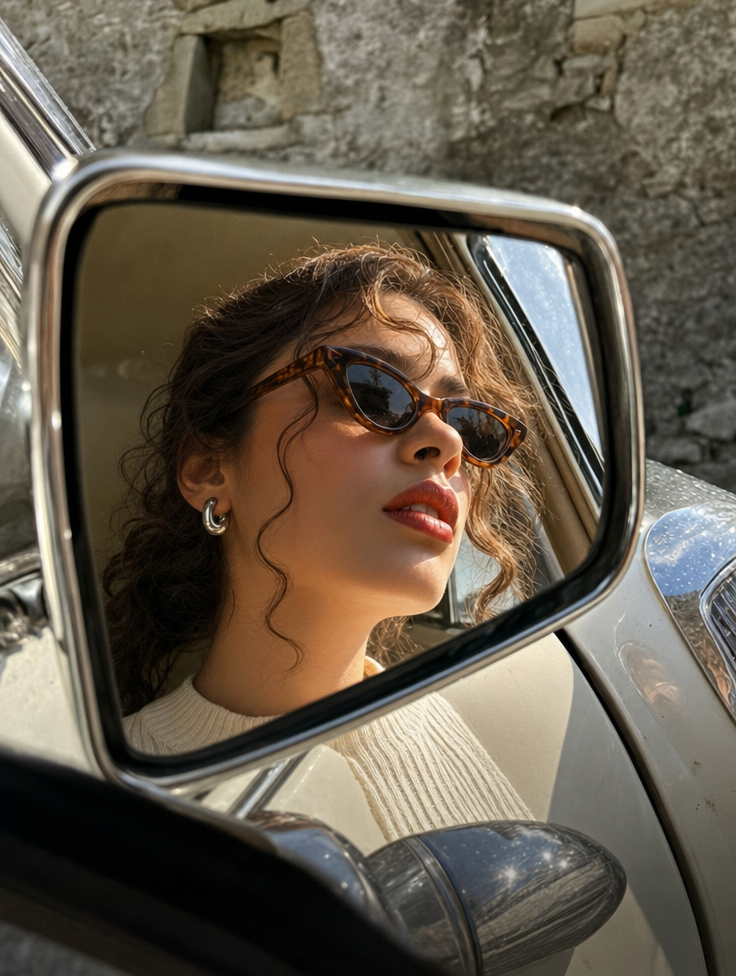
The reflection in a “vintage car side mirror” makes the close-up feel observational rather than posed, while “close-up portrait framing” keeps the woman’s face as the clear focal point. “Sunlight glints off the car’s chrome trim” supplies the sharp visual accent, and “softly blurred stone wall with warm golden-hour tones” separates the reflection from the gray-brown surroundings; the dark sunglasses and tortoiseshell frame reinforce the image’s dominant brown, gray, and black palette. “Loose wavy tendrils,” “realistic skin texture,” and an “elegant, spontaneous natural pose” keep the polished cinematic-editorial treatment from becoming stiff.
FAQ
→How do I make the woman’s face more prominent than the mirror and car?
Replace “Close-up portrait framing” with “extreme close-up centered tightly on her reflected face,” and add “her eyes and facial expression occupy most of the mirror.” Remove or soften “Sunlight glints off the car’s chrome trim” by changing it to “minimal chrome visible at the edge of the frame.”
→How do I shift this from warm, elegant sunlight to a moodier nighttime portrait?
Replace “warm golden-hour tones” and “Warm golden-hour sunlight” with “cool blue-hour light with a single soft streetlamp reflection.” Change “spontaneous sunlit mood” to “quiet nocturnal mood,” and replace “subtle glints on chrome details” with “small, controlled highlights on wet chrome.”
→How do I create a cohesive series of variations from this image?
Keep the fixed phrases “woman reflected in a vintage car side mirror,” “close-up portrait framing,” “realistic skin texture,” and “soft bokeh background blur.” Swap only the setting and light, such as “rain-speckled city street with neon reflections,” “coastal road with pale overcast light,” or “quiet courtyard with late-afternoon sunlight,” while retaining “elegant, spontaneous natural pose” for continuity.
Learn the technique behind this
- Why can't AI spell, and how do I get readable text in an image? — Older diffusion models had no character-level representation of text, so they produced letterform-shaped texture instead of words.
- How should a prompt be structured, and does word order matter? — A prompt that behaves predictably names one subject first, then what it is doing, then where, then the light, then the lens or medium, then the style.
- Why does AI get hands and faces wrong, and how do I fix it? — Hands fail because they're small in frame, extremely variable in pose, and self-occluding — the model has less usable signal per pixel than for any other body part.
Related prompts
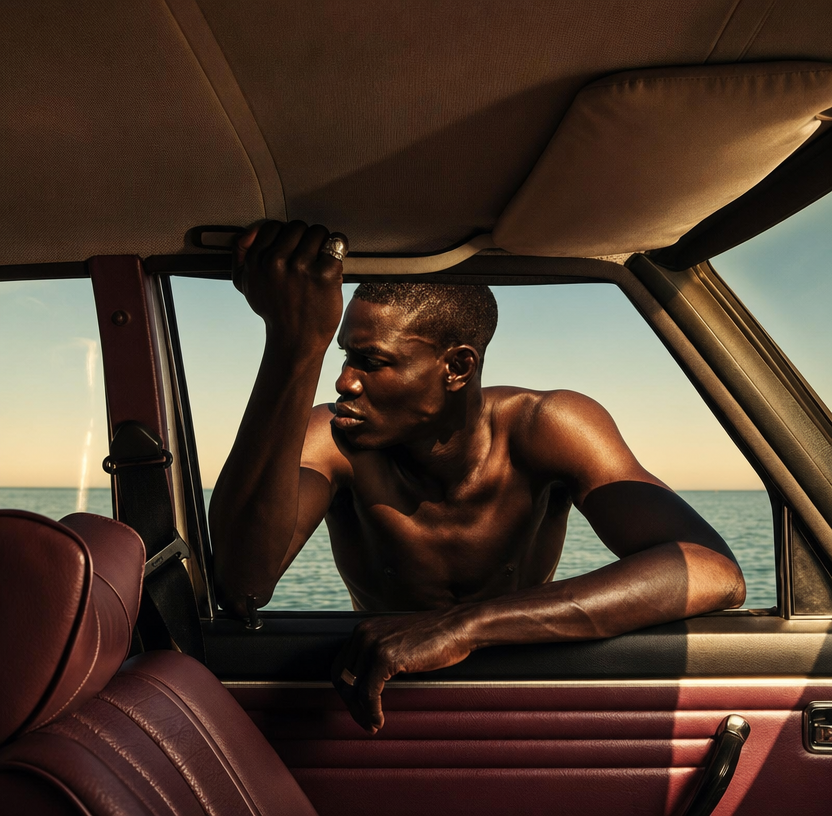
Shirtless Man, Vintage Car, Coastline Light
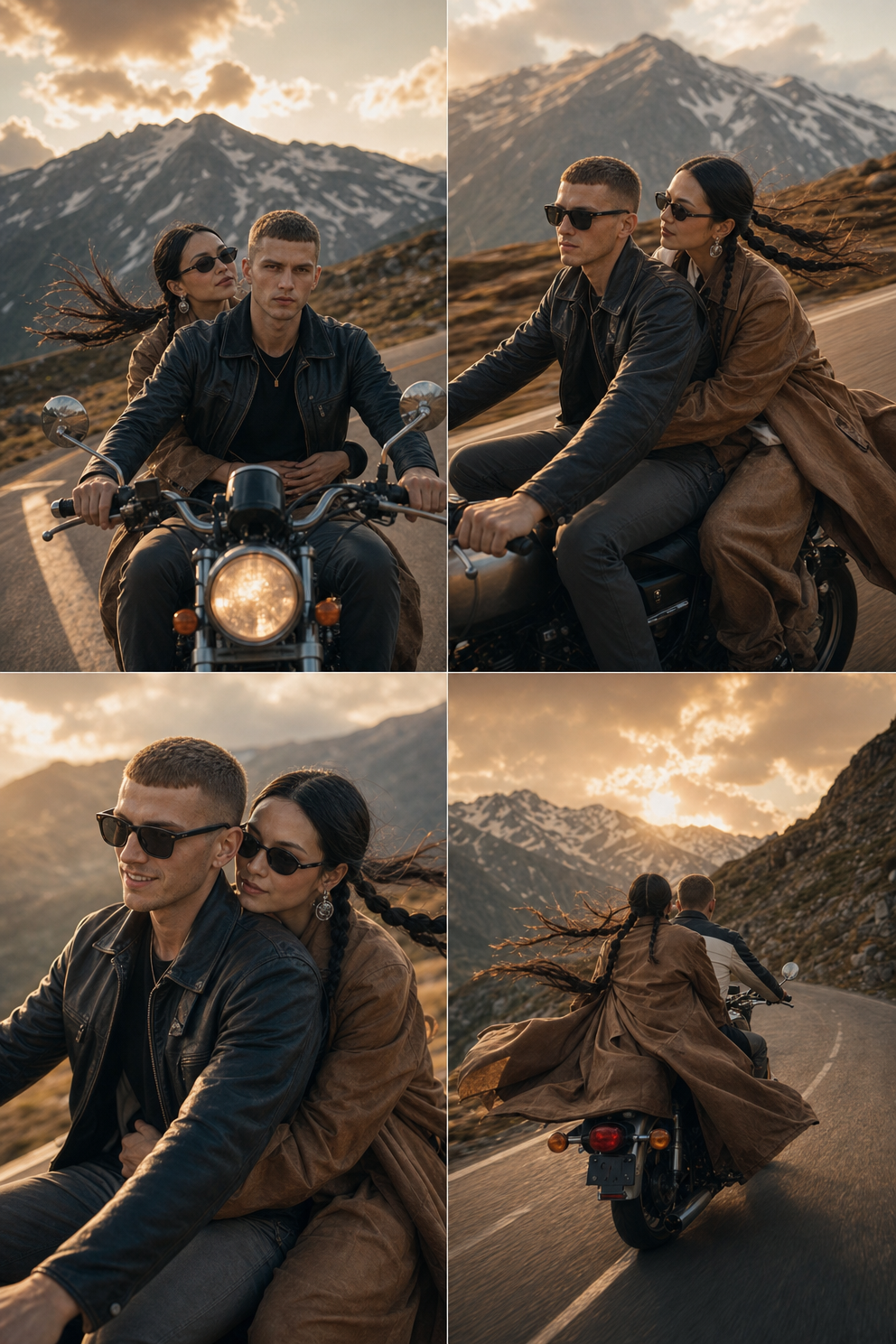
Golden-hour couple rides a classic bike

Golden-hour Matcha Sips in Luxury SUV
Young model in studio by sports car