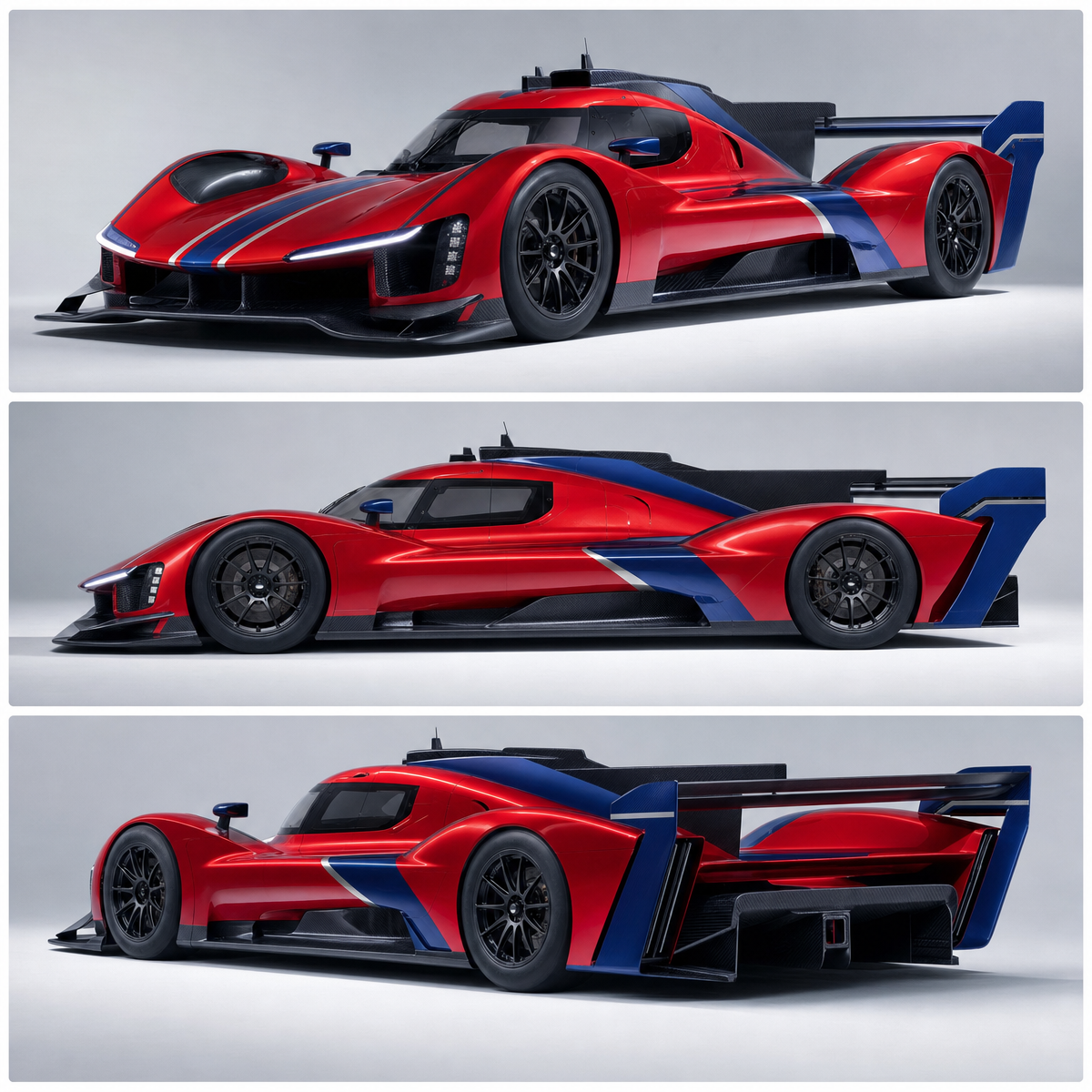
Same prompt, generated with each model separately — click one to see how it holds up.
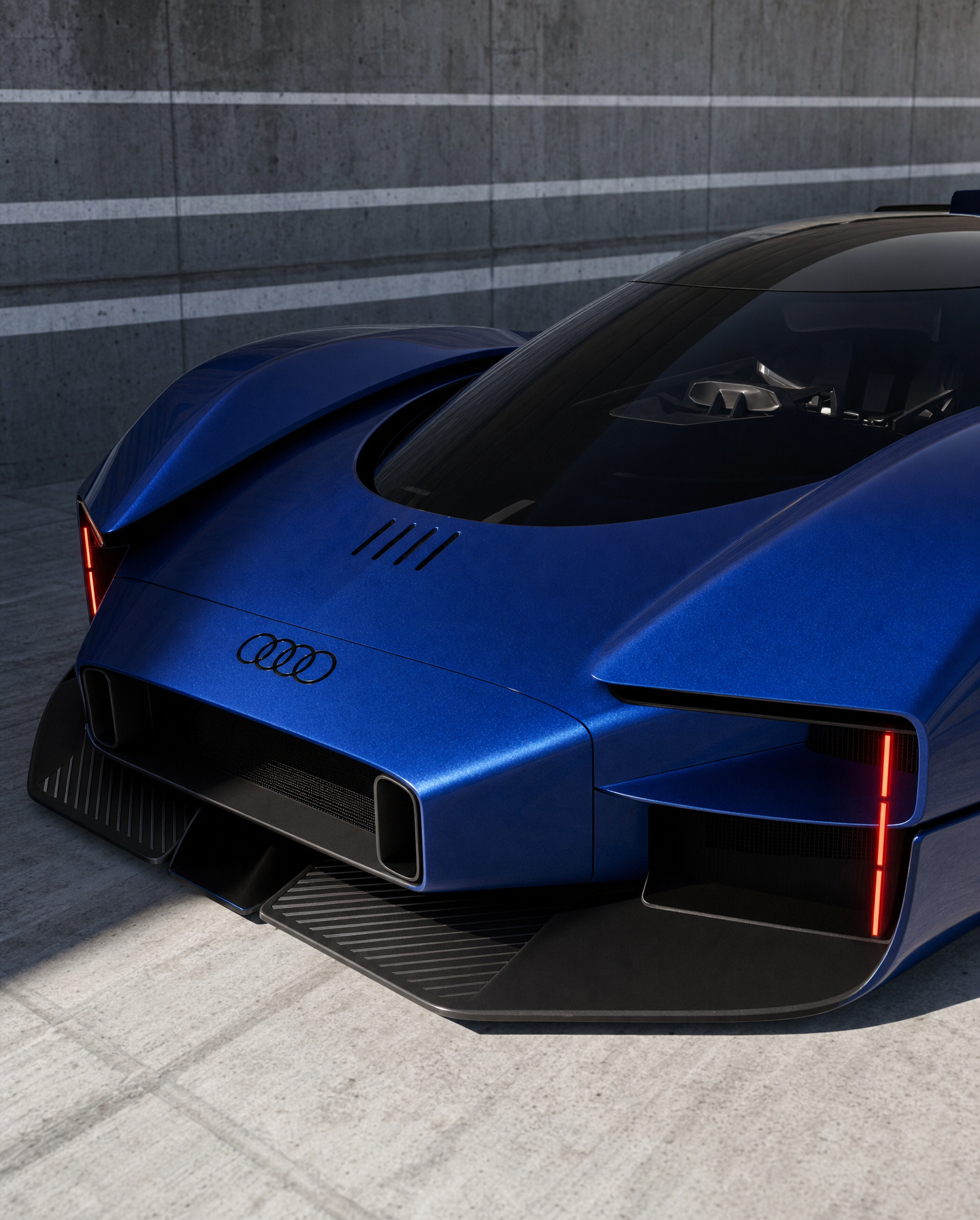
Why this works
The “rear three-quarter view” and “wide-shot” establish a broad, readable silhouette while keeping the “slim red vertical LED taillights” and “prominent vented rear diffuser” as strong rear focal points. “Metallic deep blue paint” against the “brutalist concrete garage” and its “horizontal painted stripes” creates a cool, graphic palette, reinforced by the image’s dominant black, red, and gray tones. “Dramatic studio-like lighting with crisp reflections” supplies the polished automotive sheen, while “shallow depth of field” and “cinematic contrast” separate the car from the garage without losing its architectural scale.
FAQ
→How do I make the rear diffuser and taillights more prominent?
Replace “rear three-quarter view” with “low rear three-quarter close-up focused on the rear fascia,” and change “prominent vented rear diffuser” to “oversized vented rear diffuser as the dominant foreground feature.” Add “taillights filling the upper rear frame” after “slim red vertical LED taillights.”
→How do I shift this from a dramatic studio mood to a colder, more industrial tone?
Replace “Dramatic studio-like lighting with crisp reflections” with “cold overhead fluorescent lighting with hard-edged shadows,” and change “cinematic contrast” to “desaturated industrial contrast.” Replace “metallic deep blue paint” with “brushed gunmetal paint” to reduce the saturated, luxurious color emphasis.
→How do I create a matching series with different garage environments?
Keep the subject, “rear three-quarter view,” “high detail,” and “shallow depth of field” unchanged, then replace “brutalist concrete garage featuring horizontal painted stripes” with specific settings such as “minimalist white concrete tunnel with linear ceiling lights,” “rain-slick underground parking structure with numbered pillars,” or “dark exhibition hall with polished black flooring.” Retain “dramatic studio-like lighting with crisp reflections” across the variations so the car remains visually consistent.
Learn the technique behind this
- Why can't AI spell, and how do I get readable text in an image? — Older diffusion models had no character-level representation of text, so they produced letterform-shaped texture instead of words.
- How should a prompt be structured, and does word order matter? — A prompt that behaves predictably names one subject first, then what it is doing, then where, then the light, then the lens or medium, then the style.
- Do negative prompts work, and what should go in one? — Negative prompts work on models that support a separate negative conditioning channel — mainly Stable Diffusion and FLUX-family models.
Related prompts
Shirtless Man, Vintage Car, Coastline Light
Golden-hour couple rides a classic bike
Top-Down Yellow Porsche GT2 RS
Red Ferrari F1 Panning Speed Shot