Why this works
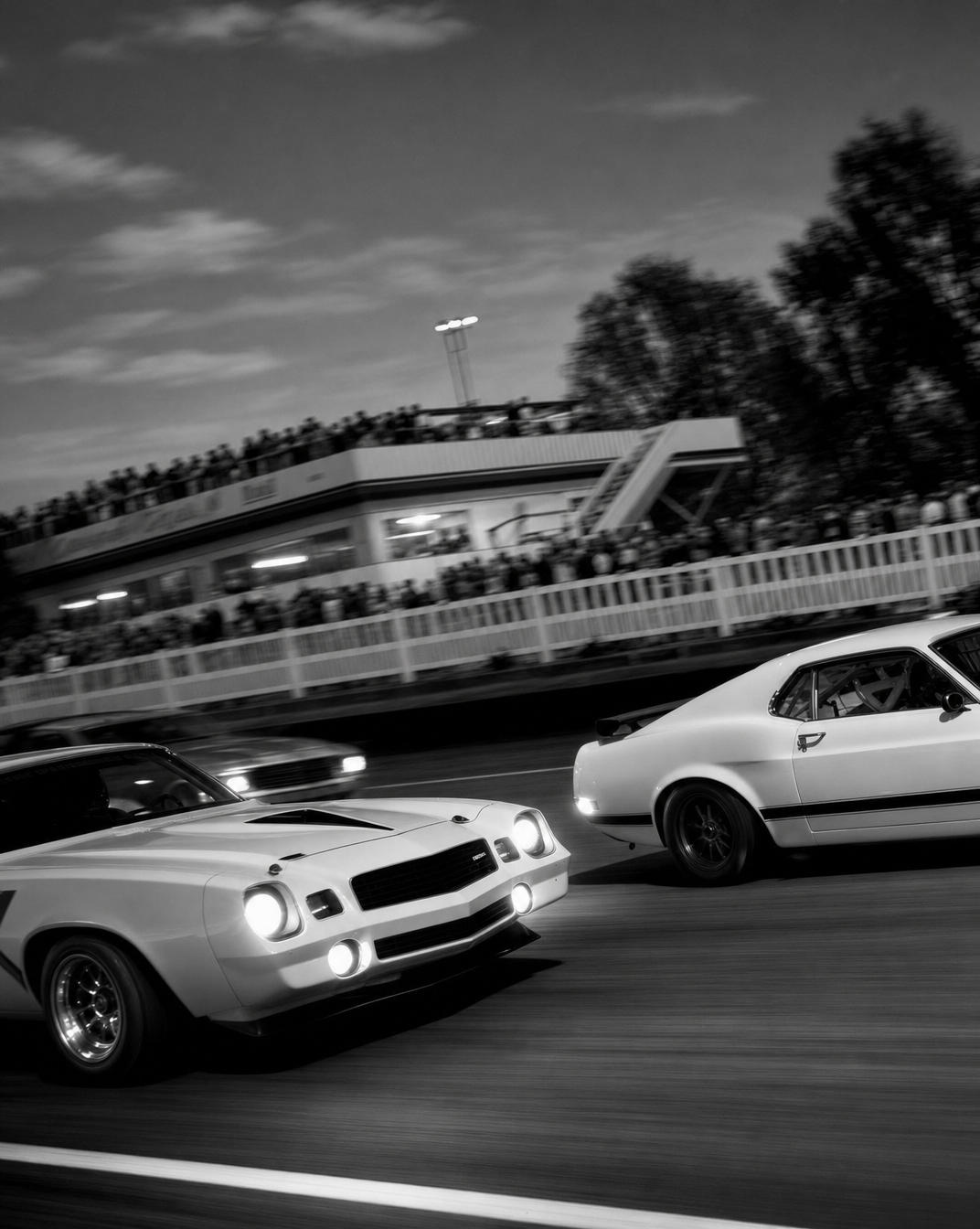
The phrase “low-angle diagonal tracking shot with strong motion blur” puts the viewer at track level and drives the raw, fast composition, while “dynamic speed lines created by panning” separates directional movement from the cars’ forms. “Brighter headlight glow” gives the monochrome frame a sharp focal accent, and “strong background separation” keeps the blurred grandstands and trees distinct without competing with the two cars. “High-contrast black-and-white,” “visible track texture,” and “authentic 1960s-era racing atmosphere” supply the documentary grit and period character.
FAQ
→How do I make one race car more prominent than the other?
Replace “two vintage saloon race cars racing side by side” with “one vintage saloon race car dominating the foreground, a second car trailing in the background,” and change “diagonal composition” to “foreground-biased diagonal composition.” Keep “low-angle tracking shot” to preserve the speed and track-level perspective.
→How do I make the image feel more dangerous and aggressive?
Replace “raw and intense” with “menacing, chaotic, near-collision intensity,” and change “racing side by side” to “racing inches apart, wheels nearly touching.” Add “hard-edged headlight glare and deep black shadows” after “brighter headlight glow” for a more threatening contrast pattern.
→How do I build a color variation while keeping the 1960s racing character?
Replace “black-and-white documentary sports photography” and “high-contrast black-and-white” with “muted period color documentary photography, faded racing reds, cream bodywork, and dusty blue shadows.” Retain “authentic 1960s-era racing atmosphere,” “visible track texture,” and “blurred grandstands and trees” so the palette changes without losing the historical setting.
Learn the technique behind this
- Why can't AI spell, and how do I get readable text in an image? — Older diffusion models had no character-level representation of text, so they produced letterform-shaped texture instead of words.
- Why does the model ignore parts of my prompt? — Ignored instructions are almost always conflicts, counts, or spatial relationships — three things current models handle badly — rather than the model failing to read you.
- Do negative prompts work, and what should go in one? — Negative prompts work on models that support a separate negative conditioning channel — mainly Stable Diffusion and FLUX-family models.
Related prompts
Shirtless Man, Vintage Car, Coastline Light
Golden-hour couple rides a classic bike
Golden-hour Matcha Sips in Luxury SUV
Young model in studio by sports car