Why this works
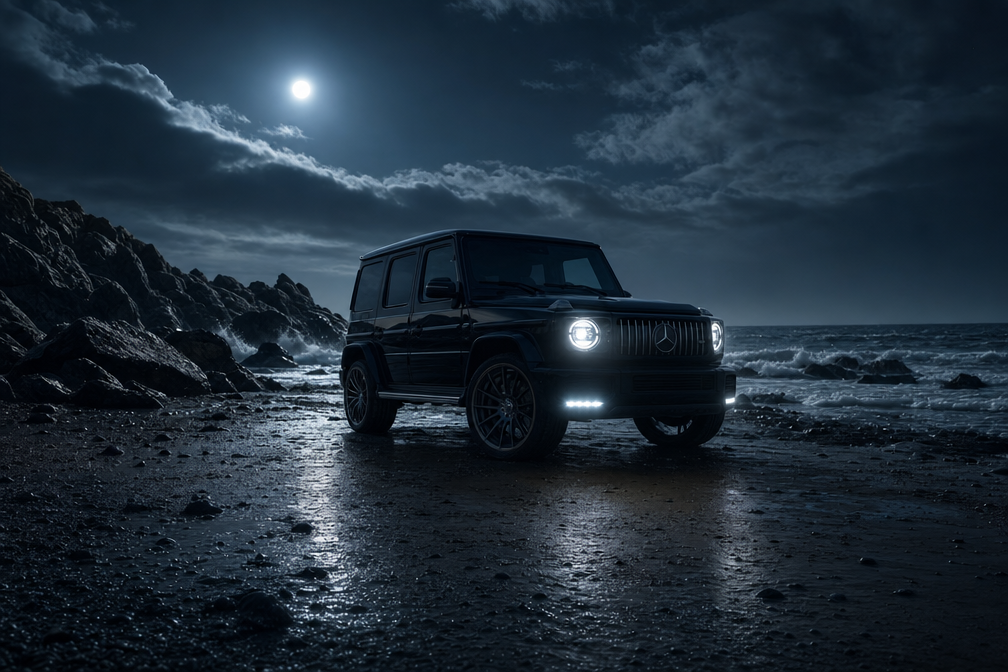
The “low-angle wide shot with a slight rearward perspective” makes the SUV feel imposing while preserving the rocky beach, distant surf, and faint horizon as scale cues. Its moody blue-gray palette comes from the “cool moonlit glow” and “heavy overcast,” while the “front right headlight and LED fog lights glow” supplies the focused contrast that pulls attention to the grille and rugged tires. “Wet dark sand reflects subtle highlights” adds a controlled mirror-like foreground, reinforcing the “premium commercial look” without competing with the vehicle.
FAQ
→How do I make the SUV feel more aggressive and dominant?
Replace “slight rearward perspective” with “extreme low front three-quarter angle,” and change “emphasizing the grille and rugged tires” to “emphasizing the oversized grille, raised suspension, and deeply treaded tires.” You can also replace “subtle highlights” with “sharp specular reflections” for harder, more assertive contrast.
→How do I shift the scene from moody night photography to a warmer, more dramatic sunset image?
Replace “at night” and “cool moonlit glow” with “at blue hour beneath a stormy sunset” and “warm orange sidelight breaking through storm clouds.” Change the dominant cool emphasis in “blue-gray” to “charcoal, amber, and muted copper,” while retaining “wet dark sand reflects” to preserve the coastal reflections.
→How do I build a variation that makes the coastline more prominent than the SUV?
Replace “low-angle wide shot” with “ultra-wide environmental establishing shot,” and change “SUV parked on a rocky coastal beach” to “SUV positioned small in the lower third of a vast rocky coastal beach.” Expand “distant surf and a faint horizon line” to “towering surf, layered coastal rocks, and a clearly visible horizon,” while keeping the headlights glowing as a small focal accent.
Learn the technique behind this
- Why can't AI spell, and how do I get readable text in an image? — Older diffusion models had no character-level representation of text, so they produced letterform-shaped texture instead of words.
- How should a prompt be structured, and does word order matter? — A prompt that behaves predictably names one subject first, then what it is doing, then where, then the light, then the lens or medium, then the style.
- Do negative prompts work, and what should go in one? — Negative prompts work on models that support a separate negative conditioning channel — mainly Stable Diffusion and FLUX-family models.
Related prompts
Shirtless Man, Vintage Car, Coastline Light
Golden-hour couple rides a classic bike
Golden-hour Matcha Sips in Luxury SUV
Young model in studio by sports car