Why this works
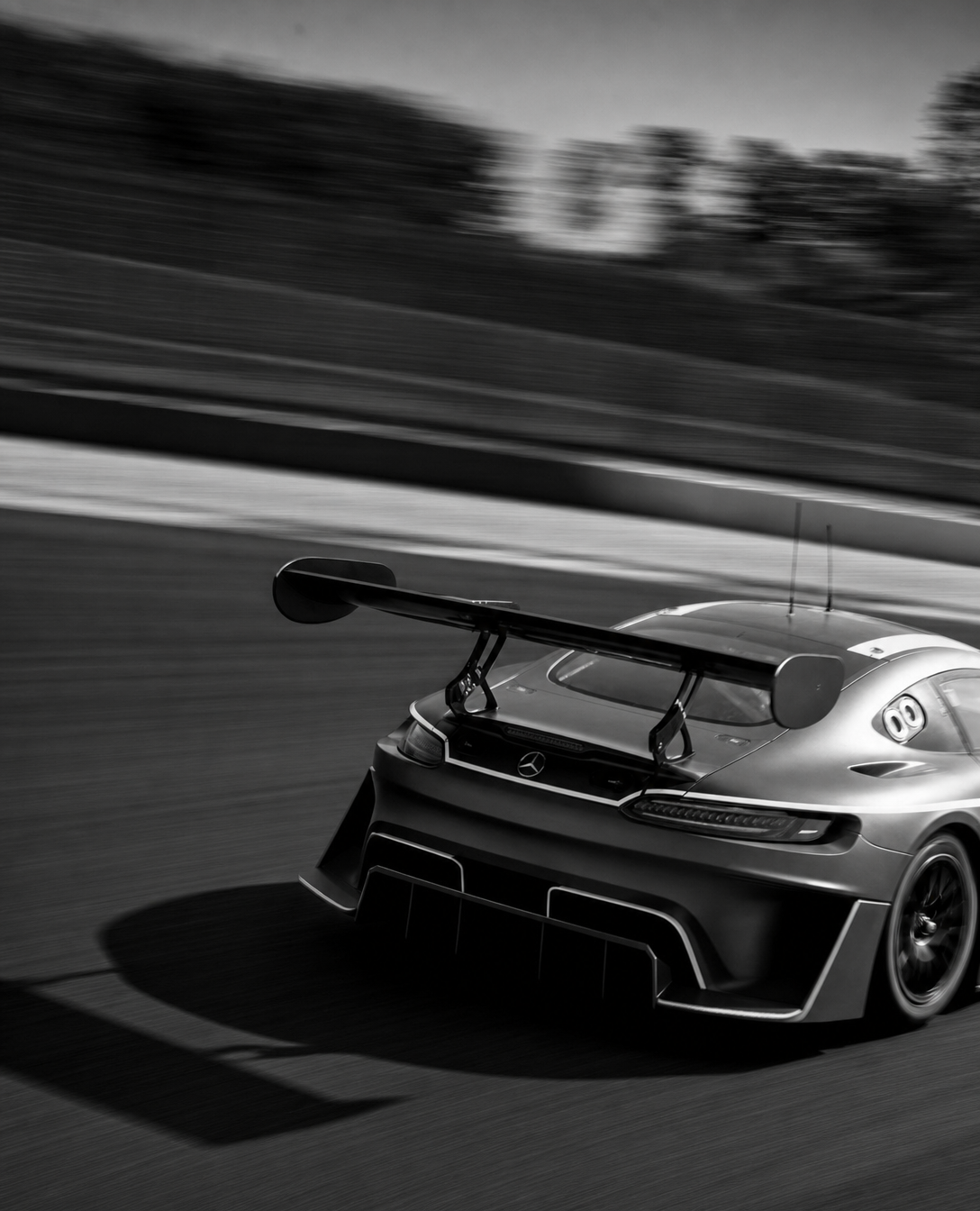
The phrase “low-angle rear three-quarter panning shot” makes the GT car the dominant diagonal subject while preserving the aggressive rear view through the corner. “Keep the car’s crisp bodywork details sharp” against a “track surface and fencing streak[ing] with motion blur” creates a clear subject-versus-background focus effect. “High-contrast black-and-white,” “stronger contrast in the highlights and deep shadows,” and the dominant black-and-white palette produce a stark, intense motorsport mood, while “curved corner lines” and “realistic asphalt texture” anchor the speed in a believable racetrack setting.
FAQ
→How do I make the car’s front splitter and aerodynamic changes more prominent?
Replace “rear three-quarter view” with “front three-quarter view focused on the nose and front splitter,” and change “Add a wider front splitter” to “prominent oversized front splitter clearly visible from a low angle.” Keep “crisp bodywork details sharp” so the revised aero remains legible rather than dissolving into the motion blur.
→How do I create a calmer, more cinematic version instead of an intense high-speed shot?
Replace “high-contrast black-and-white with deep shadows and bright highlights” with “soft grayscale tones with restrained contrast and gentle highlights,” and change “stronger contrast” to “subtle contrast.” Reduce “fencing streak with motion blur” to “light background motion blur,” while keeping “realistic asphalt texture” to preserve the grounded racetrack setting.
→How do I build a series of variations while keeping this image’s visual identity?
Keep “black-and-white motorsport photography,” “low-angle rear three-quarter panning shot,” and “crisp car body details” fixed across every prompt. Vary one concrete element at a time, such as replacing “racetrack corner” with “wet pit-lane exit,” “banked circuit hairpin,” or “night race chicane,” then substitute “realistic asphalt texture” with “rain-slick reflective asphalt,” “rubbered racing line,” or “cool artificial track lighting” to distinguish each scene.
Learn the technique behind this
- Why can't AI spell, and how do I get readable text in an image? — Older diffusion models had no character-level representation of text, so they produced letterform-shaped texture instead of words.
- How should a prompt be structured, and does word order matter? — A prompt that behaves predictably names one subject first, then what it is doing, then where, then the light, then the lens or medium, then the style.
- Do negative prompts work, and what should go in one? — Negative prompts work on models that support a separate negative conditioning channel — mainly Stable Diffusion and FLUX-family models.
Related prompts
Shirtless Man, Vintage Car, Coastline Light
Golden-hour couple rides a classic bike
Golden-hour Matcha Sips in Luxury SUV
Young model in studio by sports car