Why this works
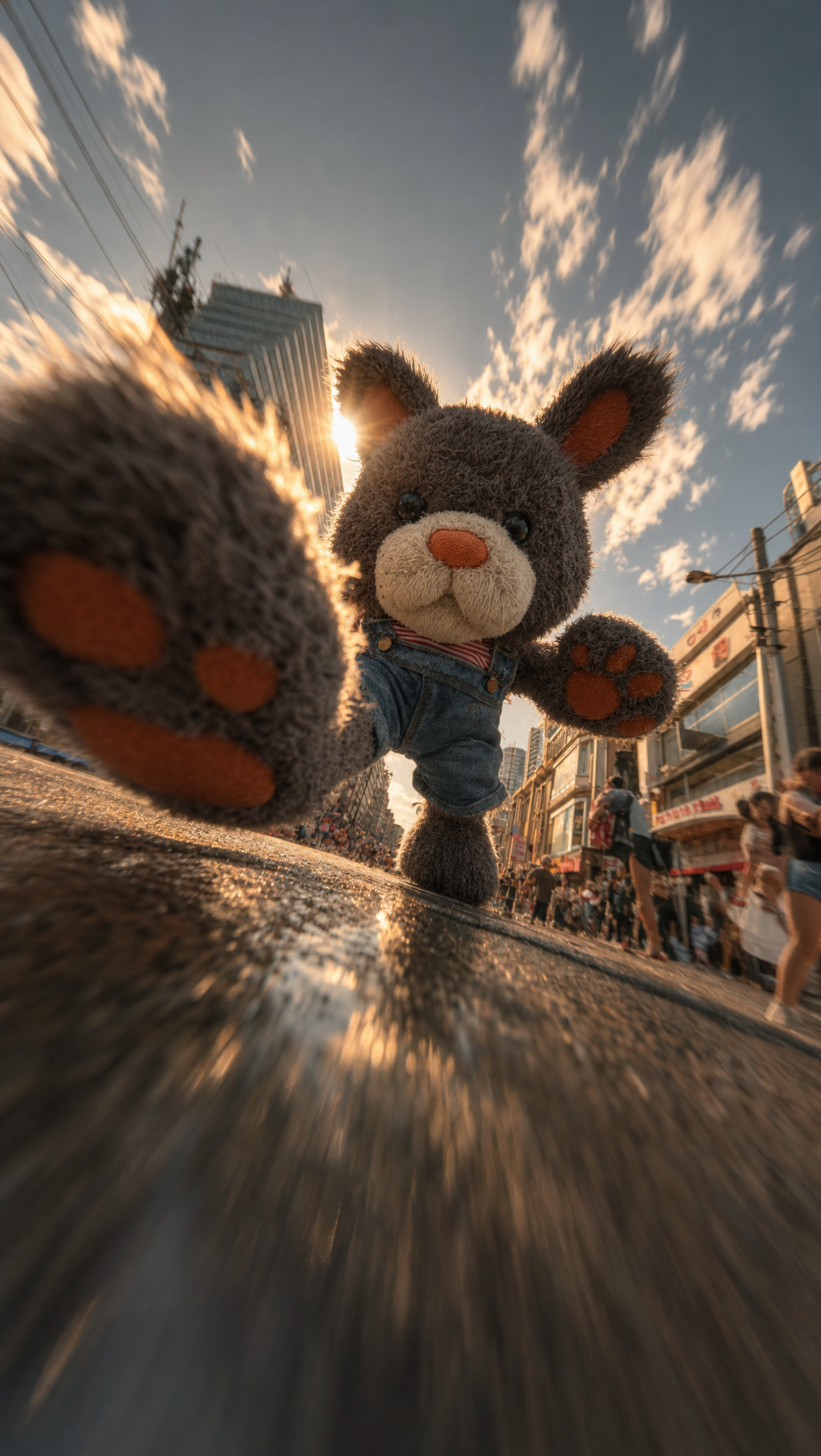
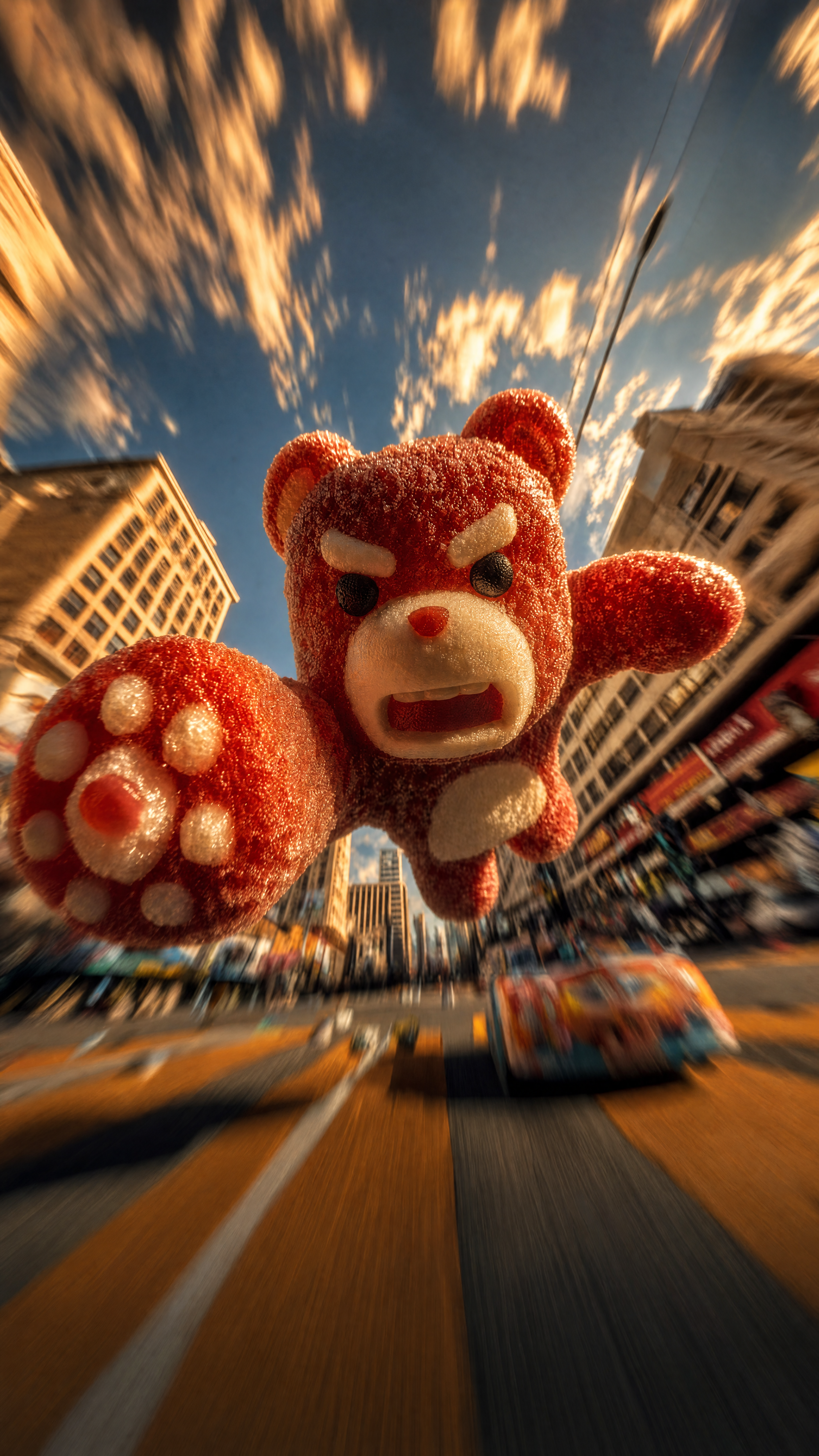
The low-angle ground-level view, wide-angle lens, and “huge fuzzy paw stepping toward the camera” make the bear feel oversized and give the candid-action composition its immediate, looming perspective. “Bright late-afternoon sunlight with longer, warmer shadows” supplies the orange warmth against the dominant gray buildings, while the “charcoal-brown coat and lighter cream muzzle” anchors the beige tones. “Noticeable motion blur,” “softly detailed in the background,” and “ultra-detailed fur texture” separate the advancing paw and bear from the street, preserving the energetic surreal playfulness without losing photorealistic detail.
FAQ
→How do I make the teddy bear feel more intimidating instead of playful?
Replace “energetic surreal playfulness” with “ominous cinematic tension,” change “bright late-afternoon sunlight” to “cold overcast light with deep directional shadows,” and replace “lighter cream muzzle” with “subtly shadowed muzzle.” Keep “low ground-level angle” and “huge fuzzy paw stepping toward the camera” to preserve the threatening scale.
→How do I make the bear’s face the central focus instead of its paw?
Replace “the huge fuzzy paw is stepping toward the camera” with “the bear’s face fills the upper center of the frame, leaning toward the camera,” and change “low ground-level angle” to “low-angle medium close-up.” Reduce “noticeable motion blur” to “slight motion blur on the lower body only,” while keeping “ultra-detailed fur texture” and “lighter cream muzzle” to sharpen facial emphasis.
→How do I turn this into a consistent series of giant plush animals in different cities?
Keep the fixed structure “photorealistic cinematic action scene,” “low-angle ground-level view,” “wide-angle lens,” “late-afternoon bright sunlight,” and “soft depth in background.” Swap “giant plush teddy bear” and “charcoal-brown coat and lighter cream muzzle” for a repeatable animal-specific pair such as “giant plush rabbit with pale gray fur and pink inner ears,” then replace “busy urban street” with locations like “rainy Tokyo crosswalk” or “sunlit Barcelona plaza.”
Learn the technique behind this
- Why can't AI spell, and how do I get readable text in an image? — Older diffusion models had no character-level representation of text, so they produced letterform-shaped texture instead of words.
- How should a prompt be structured, and does word order matter? — A prompt that behaves predictably names one subject first, then what it is doing, then where, then the light, then the lens or medium, then the style.
- Which camera and lighting terms actually change an AI image? — Focal length, aperture, light direction and time of day change the image reliably because they correlate with real photographic patterns in the training data.
Related prompts
Grotesque Claymation Gangsters in Gritty Alley
Charcoal coat with tan-handled tote
Woman in Teal Jacket Capturing Twilight Reflection
Red Gummy Bear Monster Attacks