Why this works
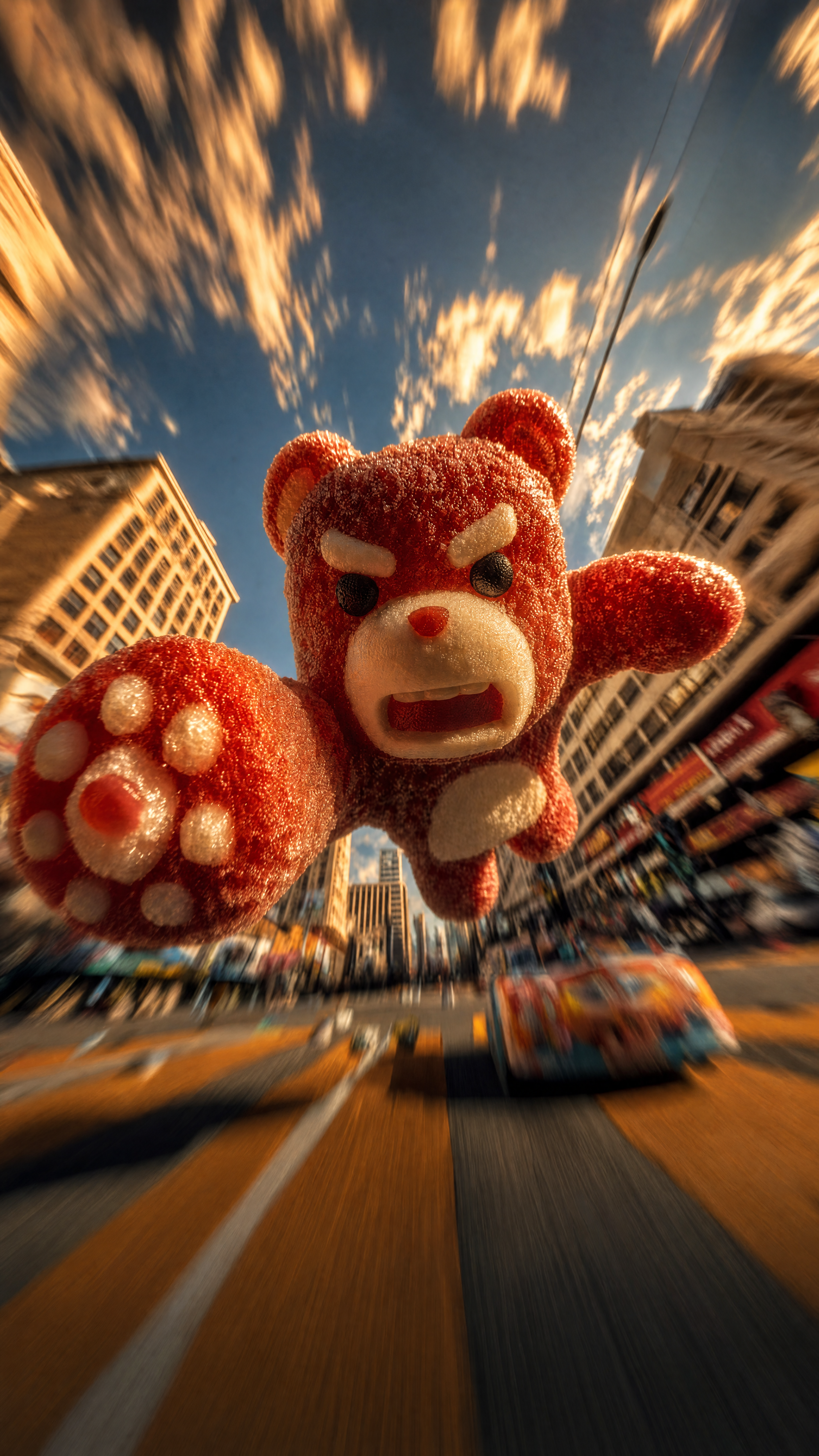
The phrase “low-angle wide shot” makes the gummy bear dominate the candid-action frame, while “towering buildings lining the street canyon” supplies vertical scale and funnels the eye toward the lunging subject. “Dramatic motion blur” and “intense aggressive action scene” establish chaotic momentum, with “warm golden-hour sunlight with a few clouds” adding a warm highlight against the image’s dominant blue, brown, black, and gray urban tones. “Highly detailed chewy gummy texture” and “glossy candy surface” keep the red monster visually legible even as “shallow depth of field” separates it from the busy street.
FAQ
→How do I make the gummy bear’s face and attack pose more prominent?
Replace “low-angle wide shot” with “extreme low-angle medium close-up,” and change “lunging toward the camera” to “open jaws and raised paws filling the foreground, face centered and sharply focused.” Reduce “shallow depth of field” to “eyes and gummy facial texture in crisp focus” so the expression carries the action.
→How do I shift this from aggressive chaos to a playful candy-commercial mood?
Replace “intense aggressive action scene” with “mischievous playful mascot moment,” and change “dramatic motion blur” to “subtle motion blur with a frozen cheerful pose.” Swap “warm golden-hour sunlight with a few clouds” for “bright pastel daylight with soft cotton-candy clouds,” while keeping “glossy candy surface” to preserve the commercial finish.
→How do I build a series of variations without losing the same visual identity?
Keep “highly detailed chewy gummy texture,” “glossy candy surface,” “photorealistic 3D render,” and “cinematic composition” unchanged. Create variations by replacing only “busy city street” with settings such as “rain-soaked subway platform,” “neon-lit rooftop,” or “crowded carnival midway,” and replace “lunging toward the camera” with “leaping over taxis,” “climbing between skyscrapers,” or “peeking around a billboard.”
Learn the technique behind this
- Why can't AI spell, and how do I get readable text in an image? — Older diffusion models had no character-level representation of text, so they produced letterform-shaped texture instead of words.
- How should a prompt be structured, and does word order matter? — A prompt that behaves predictably names one subject first, then what it is doing, then where, then the light, then the lens or medium, then the style.
- Which aspect ratio should I use, and how does it change the image? — Aspect ratio determines what the model composes, not how it's cropped afterwards.
Related prompts
Grotesque Claymation Gangsters in Gritty Alley
Woman in Teal Jacket Capturing Twilight Reflection
Charcoal coat with tan-handled tote
Neon Night Portrait by Red Signal