Why this works
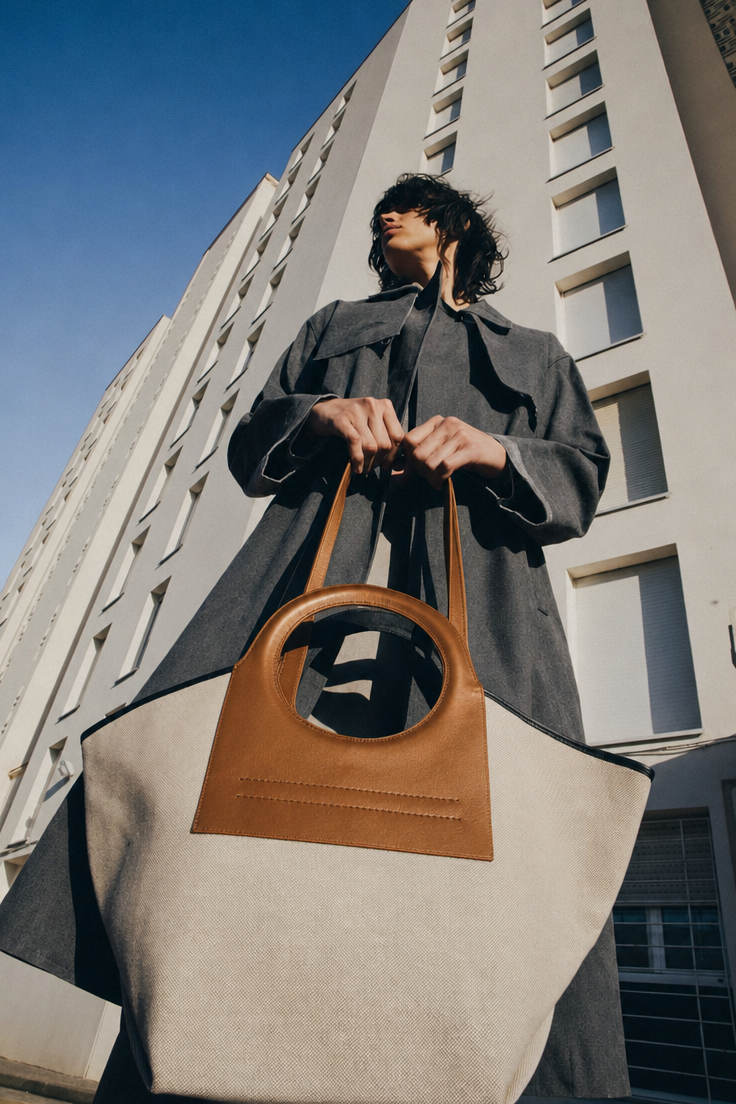
The phrase “low-angle editorial street-fashion photograph” gives the model a confident, upward-looking presence, while “slight lens distortion from the low viewpoint” exaggerates the building and adds energy to the full-body portrait. “Tall modern apartment building,” “strong geometric lines,” and “urban geometric composition” make the architecture a structural frame rather than a passive backdrop. The beige, brown, and blue palette is anchored by the “charcoal-gray oversized coat” and “tan handles,” while “clear sky” and “crisp natural daylight” keep the high-contrast image sharp and contemporary.
FAQ
→How do I make the tote bag more central and visually prominent?
Replace “holding a large structured two-tone tote bag” with “presenting an oversized structured two-tone tote bag prominently in the foreground, centered at waist level,” and add “bag in sharpest focus with visible tan handles and material texture.” Keep “low-angle” if you want the bag to retain a strong, assertive scale.
→How do I make the image feel softer and less stark while keeping the urban fashion setting?
Replace “crisp natural daylight” and “high-contrast editorial look” with “soft diffused daylight with gentle shadow transitions,” and change “sharp, high-contrast realism” to “refined natural realism with muted contrast.” You can also replace “clear sky” with “pale overcast sky” to reduce the hard blue-beige contrast.
→How do I build a cohesive series with different outfits and locations?
Keep the fixed visual anchors “low-angle editorial fashion photography,” “portrait-full-body,” “slight lens distortion,” and “sharp editorial realism,” then swap “charcoal-gray oversized coat” and “tall modern apartment building” for controlled alternatives such as “cream tailored suit” and “concrete transit station,” or “rust-colored leather jacket” and “glass office tower.” Preserve “strong geometric lines” and the same crisp daylight direction so the changing subjects still read as one series.
Learn the technique behind this
- Why can't AI spell, and how do I get readable text in an image? — Older diffusion models had no character-level representation of text, so they produced letterform-shaped texture instead of words.
- Why does the model ignore parts of my prompt? — Ignored instructions are almost always conflicts, counts, or spatial relationships — three things current models handle badly — rather than the model failing to read you.
- Do negative prompts work, and what should go in one? — Negative prompts work on models that support a separate negative conditioning channel — mainly Stable Diffusion and FLUX-family models.
Related prompts
Grotesque Claymation Gangsters in Gritty Alley
Woman in Teal Jacket Capturing Twilight Reflection
Red Gummy Bear Monster Attacks
Stuffed Bear on Winter Dumpster at Dawn