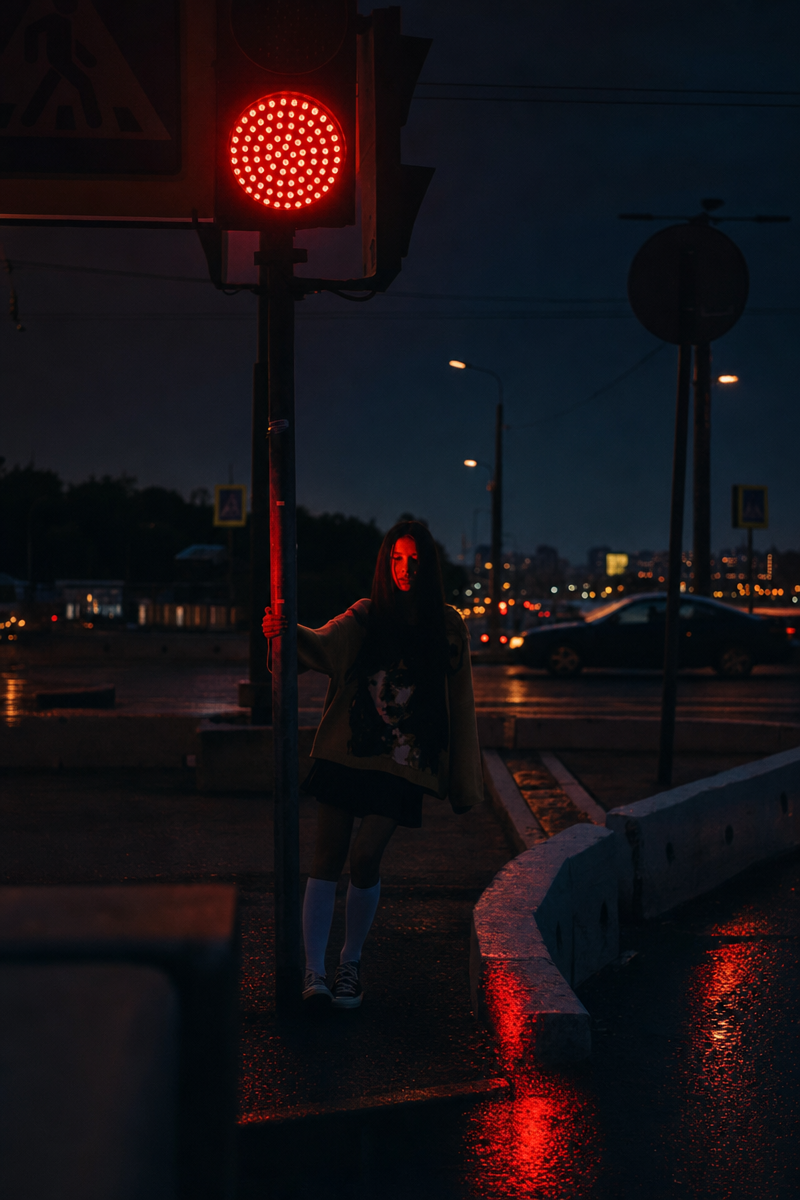
Why this works
The phrase “young woman stands beside a glowing red pedestrian signal” creates the image’s clear subject-and-color anchor, while “silhouetted street poles and traffic signage” builds layered urban framing around her. “Red neon reflections pooling on the wet pavement” links the signal to the foreground and reinforces the dominant red-and-navy palette, with “deep indigo tones and a faint teal-orange glow” extending the color harmony into the sky. “Cinematic composition with shallow depth of field” keeps the portrait emphasis intact, while “realistic high-contrast lighting” supplies the crisp separation between the illuminated signal, figure, and dark street elements.
FAQ
→How do I make the woman more prominent than the pedestrian signal?
Replace “stands beside a glowing red pedestrian signal” with “woman centered in the foreground, sharply focused, with a small red pedestrian signal receding behind her.” Change “shallow depth of field” to “very shallow depth of field focused on her face and upper body” so the signal becomes contextual rather than co-equal.
→How do I shift this from moody night photography to a warmer, more hopeful tone?
Replace “moody neon-lit scene” and “deep indigo tones” with “warm late-evening city glow” and “soft amber and rose tones.” Change “red neon reflections pooling on the wet pavement” to “golden streetlight reflections shimmering across lightly wet pavement,” while keeping “photorealistic cinematic street photography” for the same realism.
→How do I create a series of variations without losing the visual identity?
Keep the fixed phrases “photorealistic cinematic street photography,” “shallow depth of field,” and “high-contrast realistic lighting,” then swap the subject-color pair in “glowing red pedestrian signal” for alternatives such as “glowing green pedestrian signal,” “flashing amber construction beacon,” or “blue storefront sign.” Preserve “wet pavement with neon reflections” and vary only the setting clause, such as “rainy alley,” “subway entrance,” or “bus stop beneath elevated tracks.”
Learn the technique behind this
- Why can't AI spell, and how do I get readable text in an image? — Older diffusion models had no character-level representation of text, so they produced letterform-shaped texture instead of words.
- How should a prompt be structured, and does word order matter? — A prompt that behaves predictably names one subject first, then what it is doing, then where, then the light, then the lens or medium, then the style.
- Which aspect ratio should I use, and how does it change the image? — Aspect ratio determines what the model composes, not how it's cropped afterwards.
Related prompts
Grotesque Claymation Gangsters in Gritty Alley
Woman in Teal Jacket Capturing Twilight Reflection
Charcoal coat with tan-handled tote
Red Gummy Bear Monster Attacks