Why this works
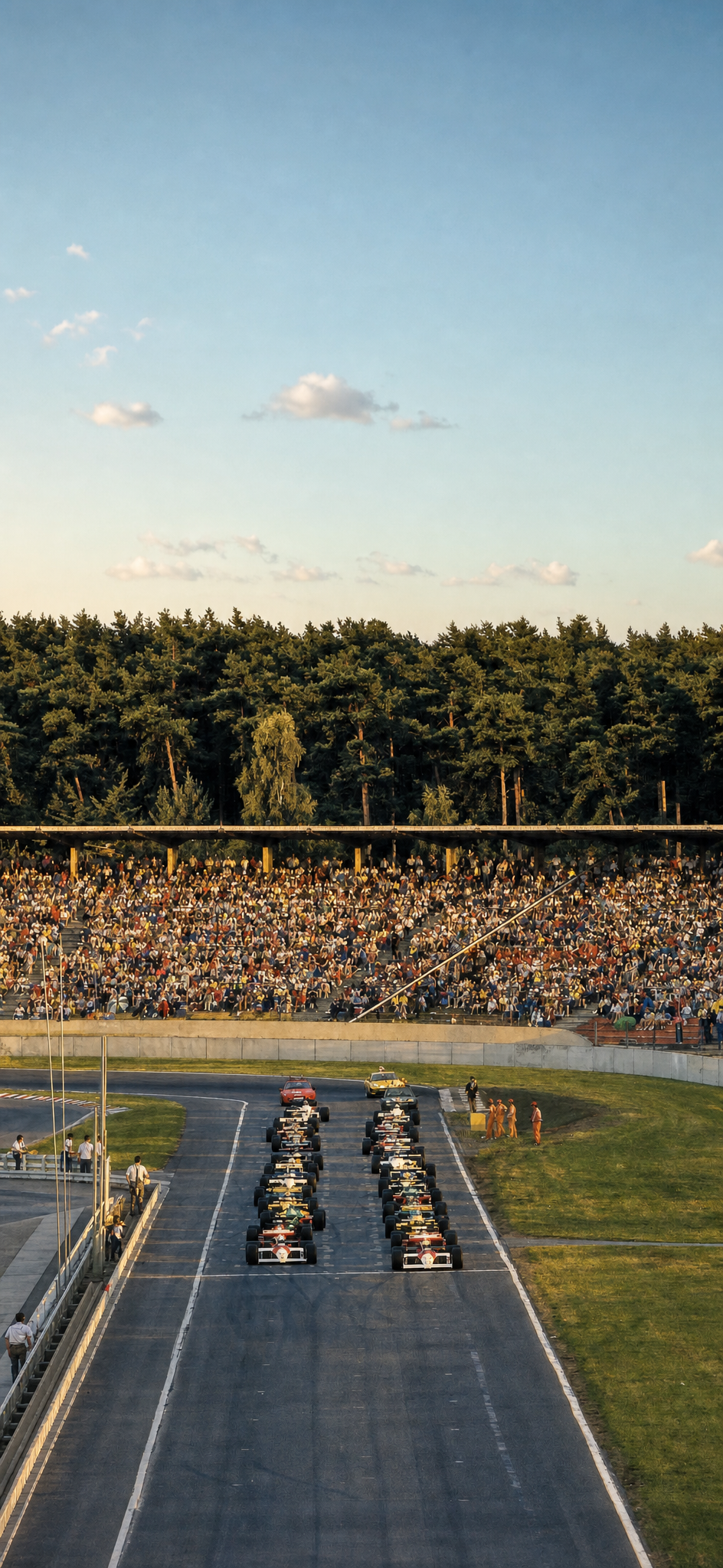
“Wide elevated wide-angle view down the starting straight” establishes the expansive framing, fitting the packed grid, grandstands, and forested horizon into one documentary-scale scene. “Clear late-afternoon golden sunlight” supplies the warm highlights and “longer shadows” that give the gray track and black cars a nostalgic time-of-day contrast, while “subdued and sun-faded” sponsor banners prevent bright branding from overpowering the green background and grid. The phrases “vintage motorsport documentary” and “sharp realistic detail” keep the energetic start grounded in an archival sports-photography look rather than a glossy commercial image.
FAQ
→How do I make one race car more prominent than the full grid?
Replace “cars lined up along the starting straight” with “the lead Formula One car dominating the foreground, with the remaining grid receding behind it,” and change “wide elevated wide-angle view” to “lower elevated three-quarter view focused on the front row.” Keep “grandstands full of spectators” and “forested areas beyond the circuit” to preserve the event scale.
→How do I shift this from nostalgic documentary mood to a tense, modern race-start image?
Replace “vintage motorsport documentary” and “dramatic, energetic, nostalgic atmosphere” with “high-pressure contemporary sports broadcast, tense and immediate atmosphere.” Change “clear late-afternoon golden sunlight” to “hard midday sunlight with crisp high-contrast shadows,” and replace “subdued and sun-faded” sponsor banners with “bright, saturated sponsor banners” for a newer visual feel.
→How do I build a matching series with different circuits while keeping this composition?
Keep “wide elevated wide-angle view down the starting straight, high vantage point, documentary composition” and replace “forested areas beyond the circuit” with a location-specific backdrop such as “dry Mediterranean hills beyond the circuit,” “dense urban skyline beyond the barriers,” or “desert mountains beyond the track.” Replace “trackside sponsor banners” with each circuit’s characteristic signage while retaining “clear late-afternoon golden sunlight” and “natural color and contrast” for continuity.
Learn the technique behind this
- Why can't AI spell, and how do I get readable text in an image? — Older diffusion models had no character-level representation of text, so they produced letterform-shaped texture instead of words.
- Which aspect ratio should I use, and how does it change the image? — Aspect ratio determines what the model composes, not how it's cropped afterwards.
- How should a prompt be structured, and does word order matter? — A prompt that behaves predictably names one subject first, then what it is doing, then where, then the light, then the lens or medium, then the style.
Related prompts
Shirtless Man, Vintage Car, Coastline Light
Golden-hour couple rides a classic bike
Golden-hour Matcha Sips in Luxury SUV
Young model in studio by sports car