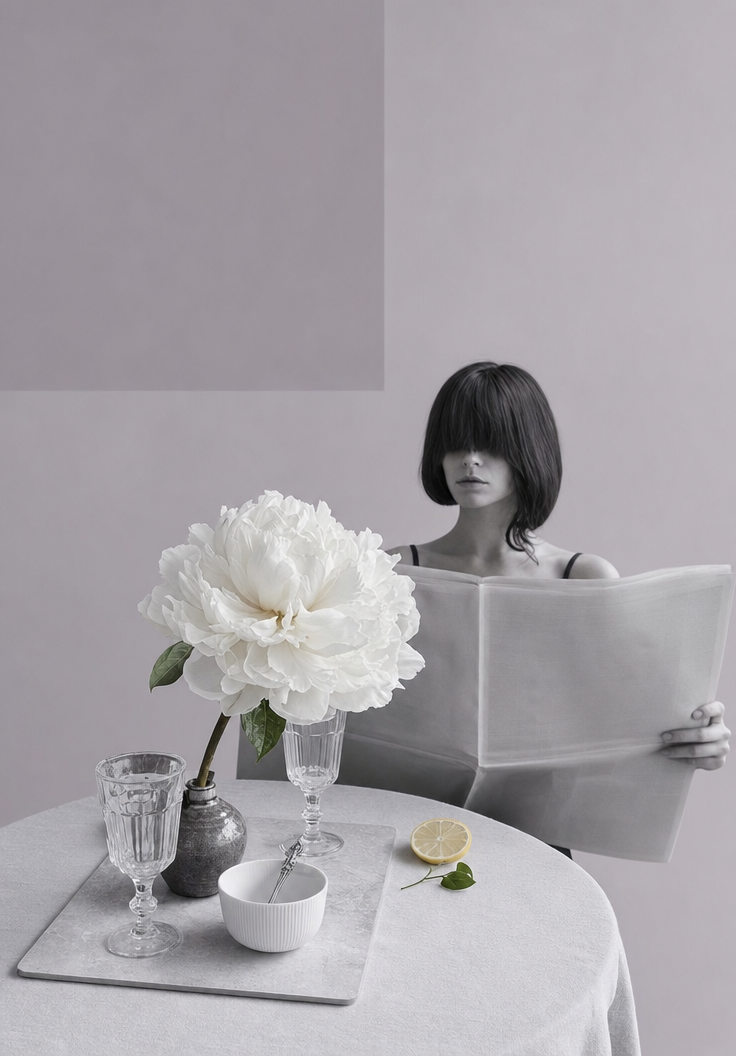
Why this works
The phrase “large white peony bloom dominates the foreground” establishes the image’s strongest focal point, while “clean balanced editorial framing emphasizing the flower foreground and the seated reader” keeps the full-body portrait from losing the woman. “Minimal cool gray and muted lavender background with airy negative space” produces the restrained, mostly white-and-black palette seen in the composition and gives the table scene room to breathe. The dreamy editorial mood comes from the specific combination of “soft overcast natural light,” “subtle collage layering and paper-cut edges,” and the quiet action of “reading a newspaper,” rather than from color alone.
FAQ
→How do I make the woman more central and prominent than the peony?
Replace “a large white peony bloom dominates the foreground” with “a medium white peony rests beside the bowl in the midground,” and change “emphasizing the flower foreground and the seated reader” to “framing the woman as the primary central subject, with the flower as a secondary accent.” Keep “portrait-full-body” if you want her entire seated figure visible.
→How do I turn this calm collage into a warmer, more nostalgic scene?
Replace “cool gray and muted lavender background” with “warm parchment beige and dusty rose background,” and change “soft overcast natural light” to “late-afternoon window light with warm amber highlights.” For a stronger vintage effect, replace “clean balanced composition” with “slightly faded mid-century editorial composition” while retaining “realistic textures.”
→How do I create a coordinated series with different flowers and table details?
Keep the fixed structure “woman seated at a small round table reading a newspaper” and “clean balanced editorial framing,” then swap “large white peony bloom” for variants such as “a tall blue iris,” “a red tulip,” or “a pale yellow ranunculus.” Replace “thin lemon slice” with matching details such as “a lime wedge,” “a blood-orange slice,” or “a small green pear,” while preserving “minimal cool gray and muted lavender background” for visual continuity.
Learn the technique behind this
- Why can't AI spell, and how do I get readable text in an image? — Older diffusion models had no character-level representation of text, so they produced letterform-shaped texture instead of words.
- Do negative prompts work, and what should go in one? — Negative prompts work on models that support a separate negative conditioning channel — mainly Stable Diffusion and FLUX-family models.
- Which aspect ratio should I use, and how does it change the image? — Aspect ratio determines what the model composes, not how it's cropped afterwards.
Related prompts
Young woman in grass with cream wrap

Ethereal Peonies with Iridescent Vertical Trails
Blush-pink Ranunculus With Velvet Petals, Burgundy Background
Woman with auburn wavy hair, lavender peonies