Why this works
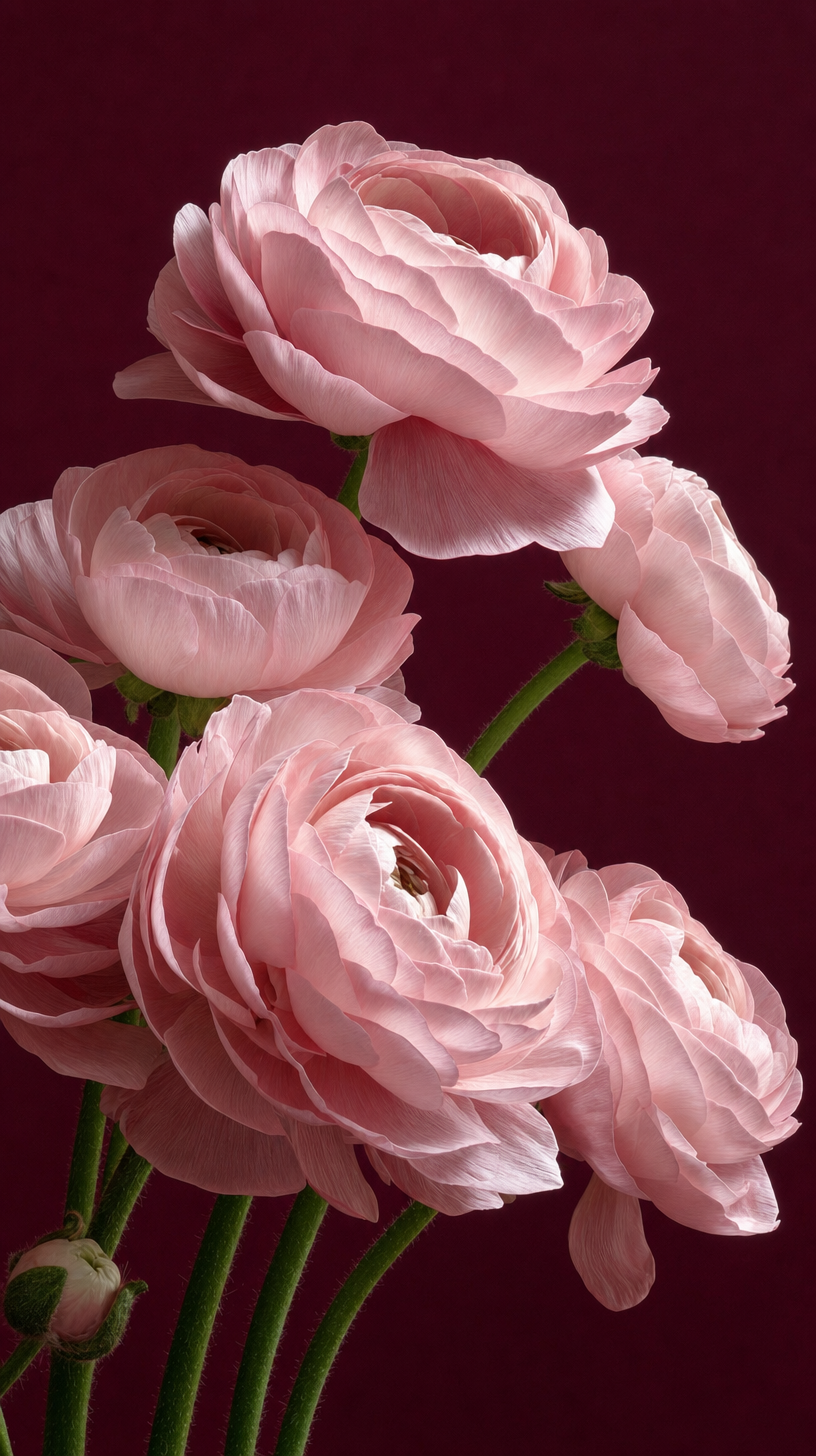
The phrase “soft blush-pink ranunculus flowers with layered, velvety petals” supplies the tactile subject detail, while “ultra-high detail” and “crisp petal texture” preserve fine folds at close range. “Soft directional light from the upper left” gives the centered composition readable highlights and shadow depth, and “shallow depth of field” keeps attention on the bloom rather than the stems or background. The intended burgundy-and-blush harmony is muted in the rendered image, whose dominant gray palette makes the result feel quieter and more restrained than the stated “elegant serene romantic mood.”
FAQ
→How do I make the flowers more prominent and less visually centered?
Replace “Arrange the blooms slightly off-center” with “place one large ranunculus bloom in the left third, with smaller blooms receding toward the right,” and add “the main flower fills most of the frame.” Keep “close-up framing,” but change “shallow depth of field” to “very shallow depth of field focused on the foremost bloom” for stronger hierarchy.
→How do I make the image warmer and more romantic instead of gray and subdued?
Strengthen “rich burgundy background” to “deep wine-burgundy background with warm red undertones,” and replace “soft directional light from the upper left” with “warm, diffused golden light from the upper left.” Add “accurate blush-pink and burgundy color rendering, no gray cast” after “photorealistic floral still life.”
→How do I build a coordinated series from this floral prompt?
Keep “photorealistic floral still life,” “soft directional light from the upper left,” “close-up framing,” and “shallow depth of field” unchanged across every image. Swap only the subject phrase, such as “soft blush-pink ranunculus flowers” for “cream garden roses,” “lavender sweet peas,” or “white anemones,” and replace “rich burgundy background” with a fixed background color family so the set remains visually consistent.
Learn the technique behind this
- Why can't AI spell, and how do I get readable text in an image? — Older diffusion models had no character-level representation of text, so they produced letterform-shaped texture instead of words.
- How should a prompt be structured, and does word order matter? — A prompt that behaves predictably names one subject first, then what it is doing, then where, then the light, then the lens or medium, then the style.
- Why does the model ignore parts of my prompt? — Ignored instructions are almost always conflicts, counts, or spatial relationships — three things current models handle badly — rather than the model failing to read you.
Related prompts

White Orchid and Emerald Halo Ring
Dreamy Woman Reading by Soft Bloom
Young woman in grass with cream wrap

Serene Fashion Portrait in Blooming Garden