Why this works
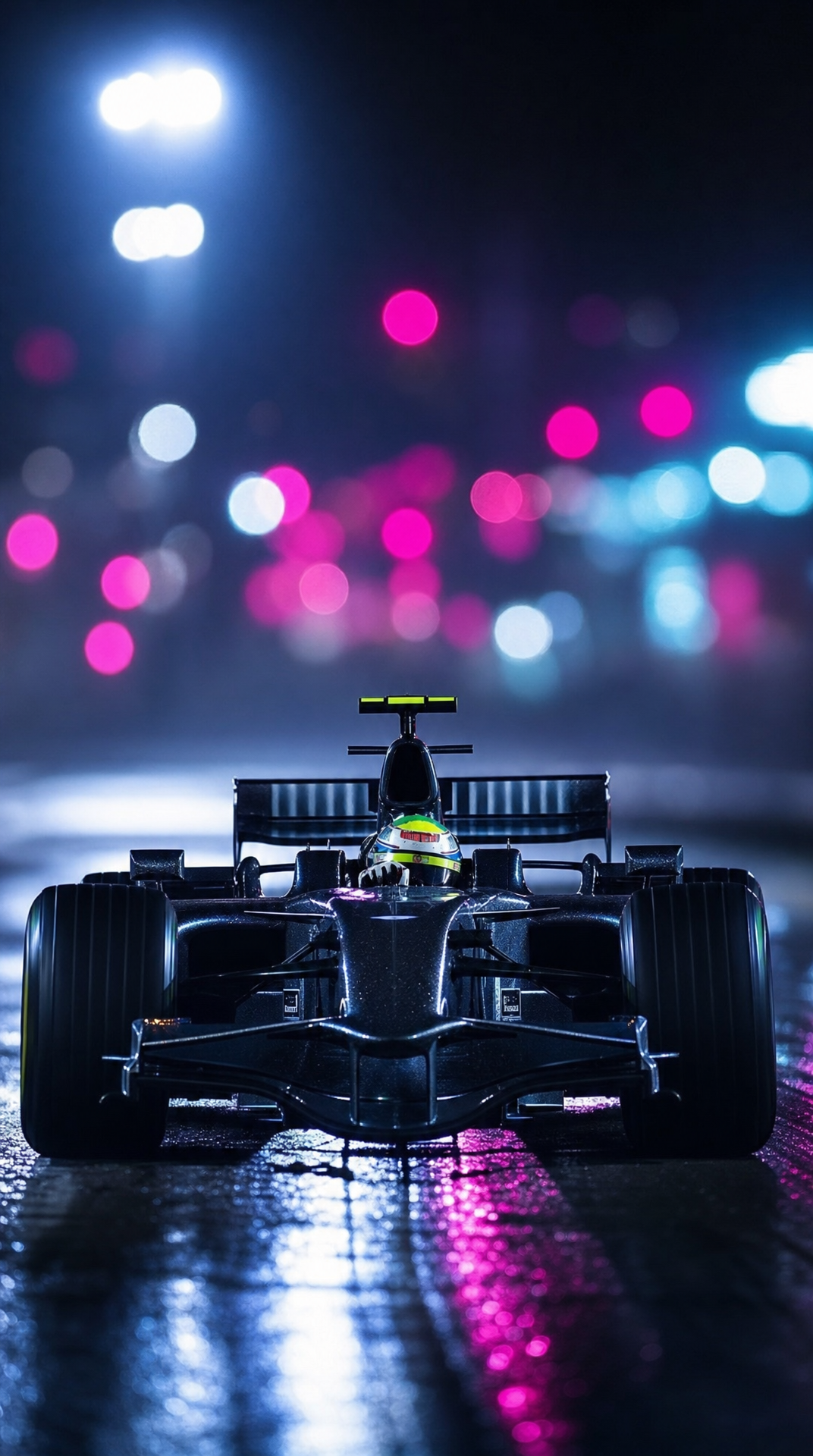
The phrase “front-facing dark metallic Formula One race car” makes the car an immediate graphic anchor, while “centered composition” gives the image a symmetrical, head-on sense of force. “High-contrast rim lighting from stadium-style lamps” separates the dark bodywork from the midnight track, and “vivid magenta and cyan bokeh light orbs” supplies the blue-pink glow visible behind it. “Wet-track reflections” add white and cool-blue highlights beneath the car, while “sharp focus on the car” paired with “85mm lens look” and “shallow depth of field” keeps the vehicle crisp against softened lights and reinforces speed without losing the photorealistic motorsport feel.
FAQ
→How do I make the car feel more aggressive and dominant in the frame?
Replace “centered composition” with “low-angle, tightly cropped frontal composition” and expand “aggressive aerodynamic bodywork” to “exposed front splitter, sculpted sidepods, sharp wing elements, and imposing nose cone.” Change “85mm lens look” to “35mm wide-angle lens look” to make the front of the car appear larger and more forceful.
→How do I shift the image from neon drama to a colder, more realistic race-night mood?
Replace “vivid magenta and cyan bokeh light orbs” with “muted blue-white track lights and restrained red signal lights,” and change “dramatic, intense, high-speed mood” to “tense documentary race-night mood.” Keep “photorealistic motorsport photography” and “realistic wet-track reflections,” but replace “high-contrast rim lighting” with “subtle cool stadium illumination” for less stylized color.
→How do I create a matching series with different cars while preserving this visual identity?
Keep “dimly lit track at midnight,” “centered composition,” “high-contrast rim lighting from stadium-style lamps,” “vivid magenta and cyan bokeh light orbs,” “wet-track reflections,” “85mm lens look,” and “shallow depth of field” unchanged. Replace only “dark metallic Formula One race car” with a controlled subject slot such as “silver endurance prototype,” “black GT3 race car,” or “electric open-wheel racing car,” while retaining “front-facing” and “sharp focus on the car” for consistent framing.
Learn the technique behind this
- Why can't AI spell, and how do I get readable text in an image? — Older diffusion models had no character-level representation of text, so they produced letterform-shaped texture instead of words.
- Which camera and lighting terms actually change an AI image? — Focal length, aperture, light direction and time of day change the image reliably because they correlate with real photographic patterns in the training data.
- Do negative prompts work, and what should go in one? — Negative prompts work on models that support a separate negative conditioning channel — mainly Stable Diffusion and FLUX-family models.
Related prompts
Shirtless Man, Vintage Car, Coastline Light
Golden-hour couple rides a classic bike
Golden-hour Matcha Sips in Luxury SUV
Young model in studio by sports car