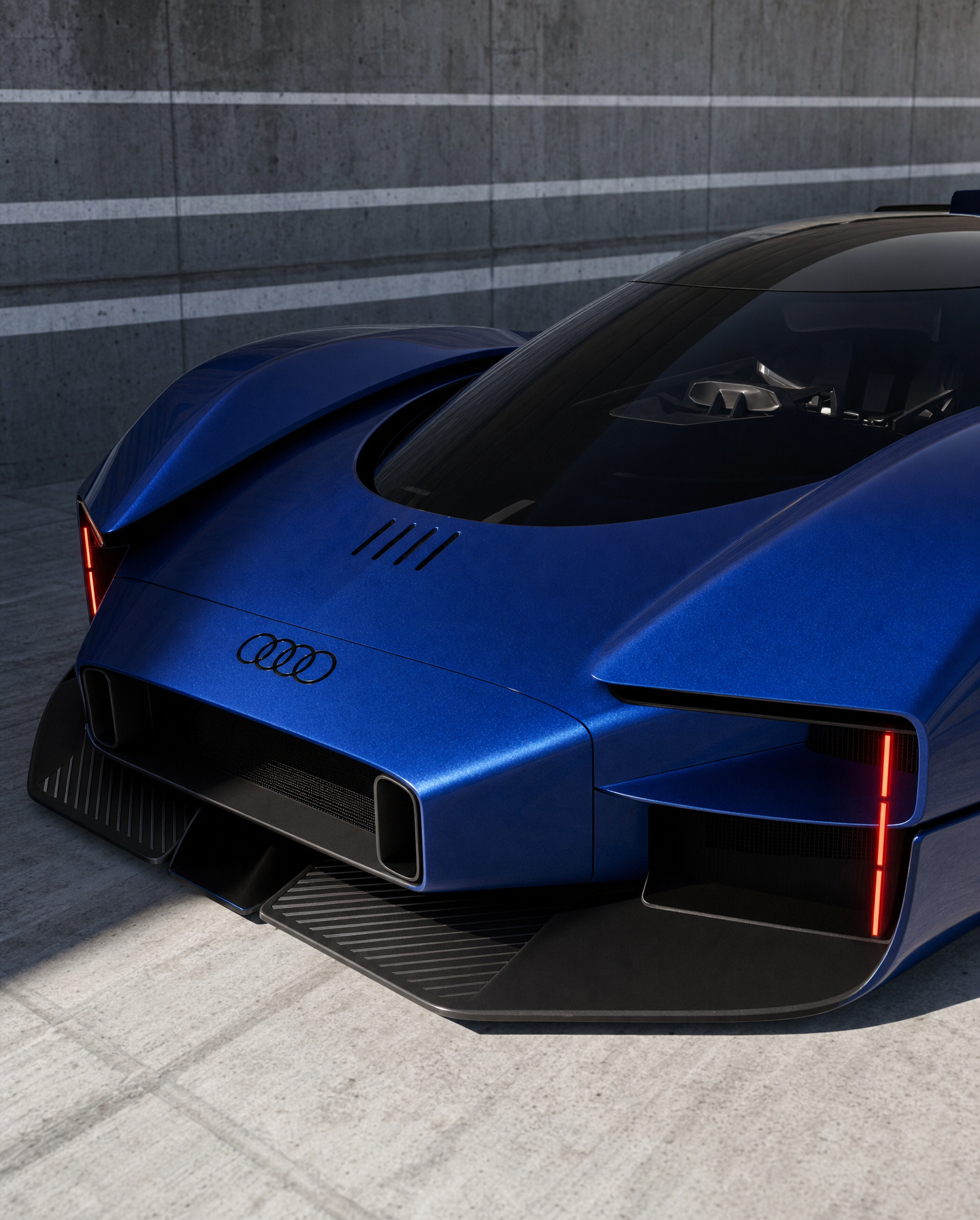
Why this works
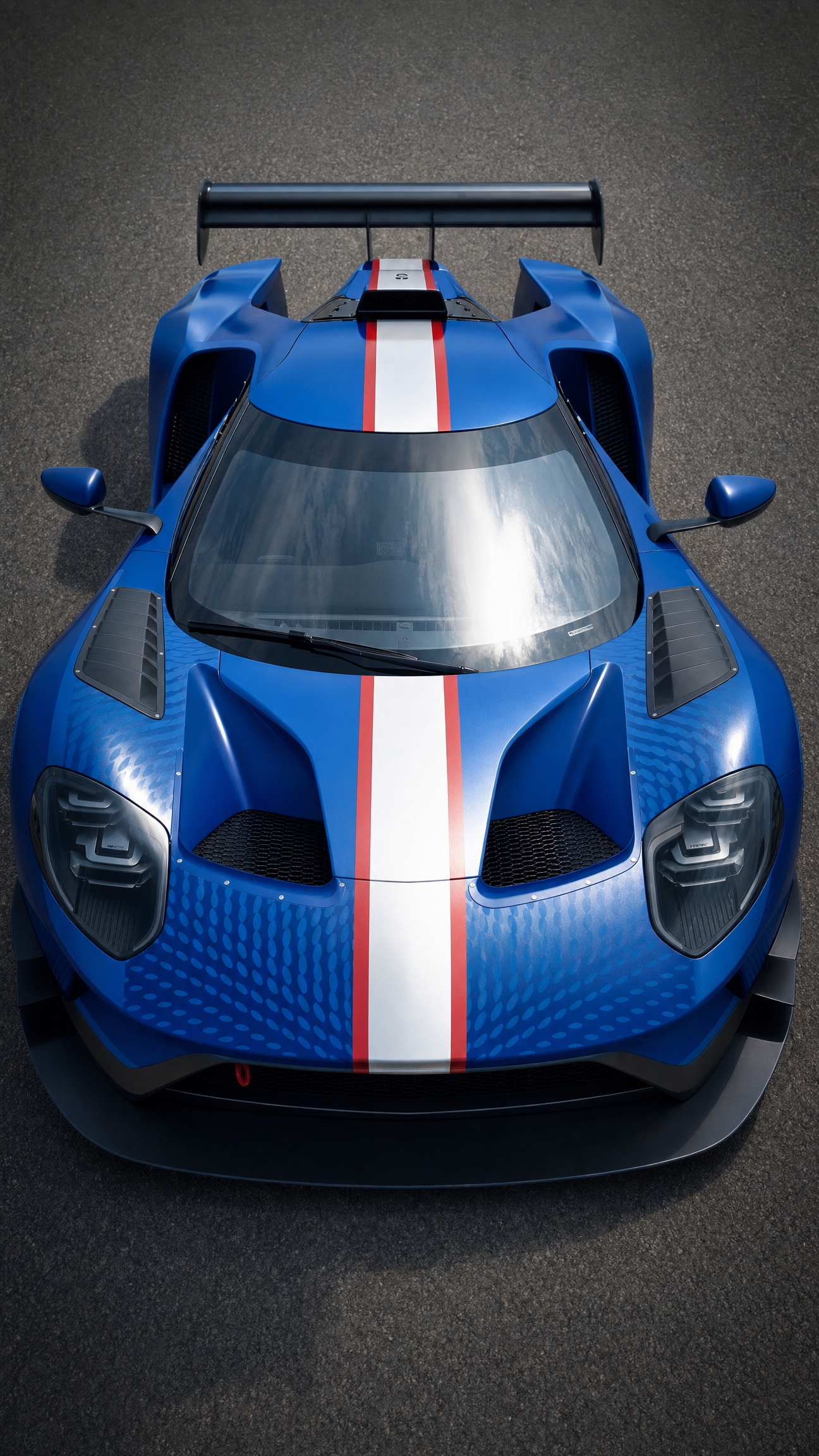
“Top-down front view” and “centered symmetrical composition” make the blue Ford GT-style race car read as a precise, frontal icon, while the “slightly blurred asphalt road” keeps the gray-black setting subordinate. “Aggressive aerodynamic body kit,” “large rear wing,” and “recessed and shadowed” headlights supply the high-performance attitude; “glossy paint,” “sharp reflections,” and “studio-quality high-performance lighting” add crisp surface definition rather than a soft cinematic mood. The intended red-and-white graphics are visually restrained in the generated image, leaving gray, black, and white as the dominant palette around the blue body.
FAQ
→How do I make the red-and-white racing stripes more prominent?
Replace “shift the racing graphics to red and white stripes instead of black and gray” with “bold, wide red-and-white racing stripes covering the hood, roof, and rear deck, with high-contrast red panels clearly visible from the front.” Add “red and white graphics occupy a major portion of the bodywork” to prevent the neutral asphalt and shadowed details from dominating.
→How do I make the headlights the main visual focus?
Replace “change the front end detailing so the headlights appear more recessed and shadowed” with “deeply recessed headlights as the brightest, most prominent front-end features, framed by dark aerodynamic channels.” Keep “top-down front view” but add “tight crop on the nose and headlights” so the front lighting becomes more central than the rear wing.
→How do I create a darker, more aggressive variation?
Replace “studio-quality high-performance lighting” with “low-key directional lighting with hard side shadows and narrow highlights,” and replace “blue Ford GT-style race car” with “deep metallic midnight-blue Ford GT-style race car.” Retain “aggressive aerodynamic body kit,” “large rear wing,” and “recessed and shadowed headlights,” then add “dark wet asphalt with subtle reflections” for a more menacing night-race tone.
Learn the technique behind this
- Why can't AI spell, and how do I get readable text in an image? — Older diffusion models had no character-level representation of text, so they produced letterform-shaped texture instead of words.
- How should a prompt be structured, and does word order matter? — A prompt that behaves predictably names one subject first, then what it is doing, then where, then the light, then the lens or medium, then the style.
- Do negative prompts work, and what should go in one? — Negative prompts work on models that support a separate negative conditioning channel — mainly Stable Diffusion and FLUX-family models.
Related prompts
Shirtless Man, Vintage Car, Coastline Light
Golden-hour couple rides a classic bike
Golden-hour Matcha Sips in Luxury SUV
Young model in studio by sports car