Same prompt, generated with each model separately — click one to see how it holds up.
Why this works
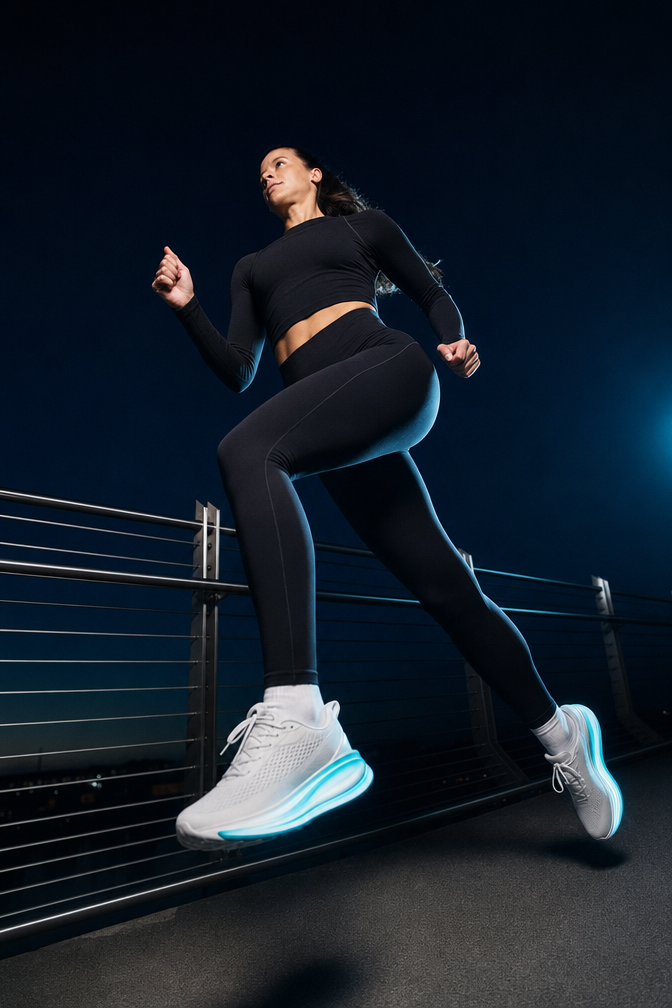
The phrase “low-angle action shot” combined with “perspective emphasizes the length of the stride” makes the runner feel powerful and gives the candid-action composition forward drive. “Deep navy” sky, “cooler highlights,” and “teal-blue neon accents” establish the blue-led palette, while deep black clothing and gray bridge structures keep the dominant colors restrained around the white shoes. “Soft rim light along her limbs” separates her silhouette from the night background, and “bridge railing and nearby city structure blur slightly from motion” preserves speed without sacrificing the “crisp detail” and “sweat-sheen realism” on the athlete.
FAQ
→How do I change this prompt to make the runner’s face and upper body more central?
Replace “low-angle action shot” with “medium low-angle portrait-oriented action shot,” and change “perspective emphasizes the length of the stride” to “framing centers her face, shoulders, and torso while keeping one leg extended.” Add “sharp focus on her eyes and sweat-sheened face” after “crisp detail,” while retaining “soft rim light along her limbs” for separation.
→How do I make the scene feel more intense and dramatic?
Replace “cooler highlights and soft rim light” with “hard directional blue-white spotlights, stronger rim light, and high-contrast shadows.” Change “deep navy” to “storm-black navy sky” and add “wet bridge surface reflecting teal neon accents.” Keep “sharp, energetic motion,” but replace “blur slightly from motion” with “pronounced directional motion blur in the railings and city lights.”
→How do I build a series of variations from this running image?
Keep the fixed phrases “photorealistic commercial sports photography,” “deep black” clothing, and “white running shoes featuring teal-blue neon accents,” then swap “running on a bridge at night” for specific locations such as “running through a rain-soaked underpass at dawn,” “sprinting beside a waterfront at blue hour,” or “climbing concrete stadium stairs under midday sun.” For consistent composition, retain “low-angle, dynamic perspective emphasizing stride length”; for controlled lighting variations, replace “cool cinematic color grading” with “warm sunrise color grading,” “red industrial color grading,” or “neutral overcast color grading.”
Learn the technique behind this
- Why can't AI spell, and how do I get readable text in an image? — Older diffusion models had no character-level representation of text, so they produced letterform-shaped texture instead of words.
- How should a prompt be structured, and does word order matter? — A prompt that behaves predictably names one subject first, then what it is doing, then where, then the light, then the lens or medium, then the style.
- Do negative prompts work, and what should go in one? — Negative prompts work on models that support a separate negative conditioning channel — mainly Stable Diffusion and FLUX-family models.
Related prompts
Grotesque Claymation Gangsters in Gritty Alley
Charcoal coat with tan-handled tote
Woman in Teal Jacket Capturing Twilight Reflection
Red Gummy Bear Monster Attacks