Why this works
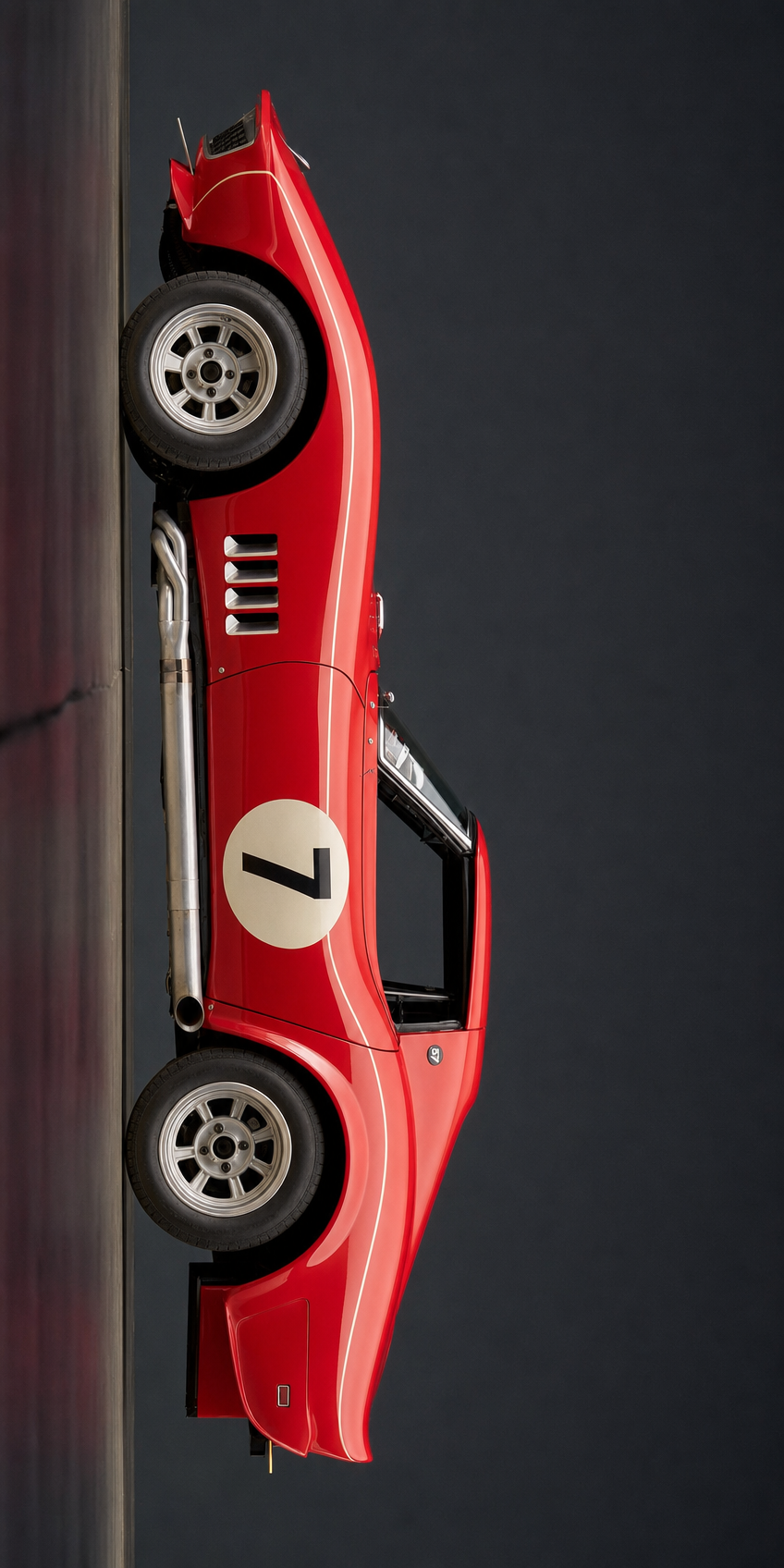
The centered side-profile composition makes the red 1969 Chevrolet Corvette Stingray read as a precise automotive study, while the “low aggressive stance” and “slightly narrower vintage racing tires” preserve its period-race character. “Dark matte seamless background” supplies the dominant black and gray field, isolating the bodywork; “soft diffused studio lighting” paired with “crisp realistic reflections” keeps the paint and metalwork legible without breaking the polished, dramatic tone. “Redesigned race livery with subtle pinstriping instead of heavy decals” and “number 7 on the door” add nostalgic motorsport identity while keeping the silhouette visually clean.
FAQ
→How do I change this prompt to make the Corvette feel more aggressive and race-ready?
Replace “soft diffused studio lighting” with “hard directional overhead lighting with sharp specular highlights,” and change “subtle pinstriping instead of heavy decals” to “bold contrasting race stripes, sponsor decals, and weathered competition markings.” Keep “low aggressive stance,” but add “wide vintage racing tires” in place of “slightly narrower vintage racing tires.”
→How do I make the car’s front end or number 7 more visually prominent?
Replace “studio side-profile shot” with “front three-quarter studio shot from a low camera angle,” and change “number 7 on the door” to “large number 7 prominently displayed on the door and front fenders.” Add “front grille and headlamps facing camera” to shift attention away from the uninterrupted side silhouette.
→How do I build a matching series of images from this prompt in different settings?
Keep the fixed identity phrases “red 1969 Chevrolet Corvette Stingray,” “number 7,” and “subtle pinstriping,” then replace “dark matte seamless studio background” with specific environments such as “rain-soaked 1969 road course pit lane,” “sunlit vintage paddock,” or “night race grid under sodium-vapor lights.” Match each setting by replacing “soft diffused studio lighting” with “overcast daylight,” “warm late-afternoon sunlight,” or “cool artificial track lighting.”
Learn the technique behind this
- Why can't AI spell, and how do I get readable text in an image? — Older diffusion models had no character-level representation of text, so they produced letterform-shaped texture instead of words.
- How should a prompt be structured, and does word order matter? — A prompt that behaves predictably names one subject first, then what it is doing, then where, then the light, then the lens or medium, then the style.
- Do negative prompts work, and what should go in one? — Negative prompts work on models that support a separate negative conditioning channel — mainly Stable Diffusion and FLUX-family models.
Related prompts
Shirtless Man, Vintage Car, Coastline Light
Golden-hour couple rides a classic bike
Golden-hour Matcha Sips in Luxury SUV
Young model in studio by sports car