Why this works
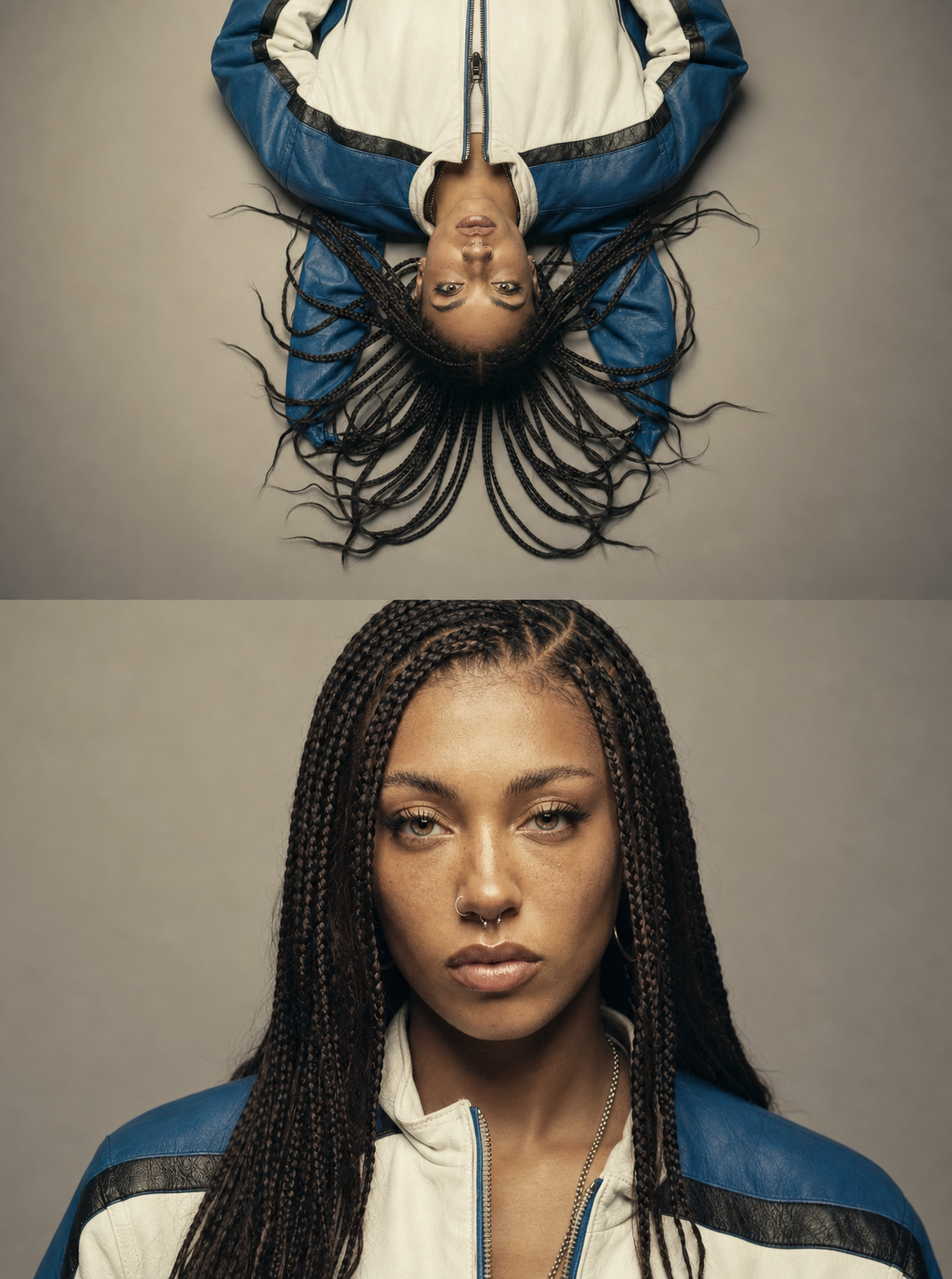
The phrase “upside-down close-up panel above and a frontal close-up panel below” makes the diptych structure and mirrored visual tension the image’s main organizing device. “Blue and white track jacket” supplies the strongest color accent against the “muted beige with deep charcoal gradient background,” while “soft directional lighting” and “crisp high-detail skin texture” keep the face dimensional and sharply defined. “Long braids,” the “nose ring,” and the “slightly neater, side-parted arrangement” provide repeated graphic details that connect both panels while preserving the cool, introspective fashion-editorial mood.
FAQ
→How do I change this prompt to make the lower frontal portrait more dominant?
Replace “shown as an upside-down close-up panel above and a frontal close-up panel below” with “large frontal close-up filling two-thirds of the frame, with a smaller upside-down portrait inset above.” Keep “sharp fashion focus” and add “primary subject centered in the lower panel, eyes as the visual anchor.”
→How do I change the mood from cool and introspective to warmer and more confident?
Replace “muted beige with deep charcoal gradient background” with “warm terracotta fading into rich umber,” and replace “soft directional lighting” with “warm golden side-lighting with controlled highlights.” Change “intense, cool, introspective editorial look” to “confident, magnetic, sun-warmed editorial look,” while retaining the blue jacket as a deliberate cool contrast.
→How do I build a series of variations while keeping this diptych recognizable?
Keep the fixed structure phrase “upside-down close-up panel above and a frontal close-up panel below,” along with “young woman with long braids and a nose ring.” Swap “blue and white track jacket” for controlled wardrobe variants such as “black leather jacket,” “cream tailored blazer,” or “green nylon windbreaker,” and replace “slightly neater, side-parted arrangement” with specific braid changes such as “center-parted braids with metallic cuffs” or “loosely gathered braids with a few flyaways.”
Learn the technique behind this
- Why can't AI spell, and how do I get readable text in an image? — Older diffusion models had no character-level representation of text, so they produced letterform-shaped texture instead of words.
- How should a prompt be structured, and does word order matter? — A prompt that behaves predictably names one subject first, then what it is doing, then where, then the light, then the lens or medium, then the style.
- How do I keep the same character across multiple images? — Text prompts alone won't hold a face across images — a description defines a type, not a person.
Related prompts
Cobalt Boots in Sleek Studio Edit
Teal fashion editorial in monster-filled lift
Sunlit editorial on striped beach towel
Silhouette Influencer by Sunlit Window