Why this works
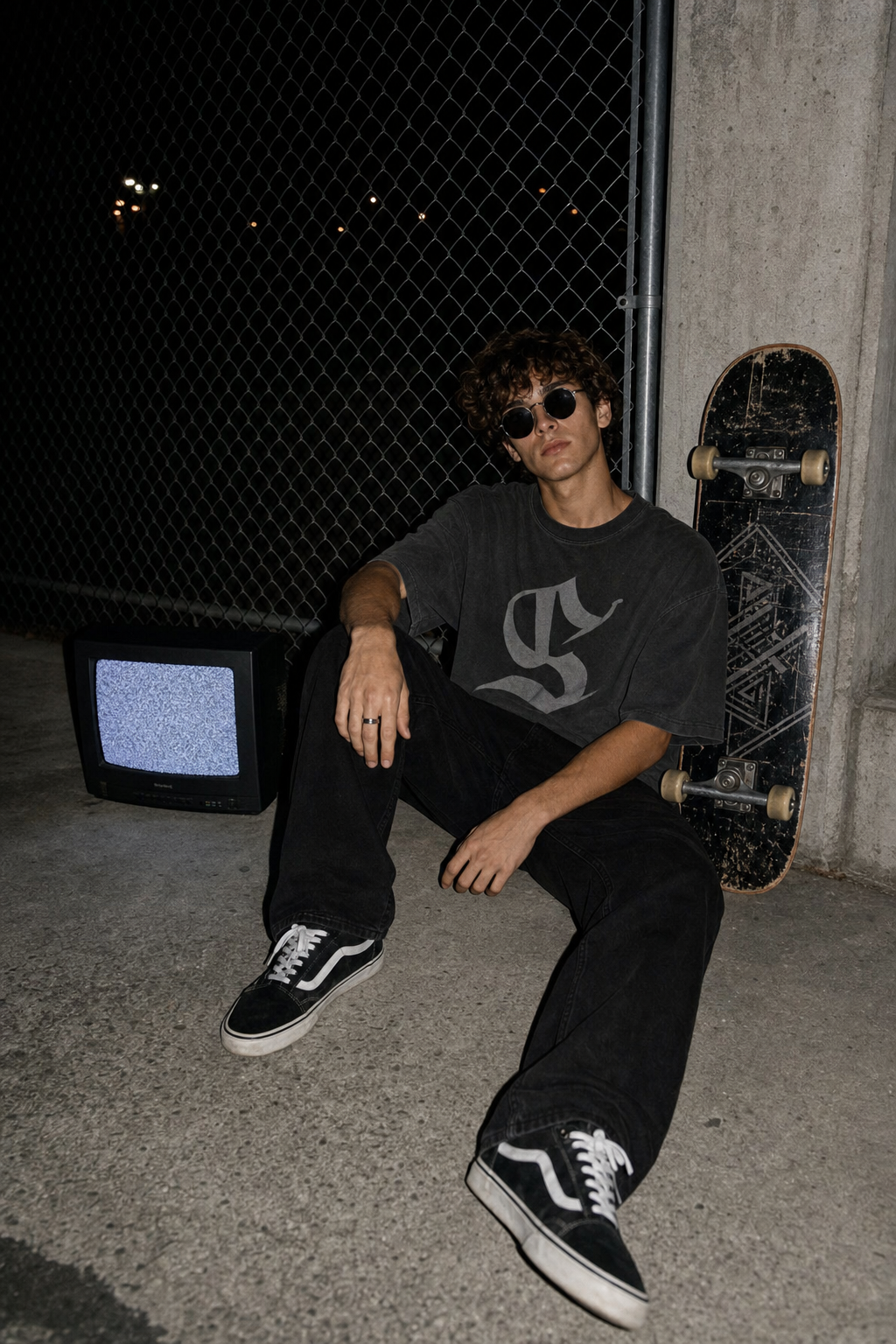
“Vertical framing” and the subject’s “both legs spread naturally toward the camera” create a portrait-full-body composition with immediate foreground presence. The detached mood comes from “head slightly tilted backward,” “calm, detached expression,” and “matte round sunglasses,” while “direct on-camera flash” against the “nighttime” setting produces hard, candid contrast and realistic shadows. Gray and white dominate because the “dark charcoal graphic t-shirt,” “rough concrete,” “chain-link fence,” and “thick white midsoles” repeat a restrained industrial palette, with “slight camera grain” and “subtle lens softness” keeping the image photographic rather than polished.
FAQ
→How do I make the portrait feel warmer and more approachable?
Replace “calm, detached expression” and “matte round sunglasses” with “slight genuine smile, direct eye contact, sunglasses removed,” and change “direct on-camera flash” to “soft warm streetlamp light with gentle fill flash.” Keep “nighttime” and the concrete skate spot to preserve the setting while reducing the alienated tone.
→How do I make the skateboard and CRT television more visually prominent?
Replace “A worn skateboard with faded geometric graphics leans against the wall beside him” with “the worn skateboard stands prominently in the foreground beside his legs, graphics clearly visible,” and replace “an old CRT television with static is lying lower near the ground in the background” with “an old CRT television with bright static occupies a visible secondary focal point behind him.” Add “deep focus, background objects sharply readable” to counter the softer, subject-first composition.
→How do I build a consistent series with different subjects while keeping this visual identity?
Keep “ultra-realistic nighttime direct on-camera flash,” “vertical framing,” “slight camera grain,” “subtle lens softness,” and “gritty urban environment” unchanged. Replace “young man” with a consistent subject template such as “young woman in oversized workwear” or “older skater in a patched jacket,” then swap “old CRT television” and “weathered warning sign” for recurring location props such as “payphone with peeling stickers” and “faded event poster.”
Learn the technique behind this
- Why can't AI spell, and how do I get readable text in an image? — Older diffusion models had no character-level representation of text, so they produced letterform-shaped texture instead of words.
- Why does the model ignore parts of my prompt? — Ignored instructions are almost always conflicts, counts, or spatial relationships — three things current models handle badly — rather than the model failing to read you.
- Why does AI get hands and faces wrong, and how do I fix it? — Hands fail because they're small in frame, extremely variable in pose, and self-occluding — the model has less usable signal per pixel than for any other body part.
Related prompts
Grotesque Claymation Gangsters in Gritty Alley
Charcoal coat with tan-handled tote
Woman in Teal Jacket Capturing Twilight Reflection
Stuffed Bear on Winter Dumpster at Dawn