Why this works
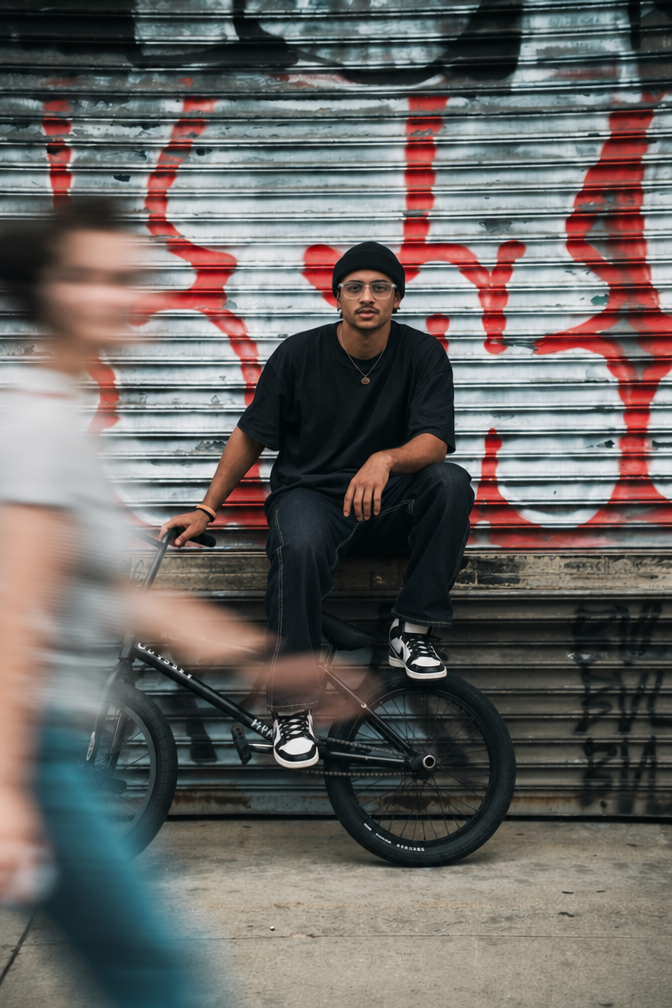
The full-body portrait framing is anchored by “a stylish young man sitting on a BMX bike,” while “candid framing” and the “blurred pedestrian” crossing the foreground make the scene feel observed rather than staged. “Natural late-afternoon light casts warm highlights and soft shadows” supplies the relaxed mood, and the black clothing against the red graffiti-covered shutter creates the dominant black-and-red color contrast. “Shallow depth of field” and “the subject stays sharply in focus” separate the rider from the gritty street-level background without losing the New York setting.
FAQ
→How do I make the BMX rider feel more dominant and imposing?
Replace “portrait-full-body” and “candid framing” with “low-angle three-quarter portrait, rider fills most of the frame,” and change “sitting on a BMX bike” to “rider leaning forward over the BMX handlebars.” Keep “sharp subject focus,” but reduce “blurred pedestrian foreground” to “pedestrian reduced to a faint edge blur” so the passerby does not compete with him.
→How do I shift this from a cool late-afternoon mood to a darker night-street tone?
Replace “Natural late-afternoon light with warm highlights, soft shadows” with “hard neon red and blue storefront light, deep directional shadows,” and change “warm highlights” to “cold specular highlights.” Add “wet pavement reflecting neon” after “urban street scene” to reinforce the darker palette while preserving the “graffiti-covered metal shutter” backdrop.
→How do I create a matching series with different riders and locations?
Keep the fixed visual structure, including “Photorealistic editorial street photography,” “shallow depth of field,” “sharp subject focus,” and “blurred pedestrian foreground.” Swap “a stylish young man sitting on a BMX bike” for subjects such as “a woman standing beside a fixed-gear bicycle” and replace “a graffiti-covered metal shutter” with “a tiled subway entrance” or “a concrete basketball court,” while retaining “Natural late-afternoon light” for consistent color and mood.
Learn the technique behind this
- Why can't AI spell, and how do I get readable text in an image? — Older diffusion models had no character-level representation of text, so they produced letterform-shaped texture instead of words.
- How should a prompt be structured, and does word order matter? — A prompt that behaves predictably names one subject first, then what it is doing, then where, then the light, then the lens or medium, then the style.
- Which aspect ratio should I use, and how does it change the image? — Aspect ratio determines what the model composes, not how it's cropped afterwards.
Related prompts
Grotesque Claymation Gangsters in Gritty Alley
Charcoal coat with tan-handled tote
Woman in Teal Jacket Capturing Twilight Reflection
Stuffed Bear on Winter Dumpster at Dawn