Why this works
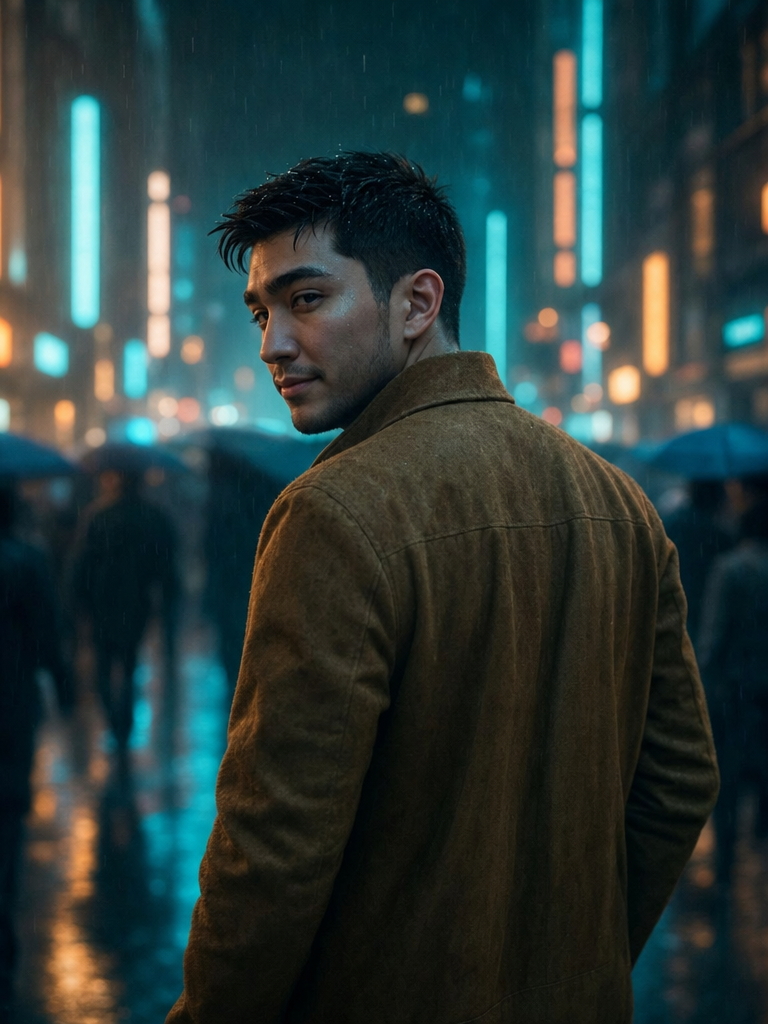
The phrase “turned slightly more toward the camera with a half-smile while looking over his shoulder” gives the full-body portrait a readable human focal point, while “natural street-level perspective” keeps the viewer embedded in the rainy street rather than looking down on him. “Wet pavement mirrors soft teal and orange neon signage” supplies the dominant teal, brown, and orange harmony, and “subtle rim lighting along the edges of his face and jacket” separates the tan suede jacket from the dark, blurred city. “Shallow depth of field with smooth bokeh” pushes the pedestrians and umbrellas into atmospheric context instead of competing with the subject.
FAQ
→How do I make the man's face and expression more prominent?
Replace “portrait-full-body” and “natural street-level perspective” with “waist-up portrait, eye-level perspective, face centered in the upper third.” Keep “turned slightly more toward the camera with a half-smile,” but add “sharp focus on both eyes and facial expression” so the over-the-shoulder pose remains visible without letting the full body dominate.
→How do I change the moody cyberpunk scene into a warmer, more romantic night portrait?
Replace “moody cyberpunk atmosphere” and “soft teal and orange neon signage” with “warm cinematic romantic atmosphere” and “amber café lights and muted rose signage reflected on wet pavement.” Change “subtle rim lighting” to “soft golden backlight and gentle warm fill on the face,” while retaining “rainy city street at night” and “smooth bokeh” for the reflective, intimate setting.
→How do I create a series of variations without losing the same visual identity?
Keep the fixed anchors “cinematic photorealistic portrait,” “tan suede jacket,” “turned slightly more toward the camera with a half-smile,” “shallow depth of field,” and “realistic urban street photography.” For each variation, swap only the setting and reflected colors, such as replacing “rainy city street at night” with “foggy tram stop at dawn” and “teal and orange neon signage” with “cool blue glass reflections and pale yellow headlights.”
Learn the technique behind this
- Why can't AI spell, and how do I get readable text in an image? — Older diffusion models had no character-level representation of text, so they produced letterform-shaped texture instead of words.
- How should a prompt be structured, and does word order matter? — A prompt that behaves predictably names one subject first, then what it is doing, then where, then the light, then the lens or medium, then the style.
- Why does AI get hands and faces wrong, and how do I fix it? — Hands fail because they're small in frame, extremely variable in pose, and self-occluding — the model has less usable signal per pixel than for any other body part.
Related prompts
Grotesque Claymation Gangsters in Gritty Alley
Charcoal coat with tan-handled tote
Woman in Teal Jacket Capturing Twilight Reflection
Stuffed Bear on Winter Dumpster at Dawn