Why this works
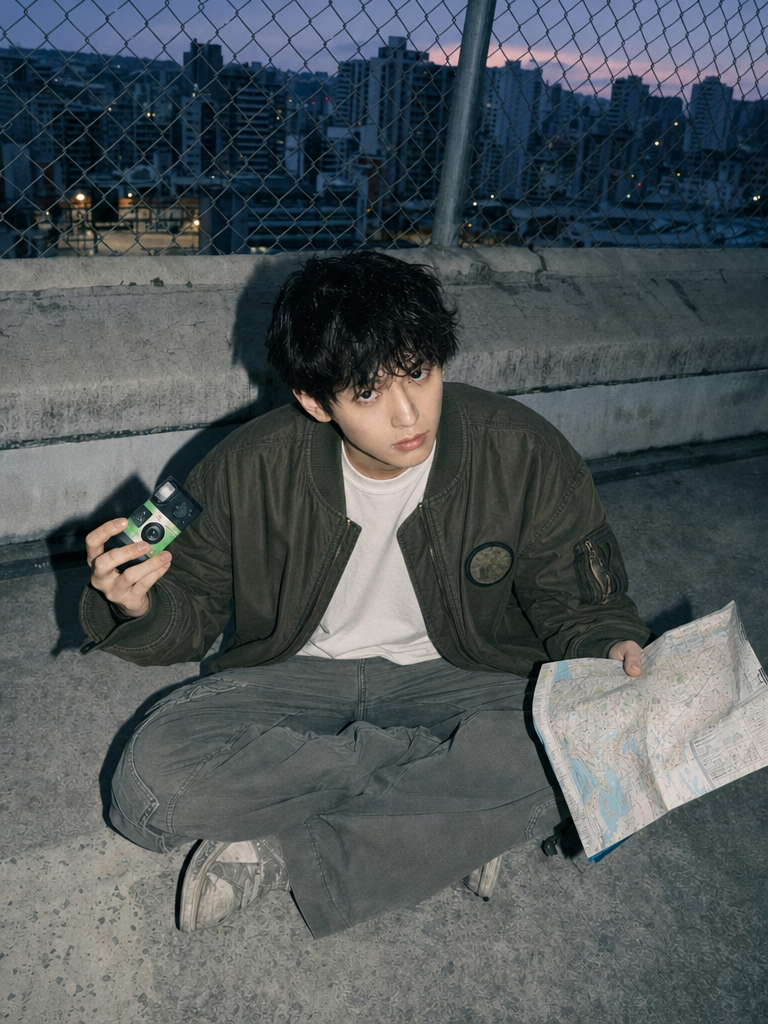
“Wide framing” and “portrait-full-body” establish the relaxed rooftop composition, keeping the young man, compact camera, folded map, and skyline readable at once. “On-camera flash with visible film grain and slight motion blur” supplies the gritty candid texture, while “cooler blue-purple dusk sky” and the darker olive bomber jacket create a controlled blue, black, and olive palette. The phrase “less washed urban skyline background” preserves city detail, so the scene feels moody and urban without losing the setting.
FAQ
→How do I make the folded map more central and readable?
Replace “holding a compact camera in one hand and a folded map in the other” with “holding the folded map open toward the lens, map markings clearly visible, compact camera hanging from his other hand.” Keep “wide framing,” but add “hands and map sharply readable” so the prop gains priority without losing the full-body rooftop context.
→How do I shift this from moody twilight to a brighter, more energetic streetwear image?
Replace “early evening,” “cooler blue-purple dusk sky,” and “moody twilight atmosphere” with “late golden hour, warm orange-pink sky, lively late-afternoon atmosphere.” Change “partially lit by flash” to “direct bright on-camera flash with warm rim light,” while keeping “film grain” and “slight motion blur” for the digicam character.
→How do I build a matching series with different rooftop moments?
Keep the fixed style phrases “candid digicam-style,” “on-camera flash,” “visible film grain,” “slight motion blur,” “gritty streetwear editorial energy,” and “wide framing.” Swap the action phrase “holding a compact camera in one hand and a folded map in the other” for variations such as “checking a disposable camera beside a rooftop antenna,” “leaning over a sketchbook near a water tank,” or “adjusting headphones while looking across the skyline,” while retaining “young man sitting on a rooftop” and the blue-purple dusk palette.
Learn the technique behind this
- Why can't AI spell, and how do I get readable text in an image? — Older diffusion models had no character-level representation of text, so they produced letterform-shaped texture instead of words.
- Which aspect ratio should I use, and how does it change the image? — Aspect ratio determines what the model composes, not how it's cropped afterwards.
- Why does the model ignore parts of my prompt? — Ignored instructions are almost always conflicts, counts, or spatial relationships — three things current models handle badly — rather than the model failing to read you.
Related prompts
Grotesque Claymation Gangsters in Gritty Alley
Charcoal coat with tan-handled tote
Woman in Teal Jacket Capturing Twilight Reflection
Stuffed Bear on Winter Dumpster at Dawn