Why this works
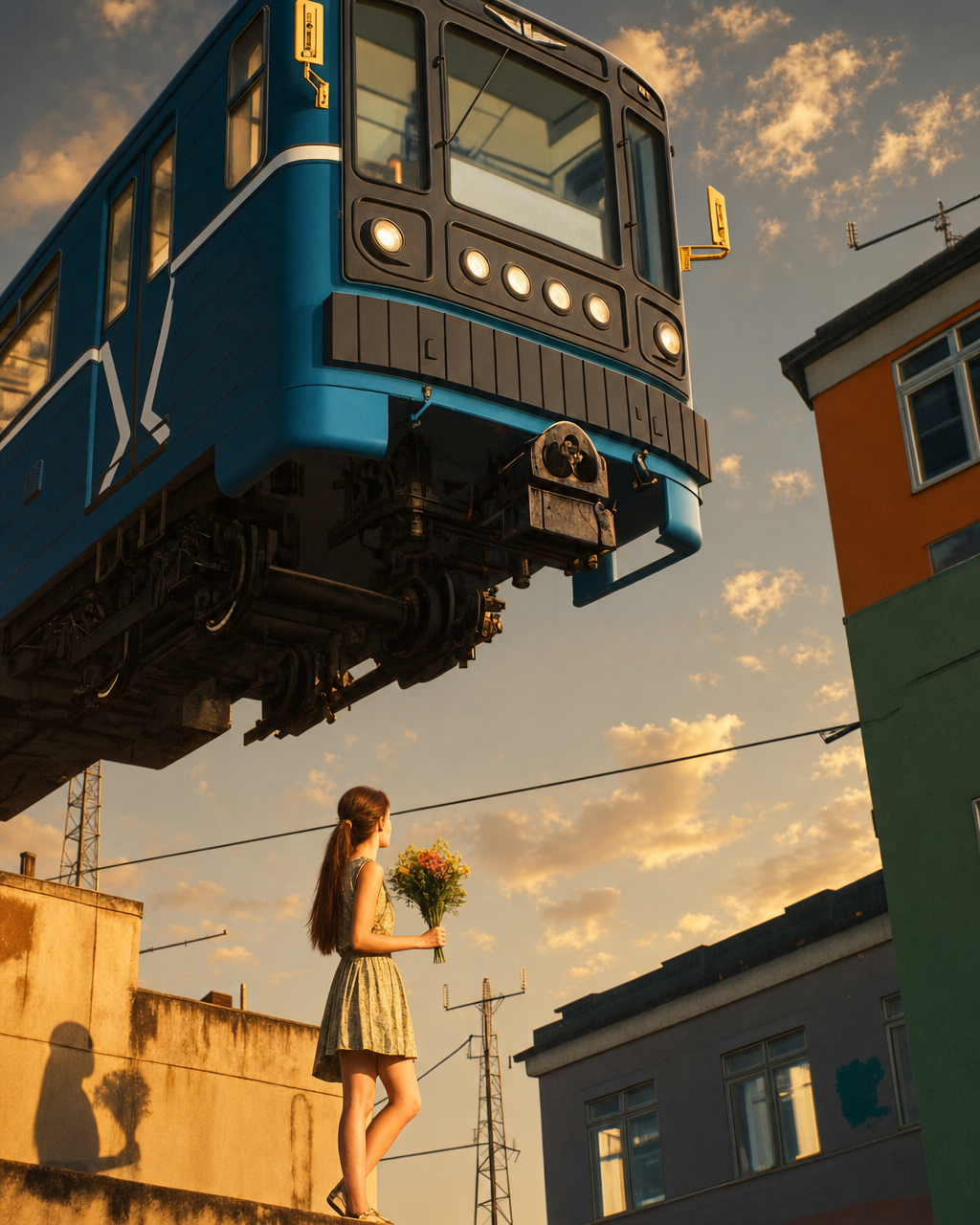
The phrase “low-angle perspective looking up at the suspended train” makes the blue train the dominant shape and gives the rooftop geometry a strong upward pull, while “a woman stands on a rooftop beneath” supplies a human scale reference. “Late-afternoon golden sky,” “warmer color contrast,” and “golden rim light on the woman and buildings” explain the image’s gold and orange highlights against gray architecture and green urban accents. “Surreal photorealism” paired with “whimsical but realistic composition” holds the impossible suspension in a dreamlike register without sacrificing the “highly detailed,” “sharply focused” architectural texture.
FAQ
→How do I make the woman more prominent than the suspended train?
Replace “low-angle perspective looking up at the suspended train” with “eye-level medium shot centered on the woman,” and change “a woman stands on a rooftop beneath a suspended blue train” to “a woman in the foreground fills the central frame, with the suspended blue train receding behind her.” Keep “golden rim light on the woman” and add “shallow depth of field focused on her face.”
→How do I make the scene darker and more ominous?
Replace “bright late-afternoon golden sky” with “stormy blue-hour sky,” and replace “warmer color contrast and a more pronounced golden rim light” with “cold cyan backlight, deep shadows, and sparse red practical lights.” Change “whimsical yet realistic” to “ominous yet photorealistic” while retaining “suspended in midair” for the central unease.
→How do I create a series of variations without losing the core concept?
Keep “a woman stands on a rooftop beneath a suspended blue train” and “low-angle perspective,” then swap only the setting and time phrase: use “rain-soaked neon district at night,” “sun-bleached industrial rooftops at noon,” or “foggy historic city at dawn.” Match each version with corresponding lighting language such as “magenta and cyan reflections,” “hard white overhead sun,” or “diffuse silver fog light.”
Learn the technique behind this
- Why can't AI spell, and how do I get readable text in an image? — Older diffusion models had no character-level representation of text, so they produced letterform-shaped texture instead of words.
- How should a prompt be structured, and does word order matter? — A prompt that behaves predictably names one subject first, then what it is doing, then where, then the light, then the lens or medium, then the style.
- Do negative prompts work, and what should go in one? — Negative prompts work on models that support a separate negative conditioning channel — mainly Stable Diffusion and FLUX-family models.
Related prompts
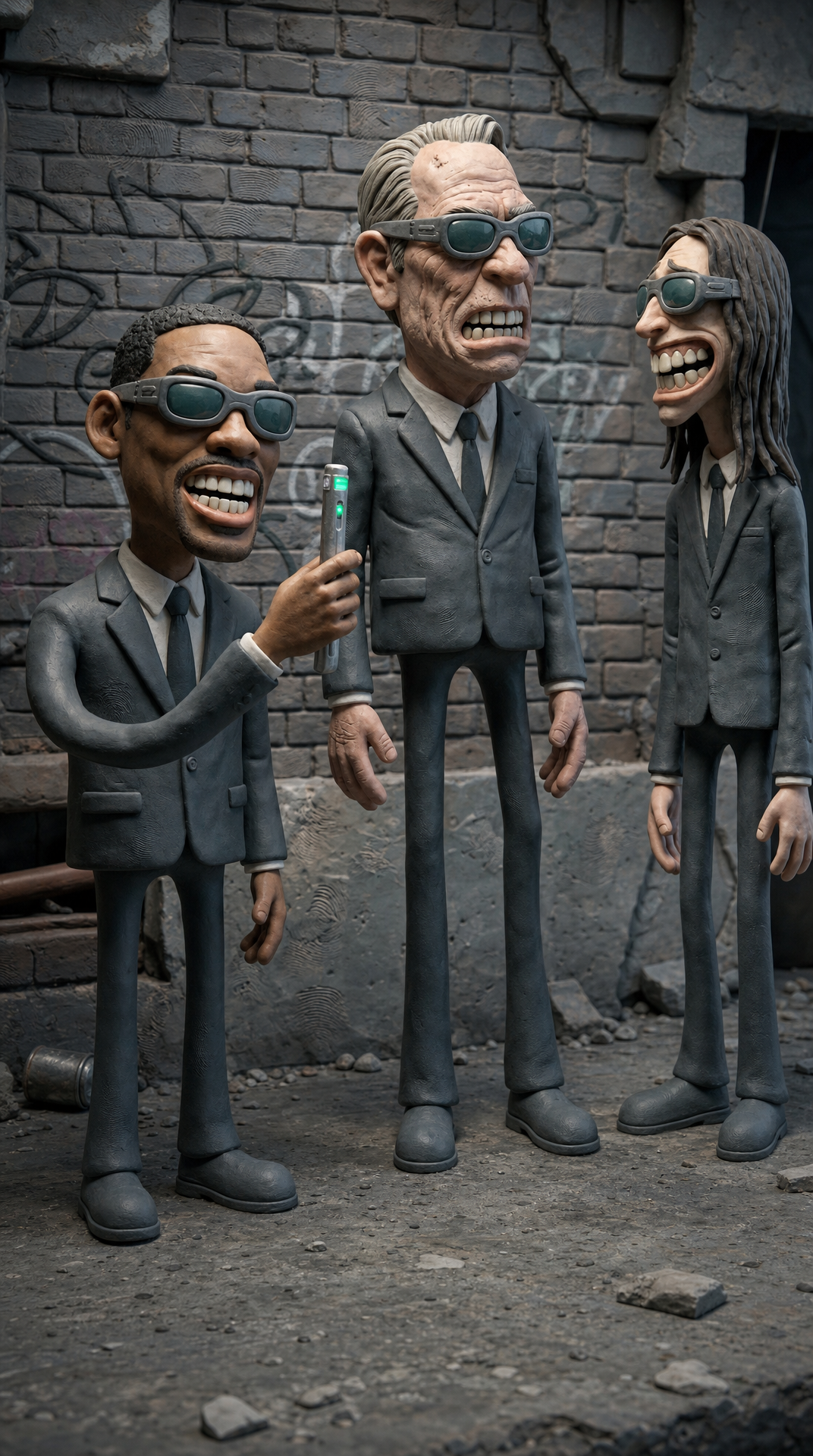
Grotesque Claymation Gangsters in Gritty Alley
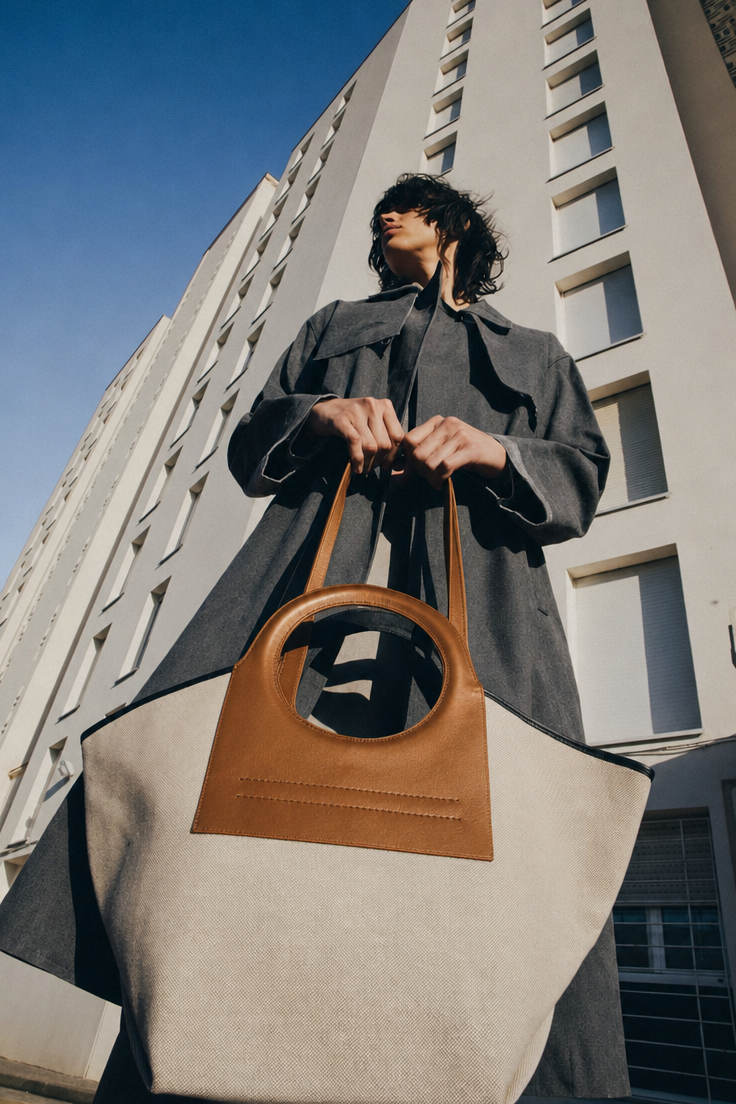
Charcoal coat with tan-handled tote
Woman in Teal Jacket Capturing Twilight Reflection
Stuffed Bear on Winter Dumpster at Dawn