Why this works
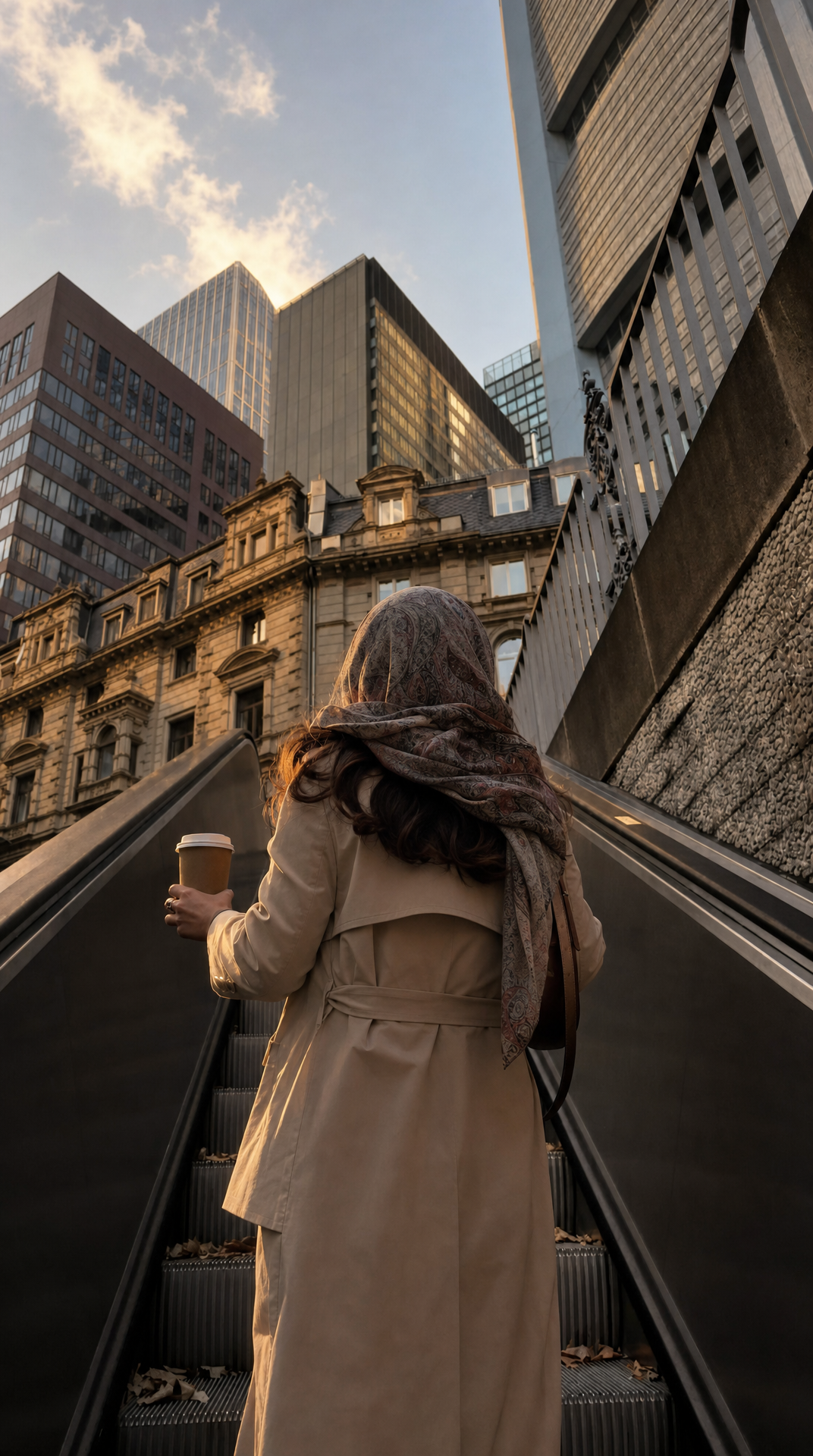
The low-angle view and “strong vertical lines” make the escalator and surrounding skyscrapers pull upward through the portrait frame, giving the full-body figure a clear sense of urban scale. “Seen from behind” and “holding a takeaway coffee cup” keep the moment candid and contemplative, while “late-afternoon golden-hour light filtered through thin clouds” adds warmth against the dominant beige-and-gray palette. The “historic stone building in the midground” supplies textural contrast between the woman, the escalator, and the glass-and-steel towers, and “warm rim light along the escalator rails” directs attention along the composition without losing the moody street-photography feel.
FAQ
→How do I make the woman more prominent in the frame?
Replace “portrait-full-body” and “photorealistic low-angle view” with “medium full-body low-angle portrait, woman occupying the central two-thirds of the frame,” while keeping “seen from behind.” Add “sharp focus on the woman and her patterned headscarf, slightly softened skyscrapers” to make her the visual anchor.
→How do I make the scene feel darker and more introspective?
Replace “late-afternoon golden-hour light filtered through thin clouds” with “blue-hour light under heavy cloud cover,” and replace “warm rim light along the escalator rails” with “cool reflected light and restrained highlights on the rails.” Keep “moody urban atmosphere,” then add “deep gray shadows, muted beige coat, subdued contrast” to preserve the contemplative tone.
→How do I create a series of variations without losing the original composition?
Keep the fixed structure: “woman climbing an outdoor escalator from behind,” “strong vertical lines,” “historic stone building in the midground,” and “glass-and-steel skyscrapers framing the sides.” For controlled variations, swap only the subject styling and light phrases, such as “light beige trench coat and patterned headscarf” for “olive raincoat and knitted cap,” or “golden-hour light” for “soft dawn light,” while retaining “same pose and direction on the escalator.”
Learn the technique behind this
- Why can't AI spell, and how do I get readable text in an image? — Older diffusion models had no character-level representation of text, so they produced letterform-shaped texture instead of words.
- Which aspect ratio should I use, and how does it change the image? — Aspect ratio determines what the model composes, not how it's cropped afterwards.
- How should a prompt be structured, and does word order matter? — A prompt that behaves predictably names one subject first, then what it is doing, then where, then the light, then the lens or medium, then the style.
Related prompts
Grotesque Claymation Gangsters in Gritty Alley
Charcoal coat with tan-handled tote
Woman in Teal Jacket Capturing Twilight Reflection
Stuffed Bear on Winter Dumpster at Dawn