Why this works
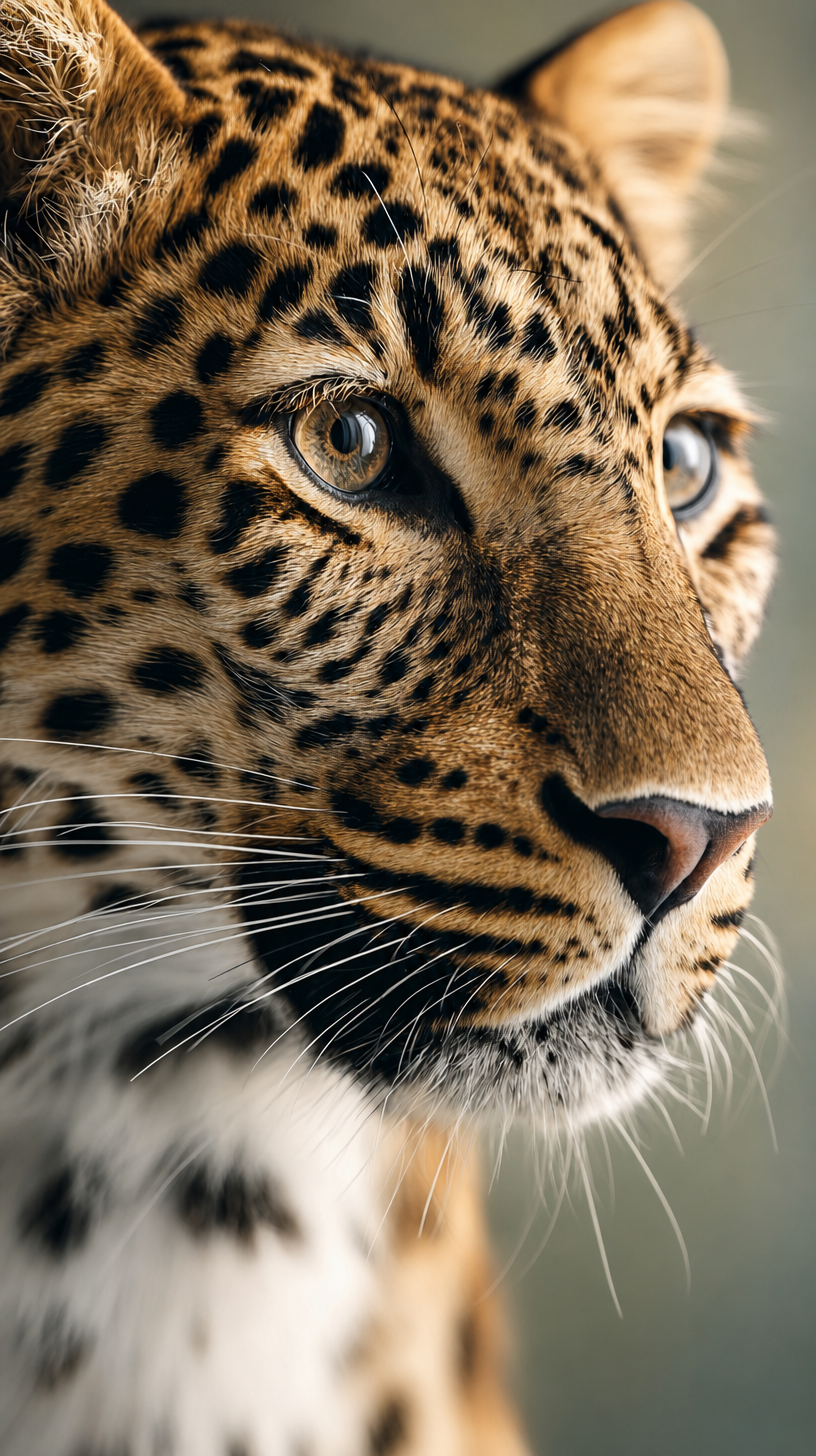
The portrait-closeup framing and “shallow depth of field macro close-up” make the leopard’s face and rosette coat the visual priority, while “crisp fur detail on the rosettes” and “ultra-detailed natural fur texture” preserve tactile realism. The calm, controlled expression comes from “refined calm/elegant gaze,” while “intense eyes” supplies the focal point and tension. “Softly blurred muted sage-green neutral background” separates the warm golden coat from the subdued backdrop, and “clean studio-like lighting with subtle rim light” gives the head a precise edge without breaking the quiet mood.
FAQ
→How do I change this prompt to make the leopard feel more threatening and dramatic?
Replace “refined calm/elegant gaze” and “clean studio-like lighting with subtle rim light” with “direct hostile stare, bared teeth, tense facial muscles” and “hard directional side-lighting with deep shadows and a narrow rim highlight.” Keep “shallow depth of field macro close-up” to retain the intimate, confrontational framing.
→How do I make the eyes and expression more central than the rosette coat?
Change “crisp fur detail on the rosettes” to “razor-sharp focus locked on the eyes, highly detailed irises and catchlights, rosettes gradually softer toward the cheeks.” Keep “intense eyes” but place it immediately after “leopard close-up portrait,” and replace “shallow depth of field” with “extremely shallow depth of field focused exclusively on the eyes.”
→How do I build a varied series from this leopard portrait without losing its visual identity?
Keep the fixed anchors “photorealistic wildlife photography,” “ultra-detailed natural fur texture,” “intense eyes,” and “high-contrast rosette coat,” then swap the setting and lighting phrases for controlled variants such as “misty forest in cool blue-green tones with diffused dawn light,” “dry savanna with warm sunset side-light,” or “dark studio background with a narrow overhead spotlight.” Retain “portrait-closeup” and “shallow depth of field macro close-up” so the series remains visually consistent.
Learn the technique behind this
- Why can't AI spell, and how do I get readable text in an image? — Older diffusion models had no character-level representation of text, so they produced letterform-shaped texture instead of words.
- How should a prompt be structured, and does word order matter? — A prompt that behaves predictably names one subject first, then what it is doing, then where, then the light, then the lens or medium, then the style.
- Do negative prompts work, and what should go in one? — Negative prompts work on models that support a separate negative conditioning channel — mainly Stable Diffusion and FLUX-family models.
Related prompts
Cream Longhaired Cat in Warm Dusty-Rose Light
Warm Studio Laughter With Brown Puppy
Cream, Smoky Gray, and Ginger Tabby Stacked Cats
Long-haired gray tabby cat with green eyes