Same prompt, generated with each model separately — click one to see how it holds up.
Why this works
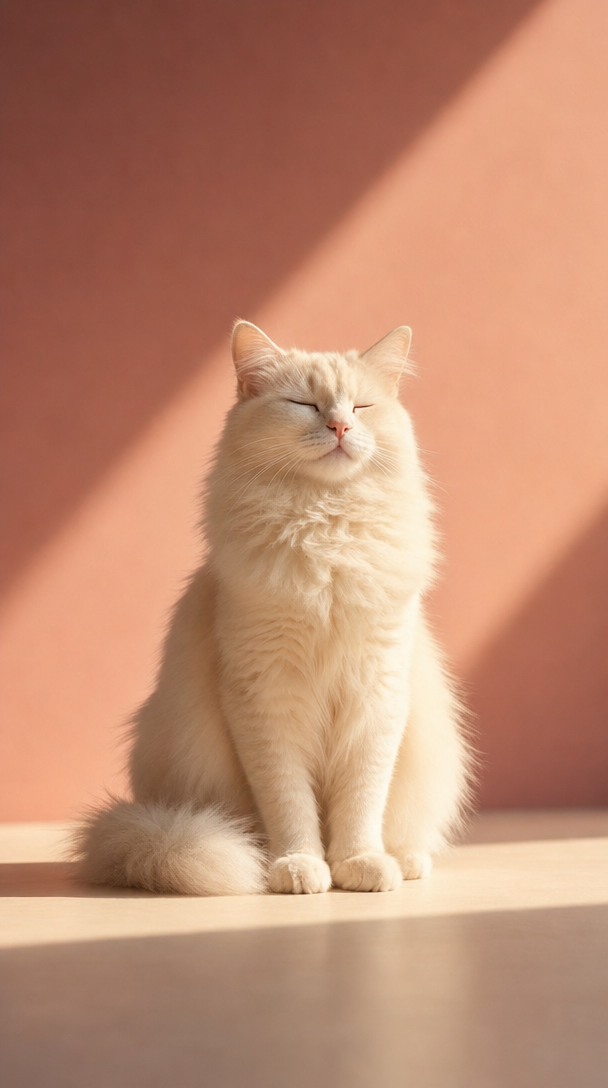
The centered full-body framing comes directly from “centered in a minimal studio portrait” and “sitting calmly,” giving the closed-eyed cream-colored cat a stable, contemplative presence. “Muted dusty-rose,” “light beige surface,” and the “overall dreamy pastel palette” create the pale, soft color harmony reflected in the dominant white appearance, while “soft, warm sunlight beams falling diagonally” adds directional structure without breaking the serene mood. “High-fidelity fur detail” and “shallow depth of field” keep the long-haired coat tactile while gently separating the cat from the studio background.
FAQ
→How do I make the cat’s face and closed eyes more prominent?
Replace “centered composition” and “portrait-full-body” with “tight head-and-shoulders close-up, face centered in frame,” and change “shallow depth of field” to “very shallow depth of field with the eyes and muzzle in crisp focus.” Keep “eyes closed” if the calm expression should remain central.
→How do I shift this from serene and dreamy to warm and cheerful?
Replace “muted dusty-rose” with “soft peach and pale apricot,” change “soft, warm sunlight beams” to “bright golden morning sunlight,” and replace “serene airy atmosphere” with “playful, sunlit atmosphere.” Retain “clean natural highlights” so the cream fur stays light rather than becoming overly contrasty.
→How do I create a matching series with different cats while preserving this visual identity?
Keep the fixed style phrases “minimal studio portrait,” “light beige surface,” “soft warm diagonal sunlight beams,” “shallow depth of field,” and “overall dreamy pastel palette.” Swap only “fluffy cream-colored long-haired cat” for variants such as “silver tabby kitten,” “black-and-white tuxedo cat,” or “ginger short-haired cat,” and adjust “high-fidelity fur detail” to “high-fidelity striped fur detail” when the coat pattern needs emphasis.
Learn the technique behind this
- Why can't AI spell, and how do I get readable text in an image? — Older diffusion models had no character-level representation of text, so they produced letterform-shaped texture instead of words.
- How should a prompt be structured, and does word order matter? — A prompt that behaves predictably names one subject first, then what it is doing, then where, then the light, then the lens or medium, then the style.
- Do negative prompts work, and what should go in one? — Negative prompts work on models that support a separate negative conditioning channel — mainly Stable Diffusion and FLUX-family models.
Related prompts
Warm Studio Laughter With Brown Puppy
Neon Iridescent Snake Macro Portrait
Long-haired gray tabby cat with green eyes
Cream, Smoky Gray, and Ginger Tabby Stacked Cats