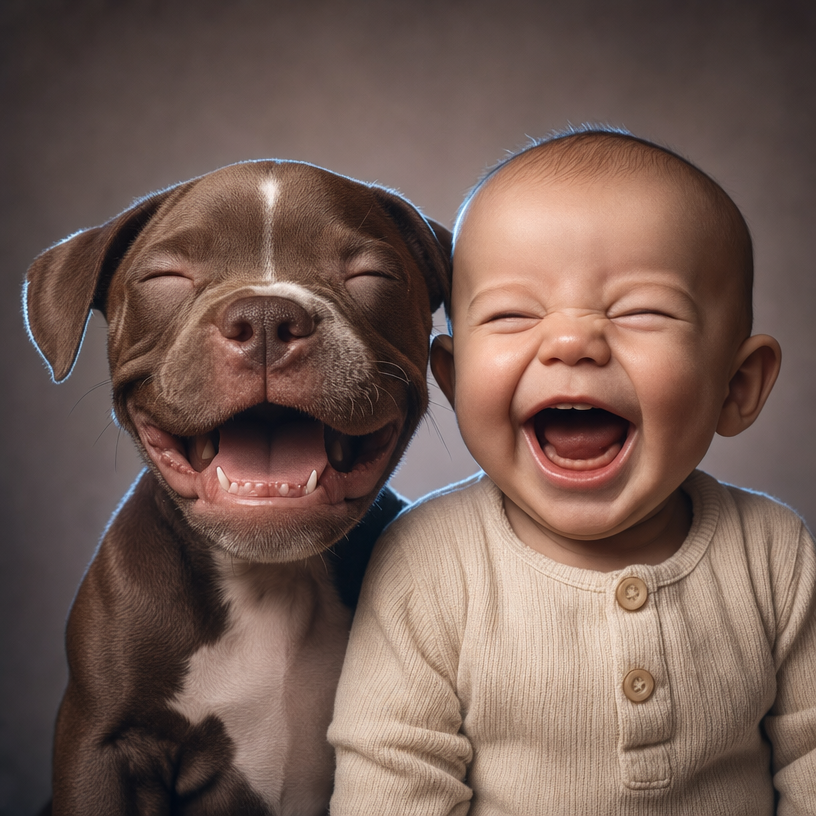
Why this works
The intimate mood comes from “intimate close-up framing,” while “joyful,” “eyes closed,” and “open-mouthed grins” give both faces a shared, unmistakable expression. “Warm soft lighting with a slightly cooler rim light” adds gentle warmth and separates the baby and puppy from the neutral beige-gray background. “Tight crop on faces,” “shallow depth of field,” “natural skin texture,” and “detailed fur” keep attention on the expressions and make the portrait feel tactile rather than staged.
FAQ
→How do I make the puppy more central and prominent in the portrait?
Replace “a laughing baby sitting beside a smiling brown puppy” with “a smiling brown puppy in the foreground beside a laughing baby,” and change “tight crop on faces” to “tight crop prioritizing the puppy’s face.” Keep “detailed fur” and add “the puppy’s eyes and muzzle in sharpest focus” so the dog becomes the visual anchor.
→How do I shift this from warm joy to a quieter, tender mood?
Replace “joyful,” “laughing,” and “open-mouthed grins” with “quietly content,” “soft smiles,” and “relaxed closed-mouth expressions.” Change “warm soft lighting” to “very soft diffused window light” and “warm joyful intimate mood” to “calm tender intimate mood,” while retaining “slightly cooler rim light” for separation.
→How do I create a consistent series with different babies and animals?
Keep the fixed structure “photorealistic studio portrait,” “intimate close-up framing,” “neutral softly blurred background,” “warm soft lighting with a slightly cooler rim light,” and “shallow depth of field.” Swap only “baby” and “brown puppy” for controlled pairs such as “toddler and cream-colored kitten,” “newborn and golden retriever puppy,” or “child and floppy-eared rabbit,” while preserving “eyes closed” and “open-mouthed grins” for a recurring expression.