Why this works
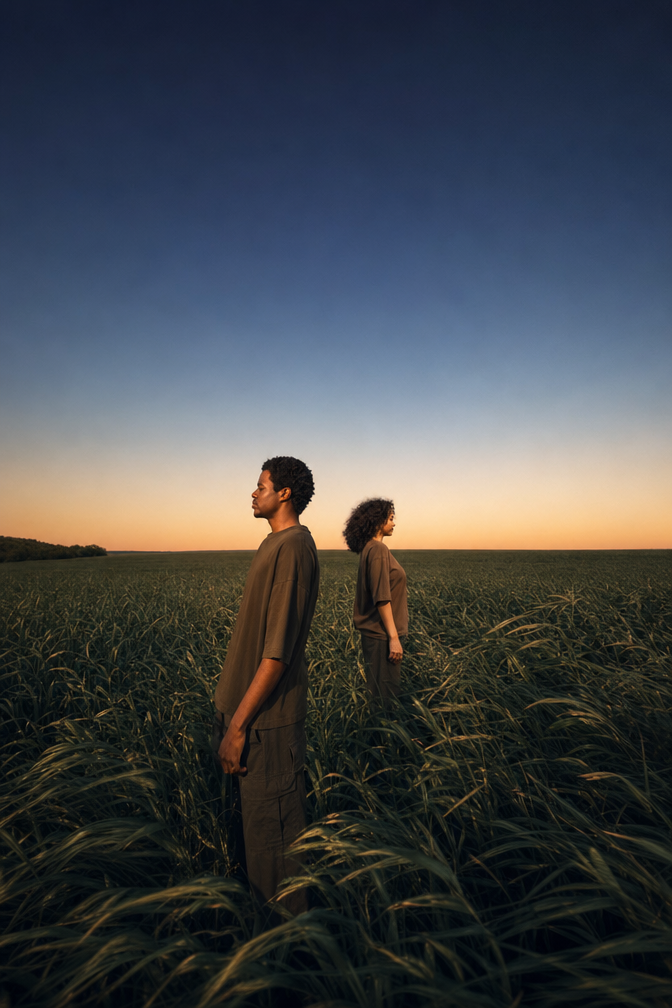
The phrase “two people standing apart” establishes the contemplative tension, while “one in the foreground shown in side profile and one further back facing away” creates a clear depth relationship and keeps both figures emotionally withdrawn. “Vast green grassy field,” “strong negative space,” and “wide frame” make the wide-shot composition feel spacious, with the tall wind-tossed grass adding movement around otherwise still bodies. The sky’s “smooth gradient from deep indigo overhead to warm light near the horizon,” reinforced by “cool shadows and subtle warm highlights,” supplies the cinematic tonal shift reflected in the image’s green, black, and beige palette.
FAQ
→How do I make the foreground person more central and visually dominant?
Replace “one in the foreground shown in side profile” with “a single foreground subject centered in a three-quarter view, occupying the central third of the frame,” and change “two people standing apart” to “a dominant foreground figure with a smaller distant companion.” Keep “full-body view” if you want the pose and clothing to remain fully visible.
→How do I shift this from moody contemplation to a warmer, more hopeful tone?
Replace “deep indigo overhead to warm light near the horizon” with “soft blue sky fading into golden late-afternoon light,” and change “cool shadows and subtle warm highlights” to “warm sunlight with gentle amber highlights and soft neutral shadows.” You can also replace “moody contemplative minimalism” with “quiet optimistic editorial minimalism.”
→How do I create a series of variations without losing the visual identity?
Keep the fixed anchors “photorealistic editorial fashion portrait,” “strong negative space,” “full-body view,” and “cinematic color grading,” then vary one block at a time. Swap “vast green grassy field” for “windswept coastal dunes,” “dry ochre plain,” or “misty alpine meadow,” while replacing the sky phrase with a matching gradient such as “pearl gray to pale rose near the horizon.”
Learn the technique behind this
- Why can't AI spell, and how do I get readable text in an image? — Older diffusion models had no character-level representation of text, so they produced letterform-shaped texture instead of words.
- How should a prompt be structured, and does word order matter? — A prompt that behaves predictably names one subject first, then what it is doing, then where, then the light, then the lens or medium, then the style.
- Which aspect ratio should I use, and how does it change the image? — Aspect ratio determines what the model composes, not how it's cropped afterwards.
Related prompts
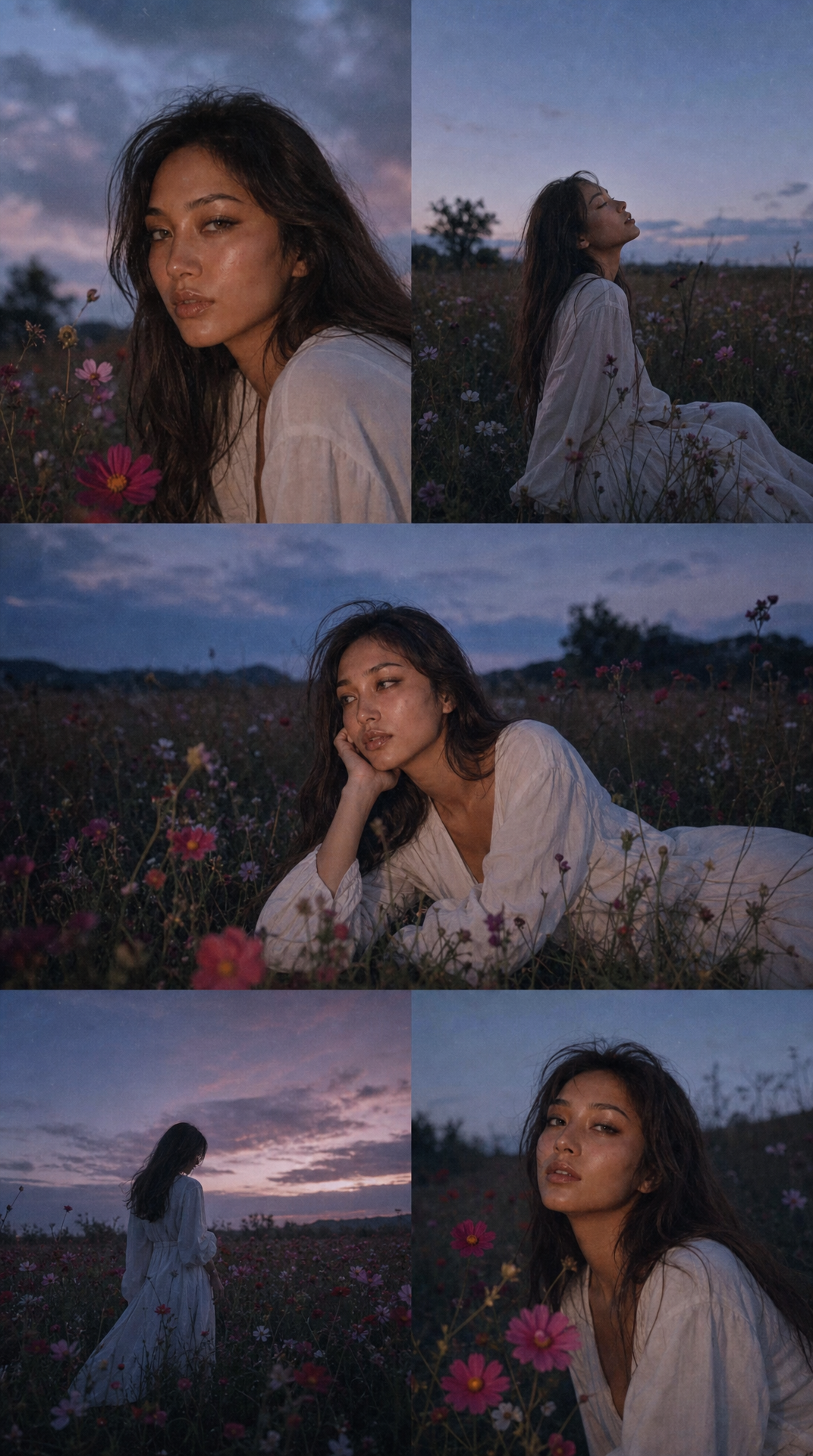
Solitary Woman in Twilight Wildflower Meadow
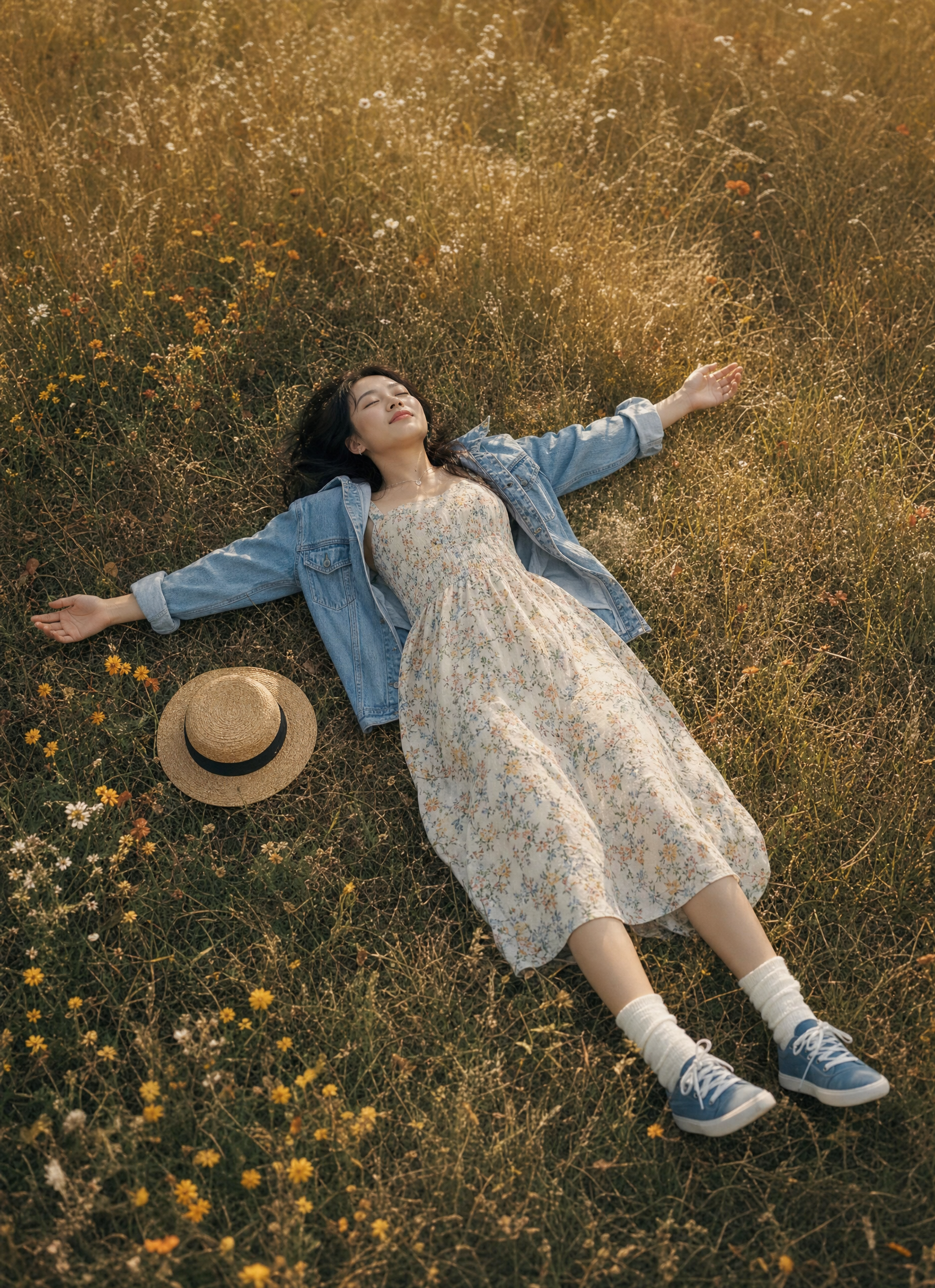
Woman Relaxing in Golden Autumn Field
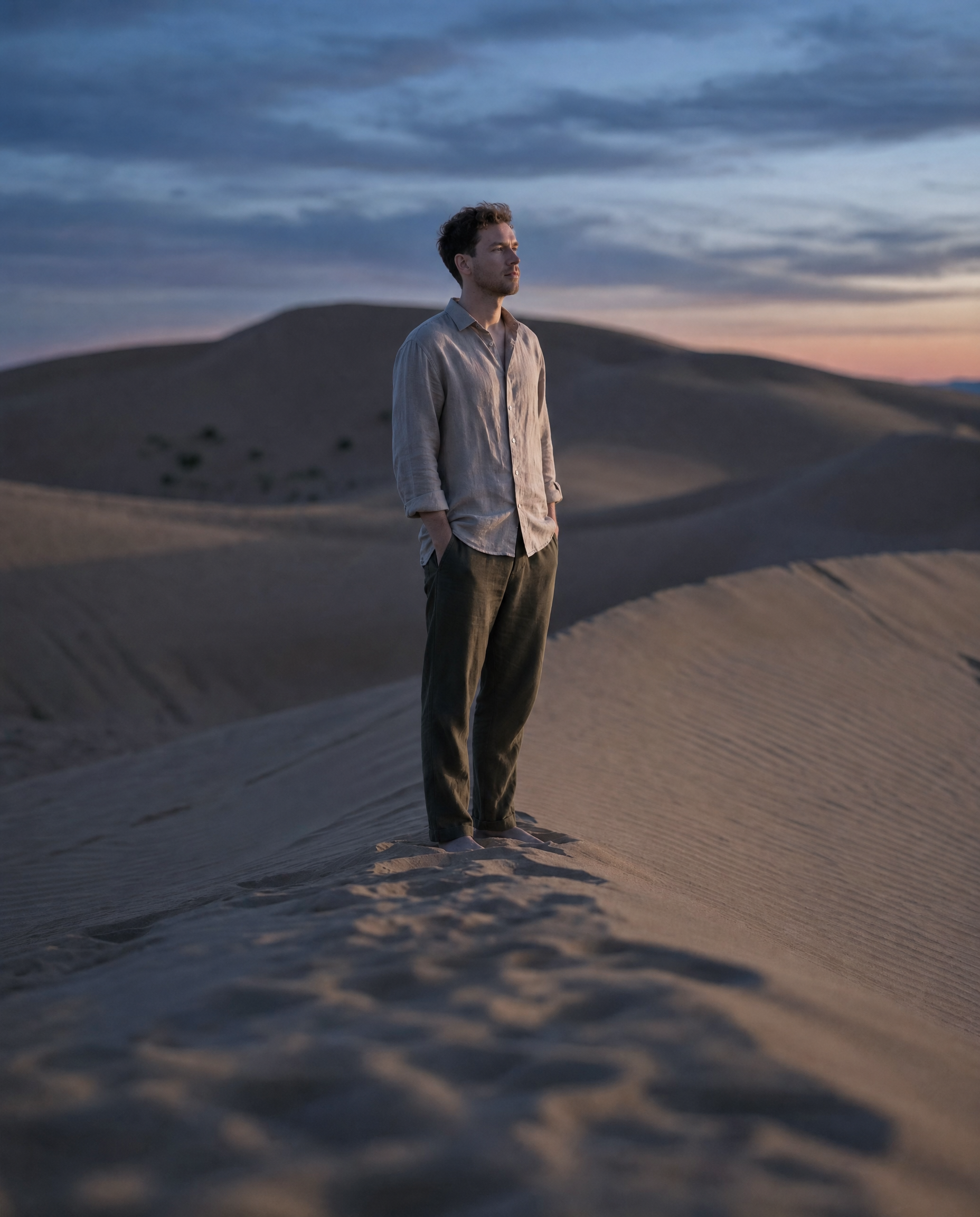
Man on sand dune in blue hour

Golden-hour surf under dramatic clouds