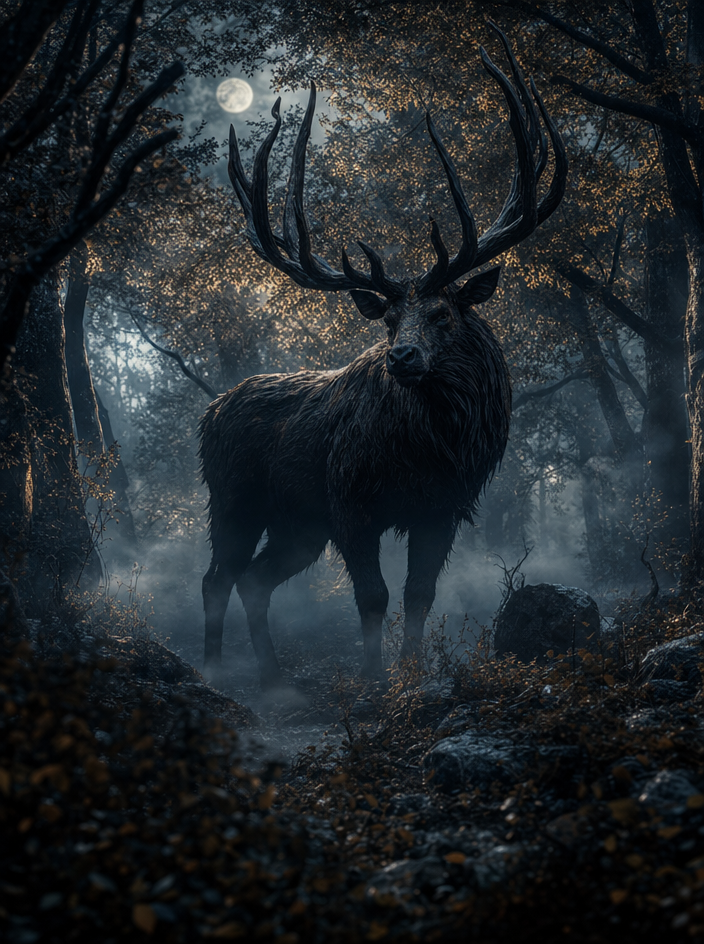
Why this works
The full-body portrait framing and “tall trees framing the scene” give the stag a centered, monumental presence, while “enormous branching antlers” supplies a strong vertical silhouette. “Dense white fog pooling low to the ground” separates the legs from the dark forest and adds the mystical mood, while “faint golden rim light from the side” against “cool moonlight filling the shadows” creates the specified dramatic contrast. The neutral, desaturated “teal-blue and charcoal browns” keeps the gray-and-brown image restrained, and “sharp focus on the stag” plus “ultra-detailed fur texture” makes the animal the visual anchor.
FAQ
→How do I make the stag feel more threatening and dominant?
Replace “majestic stag” with “intimidating, battle-scarred stag staring directly at the viewer,” and change “sharp focus on the stag” to “low-angle close wildlife framing with the stag towering over the camera.” Keep “enormous branching antlers,” or replace it with “massive irregular antlers filling the upper frame” for a more imposing silhouette.
→How do I shift this from moody twilight into a warmer, more enchanted scene?
Replace “dark forest at twilight” with “sunset-lit ancient forest,” and change “cool moonlight filling the shadows” to “soft amber sunlight filtering through the canopy.” Replace “neutral, desaturated palette with subtle teal-blue and charcoal browns” with “muted gold, moss green, and warm chestnut palette,” while retaining “dense white fog pooling low to the ground” for the mystical atmosphere.
→How do I create a varied series of images while keeping the same stag recognizable?
Keep “majestic stag with enormous branching antlers,” “ultra-detailed fur texture,” and “photorealistic cinematic wildlife photography” unchanged. Make each variation by replacing only the setting and lighting phrases, such as “dark forest at twilight” with “snow-covered pine forest at dawn,” “misty alpine meadow at sunrise,” or “rain-soaked woodland at night,” then swap the lighting to “pale sunrise rim light,” “diffuse overcast light,” or “sharp silver moonlight.”
Learn the technique behind this
- Why can't AI spell, and how do I get readable text in an image? — Older diffusion models had no character-level representation of text, so they produced letterform-shaped texture instead of words.
- How should a prompt be structured, and does word order matter? — A prompt that behaves predictably names one subject first, then what it is doing, then where, then the light, then the lens or medium, then the style.
- Do negative prompts work, and what should go in one? — Negative prompts work on models that support a separate negative conditioning channel — mainly Stable Diffusion and FLUX-family models.
Related prompts
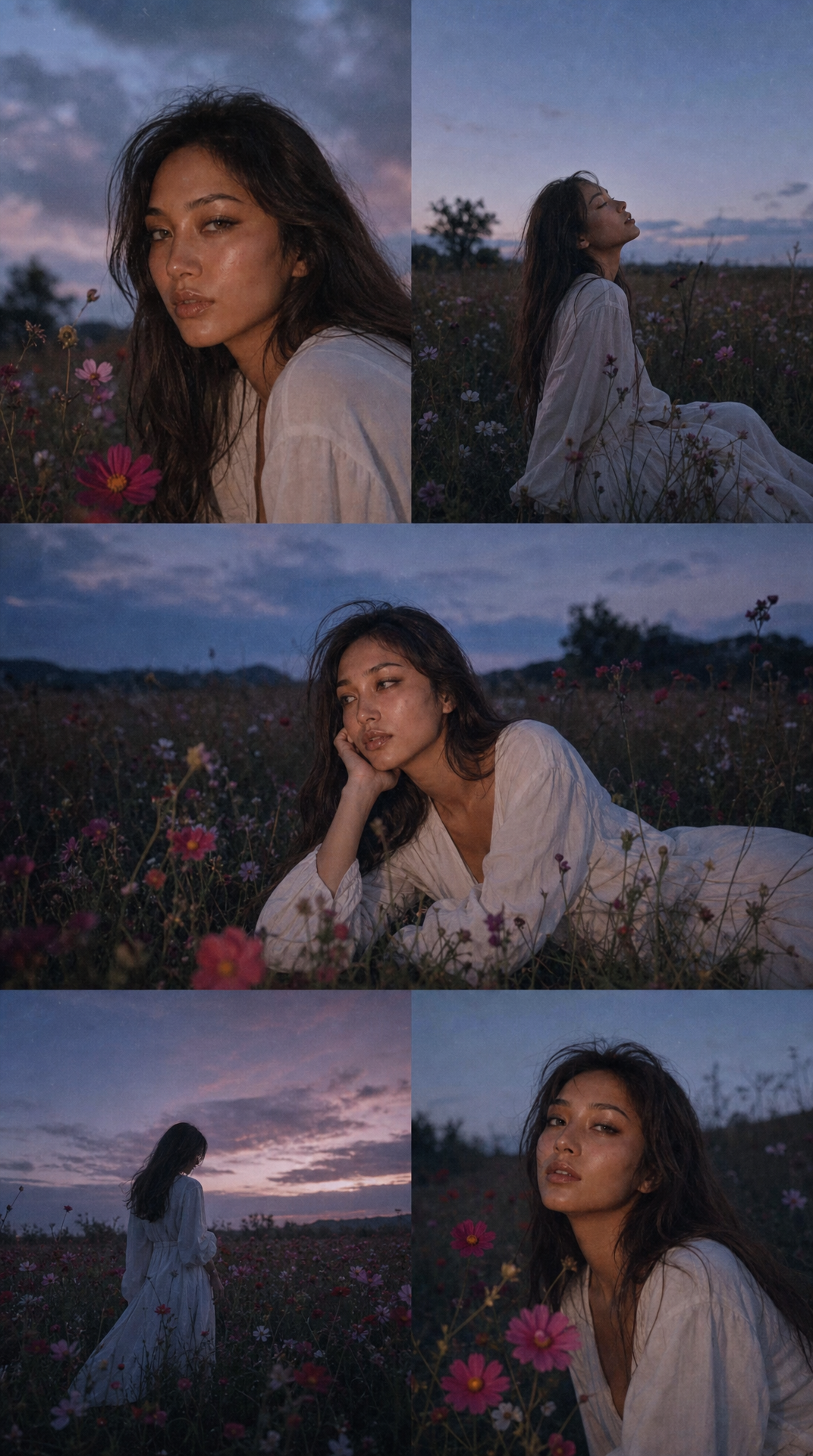
Solitary Woman in Twilight Wildflower Meadow

Golden-hour surf under dramatic clouds
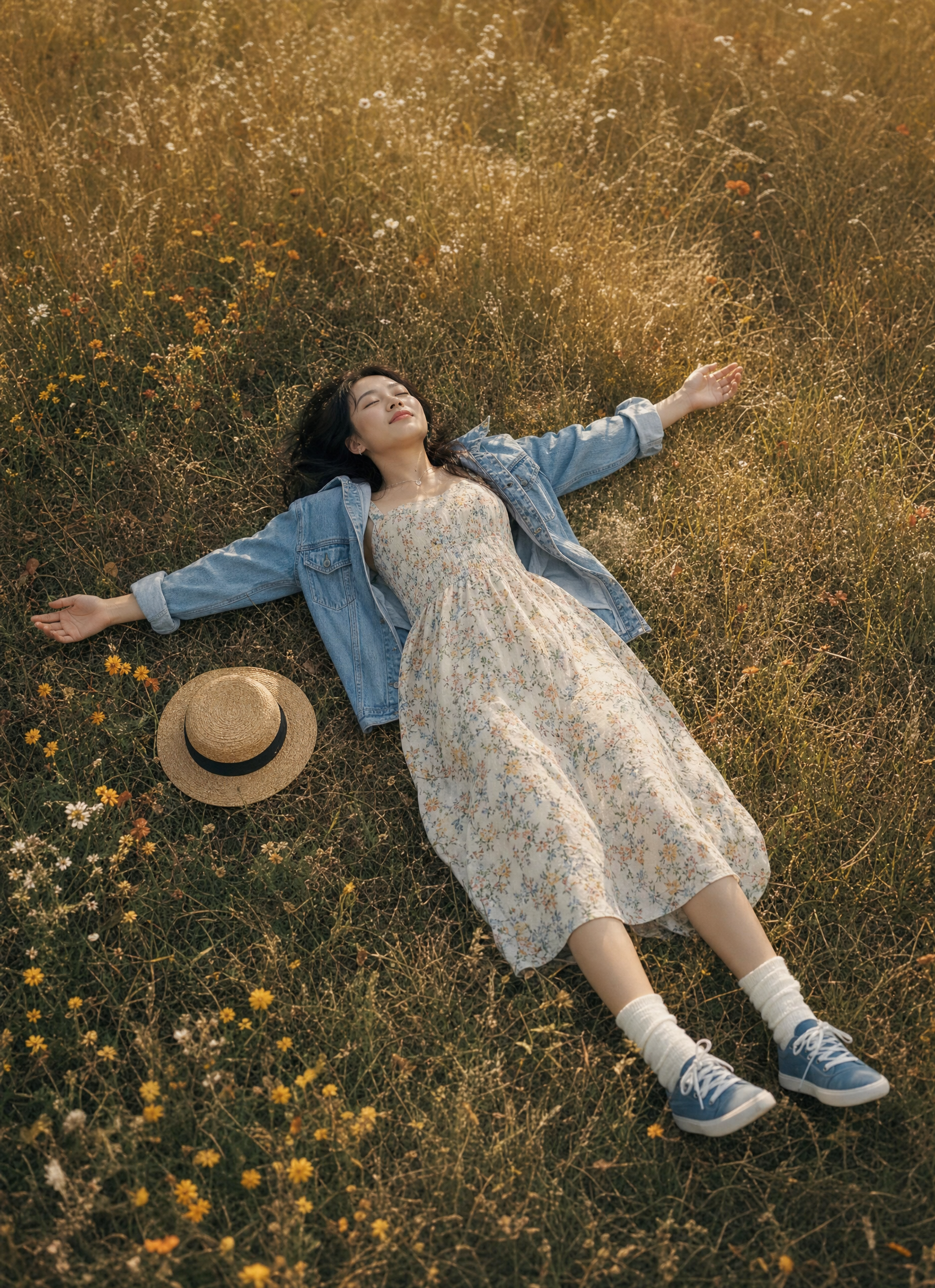
Woman Relaxing in Golden Autumn Field
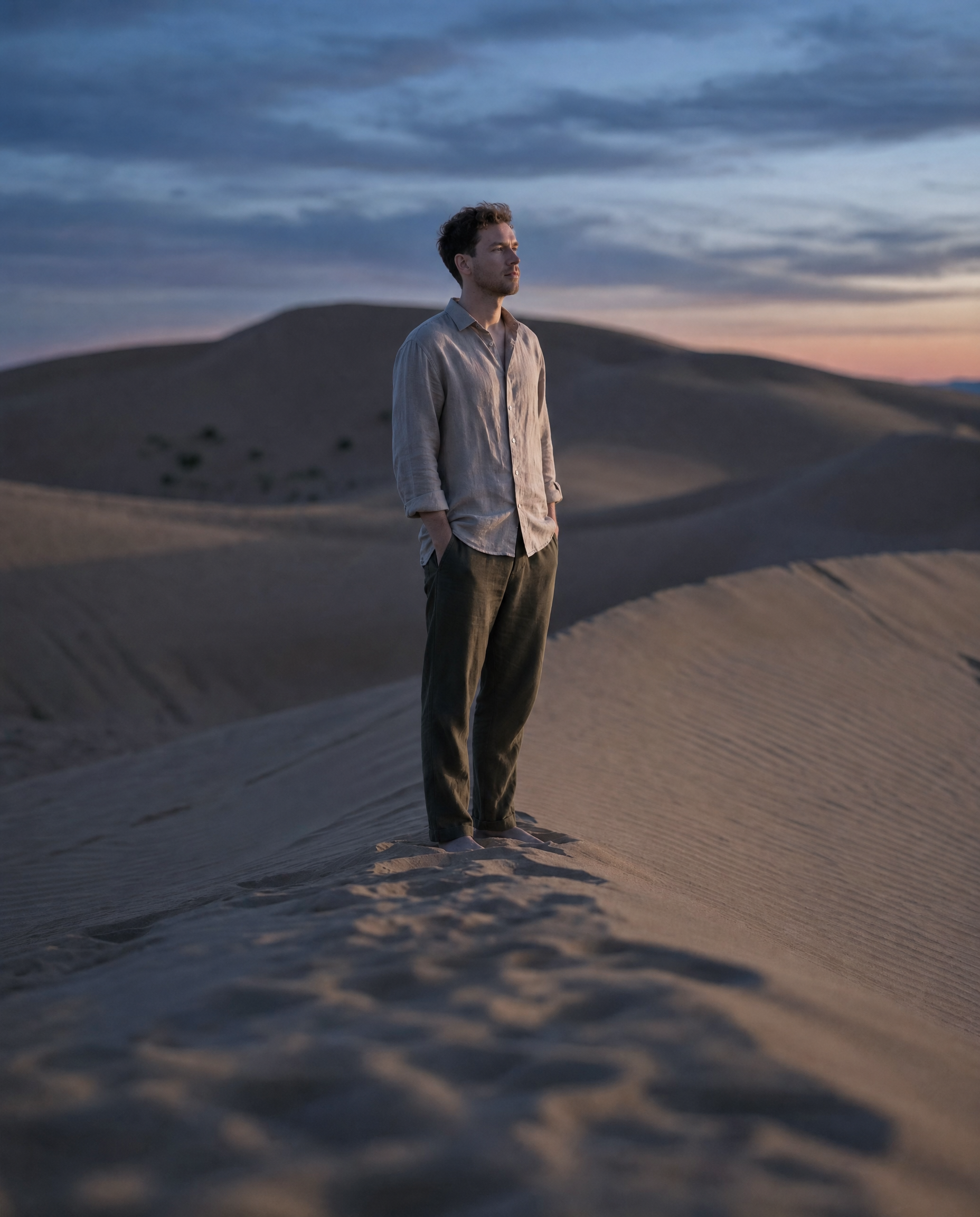
Man on sand dune in blue hour