Why this works
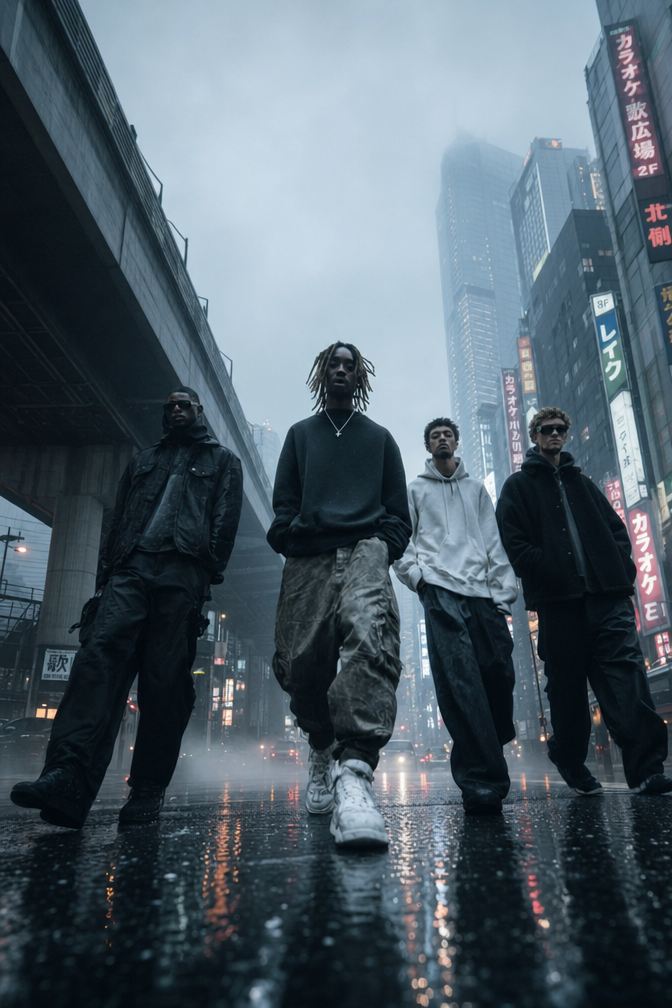
“Low-angle fashion editorial framing” gives the four-person group a confident, imposing presence, while “four young men walking together” supplies the candid-action rhythm. The mood comes from the concrete overpass, “gritty urban grunge atmosphere,” and “cinematic moody lighting with cool blue-gray tones,” reinforced by “fog/mist diffusion near the ground.” Black streetwear against the blue-gray palette creates a tight color harmony, while “passing traffic bokeh in the far background” adds depth without competing with the group.
FAQ
→How do I make one model more prominent than the other three?
Replace “high-detail photorealistic focus on the group” with “high-detail photorealistic focus on the man at front left, with the other three slightly behind and softer in focus.” Keep “low-angle fashion editorial framing,” but add “foreground hero subject” to give that model stronger visual priority.
→How do I shift this from moody grunge to a brighter, cleaner streetwear campaign?
Replace “gritty urban grunge atmosphere” and “cinematic moody lighting with cool blue-gray tones” with “clean contemporary fashion-campaign atmosphere and bright overcast daylight with neutral concrete tones.” Replace “fog/mist diffusion near the ground” with “crisp dry air and clear separation,” and change the dominant palette from black and blue to white, gray, and muted red.
→How do I build a series of variations while keeping the same group and editorial style?
Keep “four stylish young men wearing layered loose-fitting streetwear” and “low-angle fashion editorial composition” unchanged, then swap “under a concrete overpass in Tokyo” for settings such as “rainy Shibuya side street,” “rooftop parking deck at dusk,” or “narrow neon-lit alley in Osaka.” Preserve “passing traffic bokeh in the far background,” but vary it with “train lights,” “scooter headlights,” or “distant storefront signage” to create distinct background versions.
Learn the technique behind this
- Why can't AI spell, and how do I get readable text in an image? — Older diffusion models had no character-level representation of text, so they produced letterform-shaped texture instead of words.
- How should a prompt be structured, and does word order matter? — A prompt that behaves predictably names one subject first, then what it is doing, then where, then the light, then the lens or medium, then the style.
- Why does the model ignore parts of my prompt? — Ignored instructions are almost always conflicts, counts, or spatial relationships — three things current models handle badly — rather than the model failing to read you.
Related prompts
Grotesque Claymation Gangsters in Gritty Alley
Charcoal coat with tan-handled tote
Woman in Teal Jacket Capturing Twilight Reflection
Stuffed Bear on Winter Dumpster at Dawn