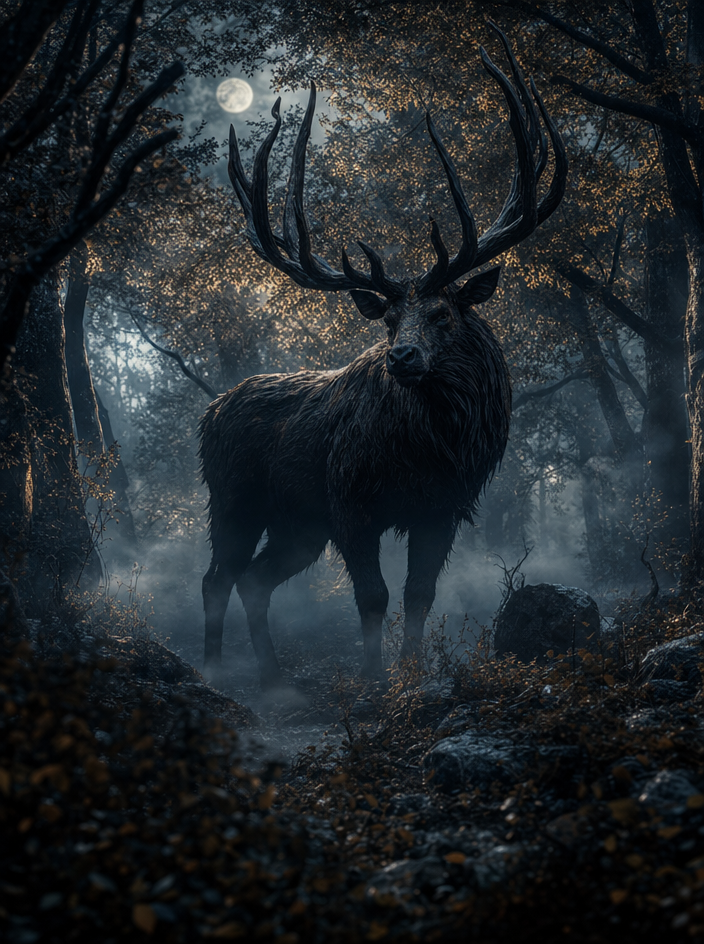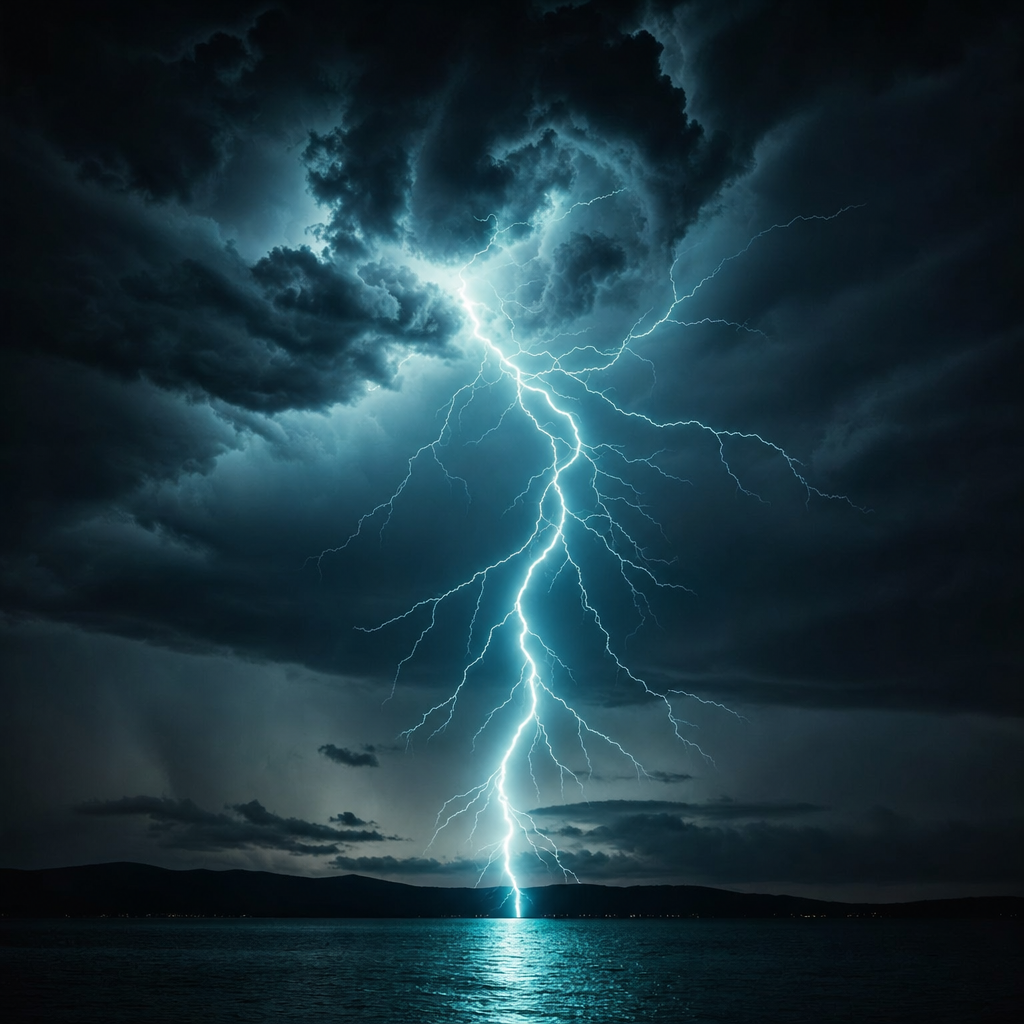
Same prompt, generated with each model separately — click one to see how it holds up.
Why this works
The centered composition is anchored by “a single intense teal-blue lightning bolt,” while the “wide cinematic framing” gives the strike and its reflection room to read against the low horizon. The ominous mood comes from “dark, swirling thunderstorm clouds,” “high-contrast, ominous illumination,” and the “mostly silhouetted” horizon, with “sharp, high-contrast reflections” creating a direct vertical echo across the calm water. “Volumetric cloud depth” supplies layered storm structure, while “photorealistic,” “crisp cinematic detail,” and “sharp detail” keep the dramatic scene grounded rather than painterly.
FAQ
→How do I make the lightning bolt feel larger and more dominant?
Replace “a single intense teal-blue lightning bolt” with “a massive branching teal-blue lightning bolt filling the upper center of the frame,” and change “wide cinematic framing” to “wide-angle composition with the bolt occupying most of the sky.” Keep “sharp, high-contrast reflections” to preserve its visual connection to the water.
→How do I shift this from ominous to awe-inspiring instead of threatening?
Replace “Ominous atmosphere” and “high-contrast, ominous illumination” with “awe-inspiring, majestic atmosphere” and “radiant atmospheric illumination.” Change “dark, swirling thunderstorm clouds” to “towering storm clouds edged with silver light” to introduce grandeur without removing the storm.
→How do I create a series of variations while keeping the same visual identity?
Keep “photorealistic cinematic night scene,” “wide cinematic framing,” “low and mostly silhouetted horizon,” and “sharp, high-contrast reflections” unchanged. Swap only “teal-blue” for controlled alternatives such as “electric violet,” “cold white,” or “amber-gold,” and replace “calm water” with “glasslike lake,” “wet tidal flats,” or “still coastal water” for distinct settings with the same centered structure.
Learn the technique behind this
- Why can't AI spell, and how do I get readable text in an image? — Older diffusion models had no character-level representation of text, so they produced letterform-shaped texture instead of words.
- How should a prompt be structured, and does word order matter? — A prompt that behaves predictably names one subject first, then what it is doing, then where, then the light, then the lens or medium, then the style.
- Do negative prompts work, and what should go in one? — Negative prompts work on models that support a separate negative conditioning channel — mainly Stable Diffusion and FLUX-family models.
Related prompts
Solitary Woman in Twilight Wildflower Meadow
Woman Relaxing in Golden Autumn Field
Man on sand dune in blue hour
Golden-hour surf under dramatic clouds