Why this works
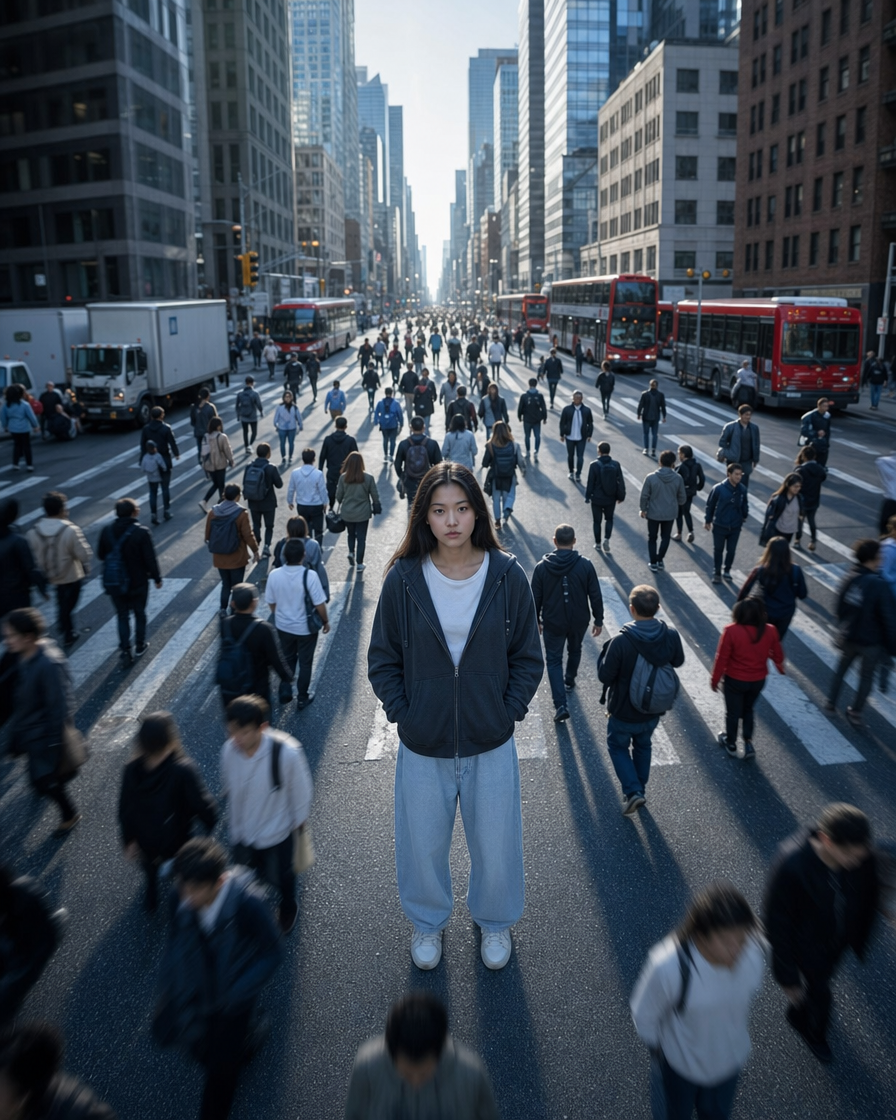
“High overhead vantage point looking straight down” turns the intersection into a graphic field, while “a young woman standing completely motionless in the center” gives the image a precise visual anchor. The contrast between “dynamic long-exposure motion blur effect” and “sharp focus on the subject” creates isolation through opposing motion states, not through lighting alone. “Cool morning sunlight casting long shadows” supplies the contemplative tone, and the white, black, and sky-blue palette reinforces the clean, cool metropolitan geometry of the pavement, shadows, and glass.
FAQ
→How do I make the woman feel more prominent and emotionally central?
Replace “a young woman standing completely motionless in the center” with “a solitary young woman occupying the central third of the frame, face and clothing clearly visible, standing motionless,” and change “high overhead vantage point looking straight down” to “steep aerial angle tilted toward the woman.” Keep “sharp focus on the subject,” but reduce the surrounding blur to “softened peripheral motion blur” so her expression and posture carry more visual weight.
→How do I shift the scene from contemplative morning isolation to a tense nighttime mood?
Replace “cool morning sunlight casting long shadows” with “harsh sodium streetlights and intermittent neon reflections casting fragmented shadows,” and change “vibrant metropolitan energy” to “restless nocturnal tension.” Swap “sky-blue” visual cues for “deep navy, black, and electric red,” while keeping “dynamic long-exposure motion blur effect” to preserve the rushing traffic and pedestrian movement.
→How do I build a consistent series of variations from this prompt?
Keep the fixed structure “young woman standing completely motionless,” “sharp focus on the subject,” and “high overhead vantage point looking straight down,” then replace the setting phrase “sprawling urban crosswalk intersection” with locations such as “rain-soaked Tokyo scramble crossing,” “sunlit Barcelona plaza,” or “snow-covered New York avenue.” Match each version with a controlled lighting replacement, such as “cool morning sunlight,” “warm late-afternoon sunlight,” or “blue hour street lighting,” while retaining “dynamic long-exposure motion blur” so the series shares the same visual signature.
Learn the technique behind this
- Why can't AI spell, and how do I get readable text in an image? — Older diffusion models had no character-level representation of text, so they produced letterform-shaped texture instead of words.
- Why does AI get hands and faces wrong, and how do I fix it? — Hands fail because they're small in frame, extremely variable in pose, and self-occluding — the model has less usable signal per pixel than for any other body part.
- How do I keep the same character across multiple images? — Text prompts alone won't hold a face across images — a description defines a type, not a person.
Related prompts
Grotesque Claymation Gangsters in Gritty Alley
Charcoal coat with tan-handled tote
Woman in Teal Jacket Capturing Twilight Reflection

Stuffed Bear on Winter Dumpster at Dawn