Why this works
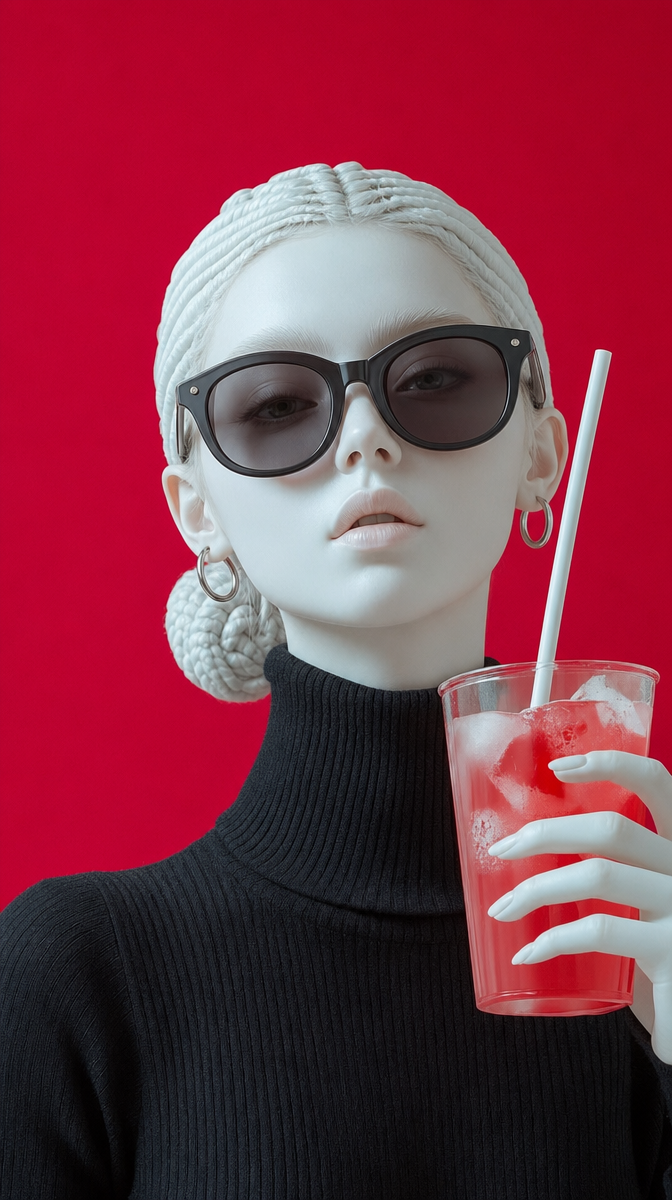
The tight, centered fashion-editorial framing makes the statue-like woman, clear glass, and white straw read as one graphic portrait rather than a loose scene. “Vivid magenta-red studio background” supplies the saturated field behind the mostly black-and-white styling, while “high-contrast studio lighting” and “crisp, clean details” define the sharp, polished surreal mood; the matte black sunglasses and fitted black turtleneck create the dominant dark structure, with the pink drink adding a controlled accent.
FAQ
→How do I make the pink iced drink more central and prominent?
Replace “holding a pink iced drink in a clear glass with a white straw” with “holding a large pink iced drink in a clear glass, glass centered beside her face, condensation and ice sharply visible, white straw angled toward the upper corner.” Keep “tight, centered fashion editorial framing” so the enlarged drink remains part of the portrait rather than becoming a separate still life.
→How do I change the bold surreal mood into a softer, more elegant portrait?
Replace “vivid magenta-red studio background” with “soft blush-pink studio background,” change “high-contrast studio lighting” to “diffused beauty lighting with gentle facial shadows,” and replace “bold chic surreal mood” with “quiet refined editorial mood.” Retain the “fitted black turtleneck” and “silver hoop earrings” to preserve the clean fashion contrast.
→How do I create a series of variations without losing this visual identity?
Keep the fixed phrases “stylized photorealistic fashion editorial,” “tight, centered fashion editorial framing,” “minimalist composition,” and “crisp, clean details,” then swap only the subject prop and background. For example, replace “pink iced drink in a clear glass with a white straw” with “透明 perfume bottle with a silver cap” and “vivid magenta-red studio background” with “electric cobalt-blue studio background,” while retaining the “matte black oversized translucent sunglasses,” “silver hoop earrings,” and “fitted black turtleneck.”
Learn the technique behind this
- Why can't AI spell, and how do I get readable text in an image? — Older diffusion models had no character-level representation of text, so they produced letterform-shaped texture instead of words.
- How should a prompt be structured, and does word order matter? — A prompt that behaves predictably names one subject first, then what it is doing, then where, then the light, then the lens or medium, then the style.
- Which aspect ratio should I use, and how does it change the image? — Aspect ratio determines what the model composes, not how it's cropped afterwards.
Related prompts
Cobalt Boots in Sleek Studio Edit
Teal fashion editorial in monster-filled lift
Sunlit editorial on striped beach towel
Silhouette Influencer by Sunlit Window