Why this works
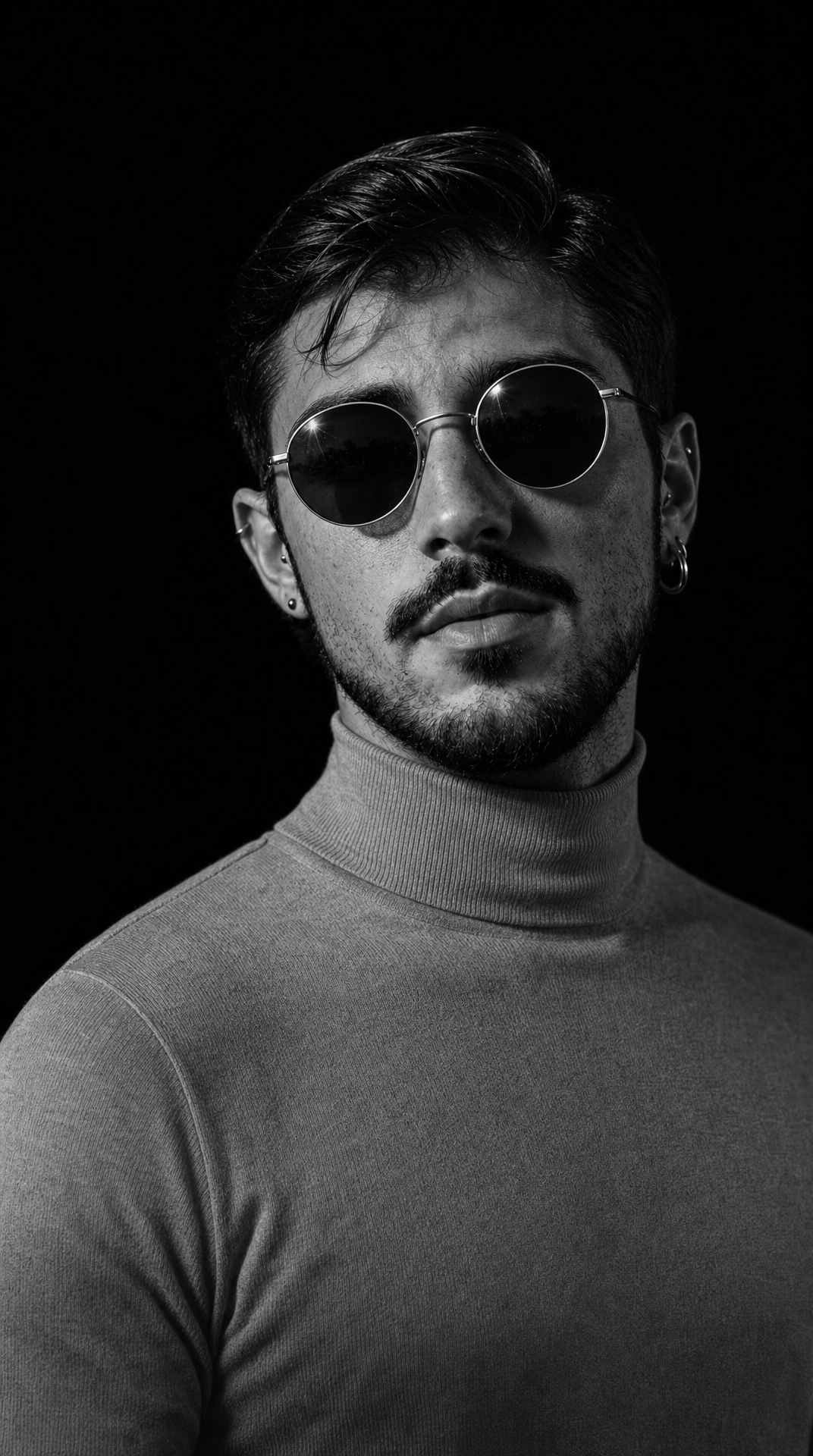
The “chest-up framing against a pure black background” makes the portrait-closeup feel concentrated, while “dramatic directional lighting from one side to carve strong shadows” gives the face a sculpted, dramatic structure. “Black-and-white” and “high contrast” reduce the palette to the dominant gray range, letting the “soft city light reflections” in the round sunglasses become the main visual accent. “Sharp focus” and “realistic skin texture” keep attention on the eyes, stubble, earrings, and the slight wave in the hair rather than on the studio setting.
FAQ
→How do I make the portrait feel softer and less severe?
Replace “dramatic directional lighting from one side to carve strong shadows” and “high contrast” with “large diffused frontal light, gentle fill light, soft shadows, and low-contrast monochrome.” Keep “pure black background” if you want the subject isolated, or change it to “deep charcoal studio background” for a less stark result.
→How do I make the sunglasses and reflections more prominent?
Change “chest-up framing” to “tight face close-up with the sunglasses occupying the central foreground,” and replace “soft city light reflections in the lenses” with “bright, sharply defined geometric city-light reflections filling both lenses.” Add “slightly lowered camera angle” to give the glasses more visual dominance.
→How do I turn this into a consistent series with different subjects?
Keep the fixed structure “black-and-white dark editorial studio fashion photo,” “pure black background,” “dramatic directional side lighting,” “high contrast,” and “sharp focus,” then replace the subject description beginning “young man wearing round silver-tone sunglasses” with a controlled variant such as “young woman wearing angular black sunglasses,” “older man with a neatly trimmed beard,” or “androgynous model with cropped platinum hair.” Preserve “chest-up framing” and the same lighting phrase so the series retains its portrait-closeup composition.
Learn the technique behind this
- Why can't AI spell, and how do I get readable text in an image? — Older diffusion models had no character-level representation of text, so they produced letterform-shaped texture instead of words.
- How should a prompt be structured, and does word order matter? — A prompt that behaves predictably names one subject first, then what it is doing, then where, then the light, then the lens or medium, then the style.
- Which aspect ratio should I use, and how does it change the image? — Aspect ratio determines what the model composes, not how it's cropped afterwards.
Related prompts
Teal fashion editorial in monster-filled lift
Cobalt Boots in Sleek Studio Edit
Silhouette Influencer by Sunlit Window
Sunlit editorial on striped beach towel