Why this works
The phrase “wide-angle fisheye photograph with exaggerated curved lens distortion” bends the meadow around the centered tree and outstretched limbs, making the image feel expansive and slightly surreal. “Early-evening warm glow with longer, softer shadows” supplies the serene late-day mood, while “fresh golden-green tones,” “bright sky with scattered white clouds,” and “vivid natural greens with warm highlights” create the gold, blue, and green color structure visible against the darker shadow areas. “A broad-canopied tree is centered in the background” gives the composition a strong visual anchor behind the relaxed, horizontal figure.
FAQ
→How do I make the person more prominent than the centered tree?
Replace “A broad-canopied tree is centered in the background” with “the person dominates the foreground, filling most of the frame, with the tree small and distant near the horizon,” and change “emphasizes the center tree and the person’s outstretched limbs” to “emphasizes the person’s face, torso, and outstretched limbs.”
→How do I shift this from serene early evening to a moodier, storm-lit scene?
Replace “early-evening warm glow with longer, softer shadows” with “cold storm light with hard directional shadows,” and replace “bright with scattered white clouds” with “deep slate clouds with a narrow break of blue sky.” Change “airy slightly surreal mood” to “tense, cinematic surreal mood” while keeping the fisheye distortion for the warped perspective.
→How do I build a series of variations without losing the composition?
Keep “wide-angle fisheye photograph,” “person lying on their back,” and “arms outstretched” fixed, then swap “lush green meadow” and “broad-canopied tree” for matched settings such as “misty alpine clearing with a lone pine,” “sun-bleached coastal dune with a crooked cypress,” or “autumn field with a red maple.” For controlled color variation, replace “fresh golden-green tones” and “vivid natural greens with warm highlights” with a defined palette such as “cool blue-gray foliage with silver highlights” or “rust, amber, and deep umber foliage.”
Learn the technique behind this
- Why can't AI spell, and how do I get readable text in an image? — Older diffusion models had no character-level representation of text, so they produced letterform-shaped texture instead of words.
- How should a prompt be structured, and does word order matter? — A prompt that behaves predictably names one subject first, then what it is doing, then where, then the light, then the lens or medium, then the style.
- Why does the model ignore parts of my prompt? — Ignored instructions are almost always conflicts, counts, or spatial relationships — three things current models handle badly — rather than the model failing to read you.
Related prompts
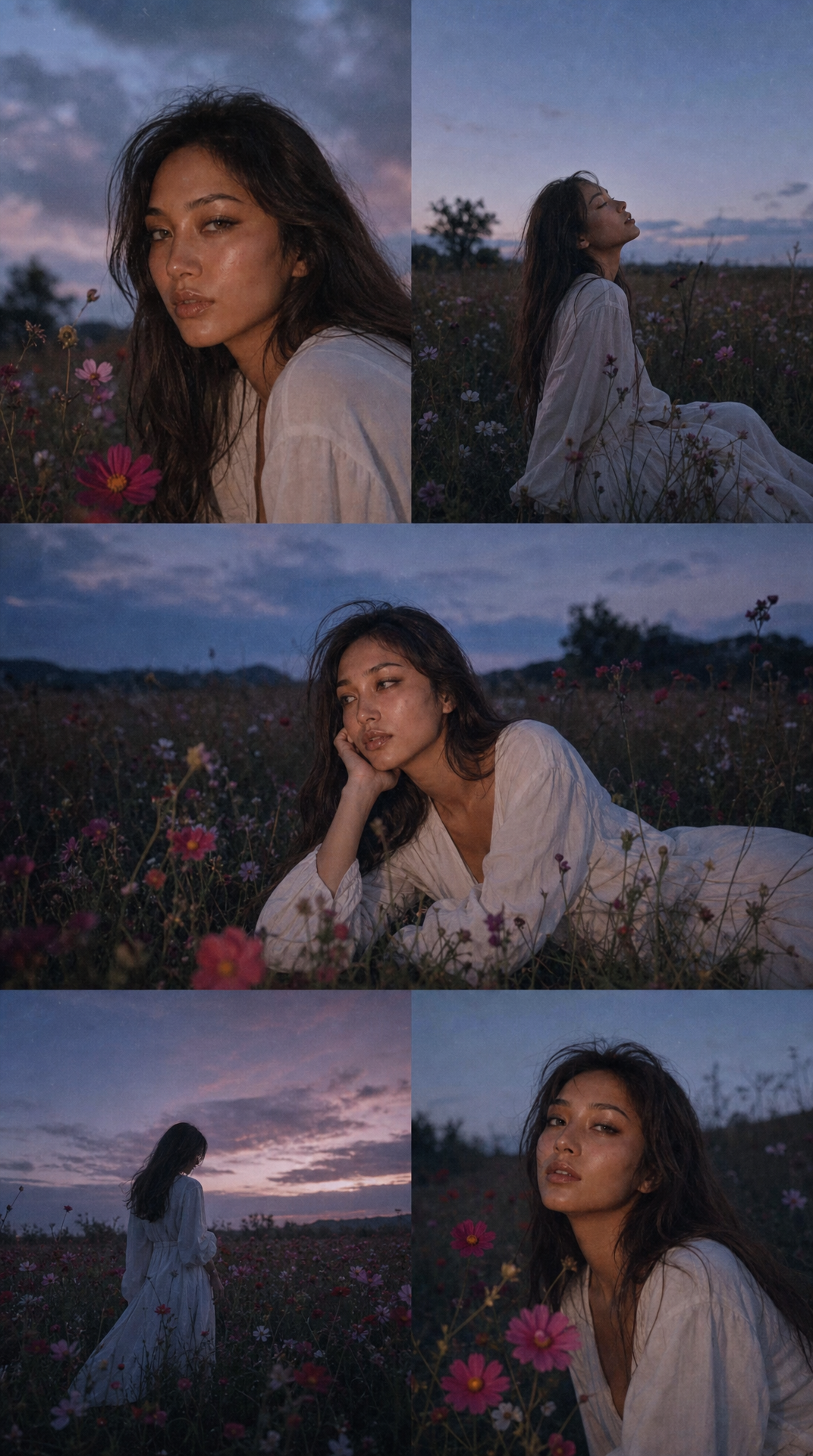
Solitary Woman in Twilight Wildflower Meadow
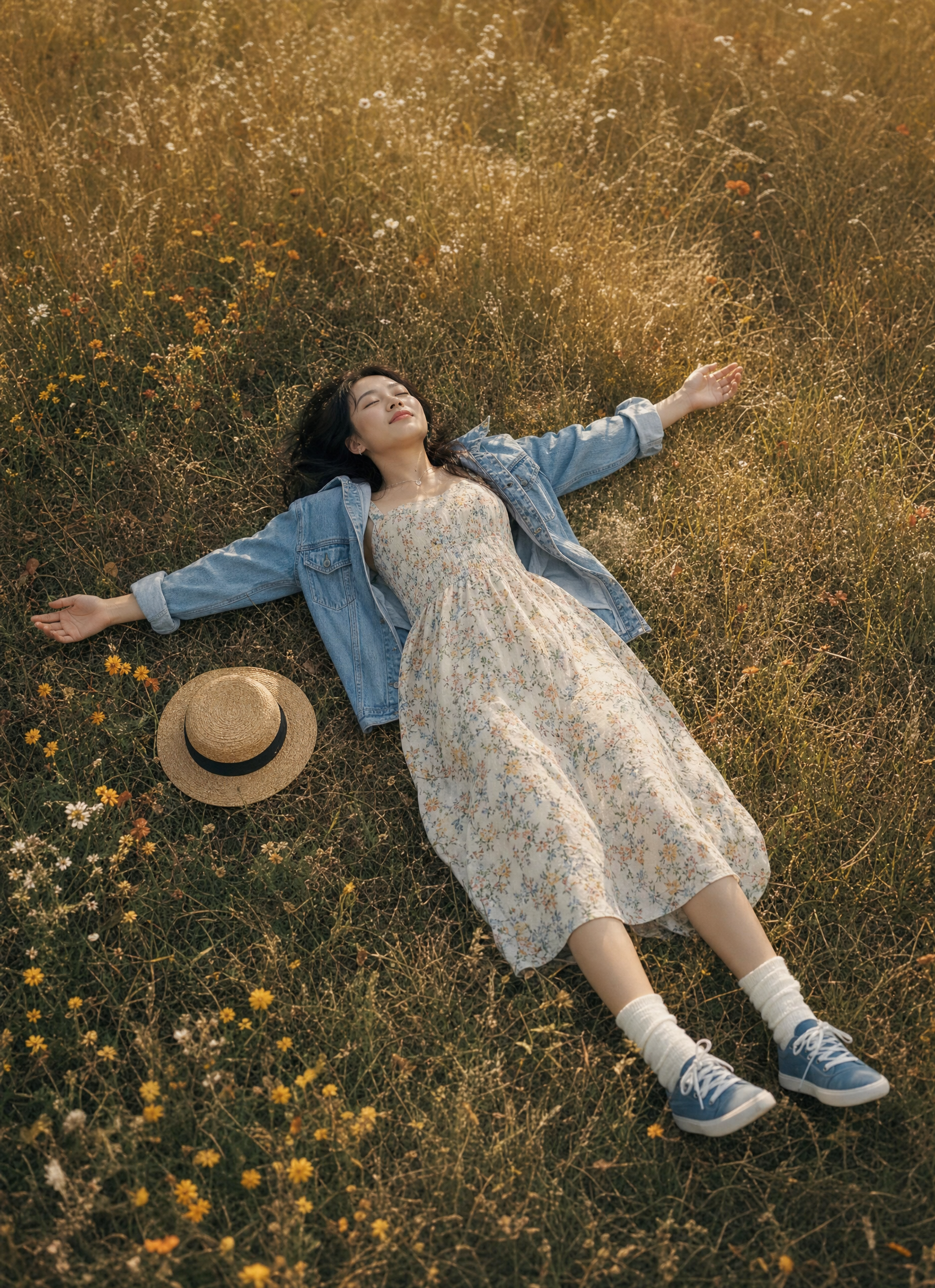
Woman Relaxing in Golden Autumn Field

Man on sand dune in blue hour

Golden-hour surf under dramatic clouds