Why this works
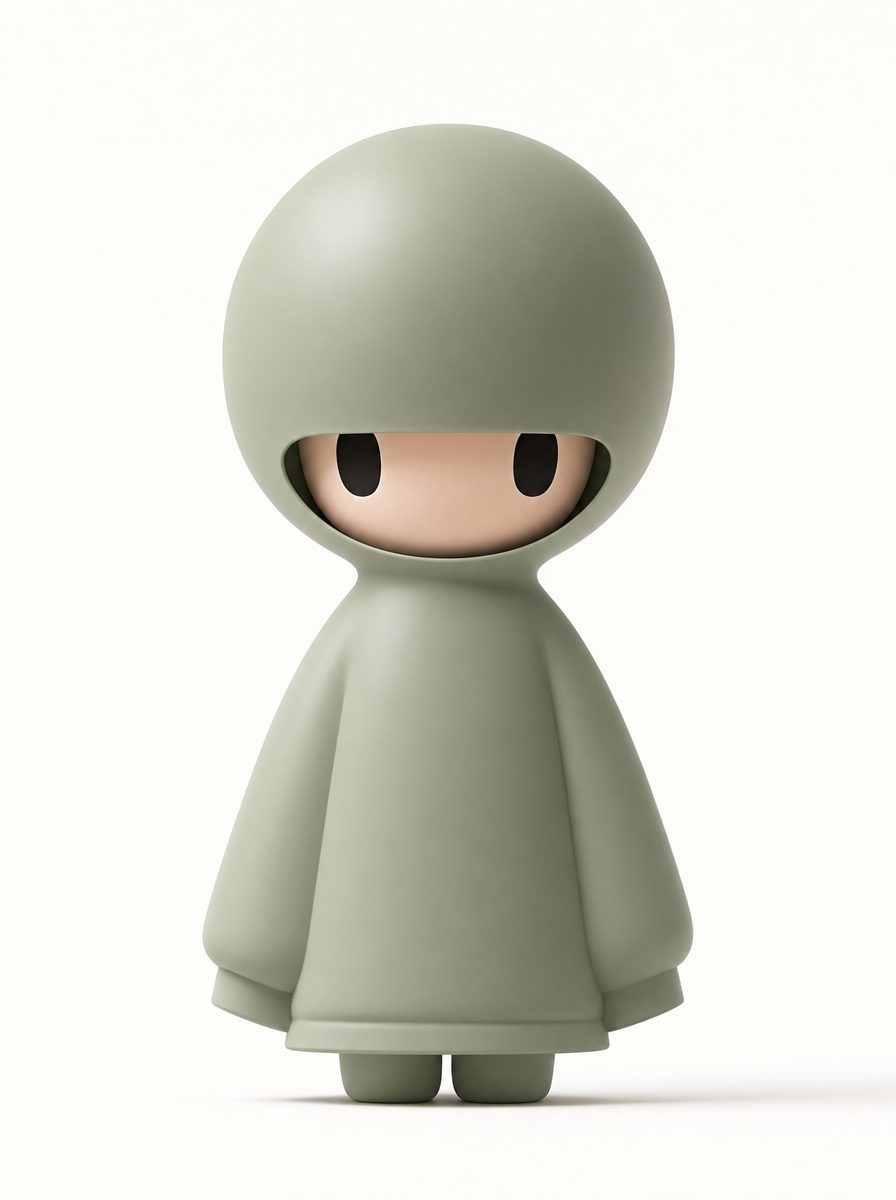
The centered full-body product-framing view and “standing centered in a full-body upright pose” give the figure a stable, icon-like composition with generous off-white space around it. “Oversized rounded hood,” “simple black oval eyes,” and “toy-like proportions” carry the whimsical character design, while “matte body is light sage green” adds a muted color accent that reads softly against the clean background, even though the generated image is dominated by gray. “Gentle diffused lighting” and a “subtle soft shadow beneath” keep the mood calm, and “smooth soft surfaces” plus “gentle specular highlights” provide the controlled finish of a modern product render.
FAQ
→How do I make the character feel warmer and more cheerful?
Replace “matte body is light sage green” with “matte body is warm butter yellow or soft coral,” and change “clean off-white studio background” to “pale peach studio background.” Keep “gentle diffused lighting,” but add “soft warm color temperature” to shift the image without losing its clean product-render structure.
→How do I make the hooded figure more visually prominent?
Replace “Centered full-body product-framing view” with “medium full-body product-framing view with the character filling most of the vertical frame,” and replace “standing centered” with “standing slightly forward with the oversized hood dominant in the composition.” Add “stronger separation between the figure and background” to make the silhouette read more clearly.
→How do I build a consistent series of variations from this character?
Keep the fixed phrases “simple black oval eyes,” “toy-like proportions,” “centered full-body product-framing view,” and “modern product-render look,” then swap only the body color and setting. For example, replace “light sage green” with “muted lavender,” “soft terracotta,” or “powder blue,” and replace “clean off-white studio background” with “pale blue,” “warm beige,” or “soft gray studio background” for controlled series variations.
Learn the technique behind this
- Why can't AI spell, and how do I get readable text in an image? — Older diffusion models had no character-level representation of text, so they produced letterform-shaped texture instead of words.
- How do I keep the same character across multiple images? — Text prompts alone won't hold a face across images — a description defines a type, not a person.
- How should a prompt be structured, and does word order matter? — A prompt that behaves predictably names one subject first, then what it is doing, then where, then the light, then the lens or medium, then the style.
Related prompts
Surprised Man Holding Mini Cartoon Self
Charcoal-blazer woman with art monsters
Laid-back 3D Caricature Portrait with Streetwear Style
Auburn-haired woman in geometric blouse and sage blazer