Why this works
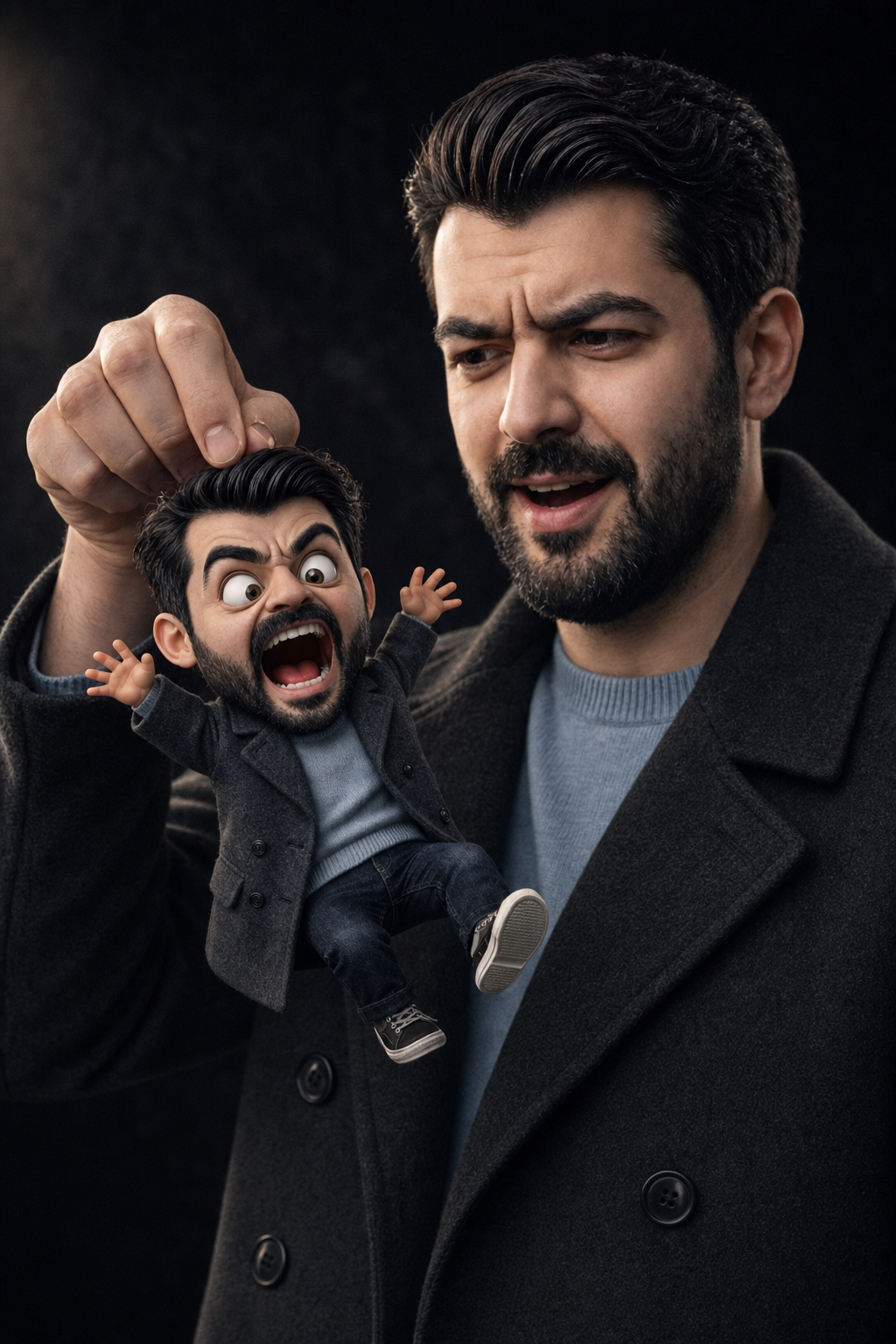
The comic premise is carried by “a tiny stylized 3D cartoon version of himself,” especially the “oversized cartoon head,” “exaggerated funny facial expression,” and “flailing arms and legs,” while “surprised, amused expression” gives the real man a readable reaction. “Cinematic portrait framing” and “portrait-closeup” keep the gray charcoal peacoat and blue sweater dominant, with the “dark studio background” isolating the figures. “Dramatic cinematic lighting” and “shallow depth of field” add a polished, focused look, while “fine pores and subtle imperfections” keeps the man photorealistic against the miniature’s “smooth high-quality stylized 3D” finish.
FAQ
→How do I make the tiny cartoon version more prominent?
Replace “tiny stylized 3D cartoon version” with “larger stylized 3D cartoon figure occupying the foreground beside his face,” and replace “shallow depth of field” with “both the man and miniature sharply in focus.” Keep “oversized cartoon head” and “flailing arms and legs” to preserve the visual joke.
→How do I shift this from humorous to eerie?
Replace “exaggerated funny facial expression” with “uncanny frozen expression with an unsettling smile,” and change “surprised, amused expression” to “quietly alarmed expression.” Replace “dramatic cinematic lighting” with “cold directional underlighting with deep shadows” while keeping the “dark studio background.”
→How do I create a series of variations from this prompt?
Keep the identity and rendering instructions unchanged, including “preserving the exact same face” and “ultra-realistic cinematic portrait,” then swap the miniature action phrase. For example, replace “gently holds ... by the back of the head” with “balances ... on his palm,” “places ... on his shoulder,” or “watches ... climb his sleeve,” while changing “flailing arms and legs” to an action-specific pose for each image.
Learn the technique behind this
- Why does AI get hands and faces wrong, and how do I fix it? — Hands fail because they're small in frame, extremely variable in pose, and self-occluding — the model has less usable signal per pixel than for any other body part.
- Why can't AI spell, and how do I get readable text in an image? — Older diffusion models had no character-level representation of text, so they produced letterform-shaped texture instead of words.
- How do I keep the same character across multiple images? — Text prompts alone won't hold a face across images — a description defines a type, not a person.
Related prompts
Charcoal-blazer woman with art monsters
Laid-back 3D Caricature Portrait with Streetwear Style
Muscular Figure With Icy Thorn Crown
Cozy woman with golden puppy companion