Why this works
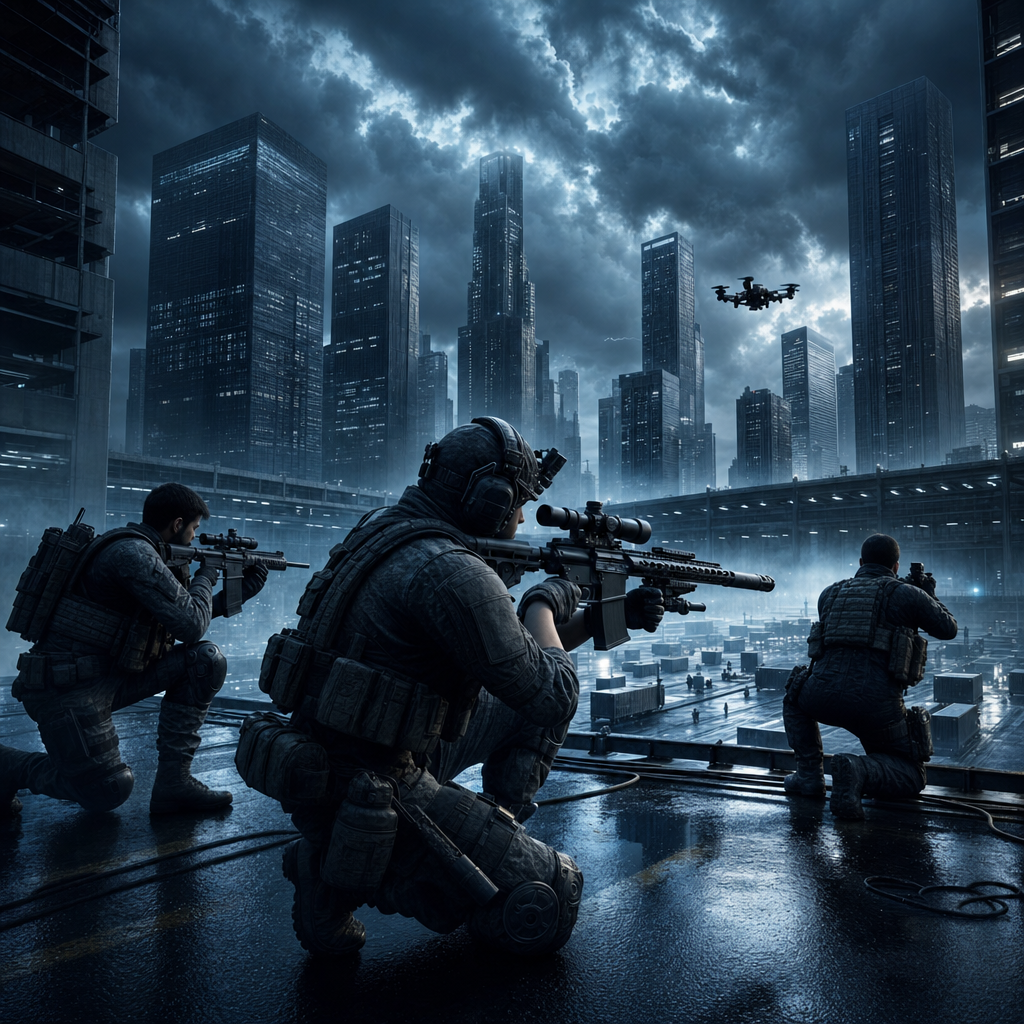
The wide-shot is anchored by “wide-angle composition” and the team’s crouched silhouette, letting the rain-soaked rooftop lead toward the futuristic skyline and distant surveillance drone. “Storm clouds loom overhead,” “moody high-contrast lighting,” and the “cool bluish color palette” establish the tense, ominous mood, while “crisp reflections shimmering on the slick roof” supplies the strongest blue-black visual rhythm. “Ultra-detailed gear and wet textures” keeps the broad composition from losing tactile focus on the armed team.
FAQ
→How do I make one soldier the clear visual focal point?
Replace “a small armed team crouched” with “one central soldier crouched in the foreground, sharply isolated from the team,” and add “shallow depth of field with the central soldier in razor focus.” Keep “wide-angle composition” for the city scale, but change “ultra-detailed action framing” to “foreground portrait-action framing.”
→How do I shift this from ominous blue tension to a warmer emergency atmosphere?
Replace “a cool bluish color palette” and “cool bluish tone” with “a desaturated amber-and-red emergency palette,” then change “moody high-contrast lighting” to “harsh red warning lights cutting through rain and smoke.” Retain “storm clouds” and “slick roof” so the wet reflections pick up the new warning colors.
→How do I create a series of variations while preserving the same visual identity?
Keep the fixed phrases “photorealistic cinematic action scene,” “cool bluish color palette,” “moody high-contrast lighting,” and “wide-angle composition,” then vary only the location and threat: replace “futuristic city skyline” with “flooded industrial district,” “desert megacity,” or “neon transit hub,” and replace “distant surveillance drone” with “searchlight helicopter,” “hovering patrol craft,” or “tower-mounted sensor.”
Learn the technique behind this
- Why can't AI spell, and how do I get readable text in an image? — Older diffusion models had no character-level representation of text, so they produced letterform-shaped texture instead of words.
- How should a prompt be structured, and does word order matter? — A prompt that behaves predictably names one subject first, then what it is doing, then where, then the light, then the lens or medium, then the style.
- How do I keep one consistent style across a whole set of images? — Style consistency is more achievable than character consistency because style lives in describable attributes.
Related prompts
Grotesque Claymation Gangsters in Gritty Alley
Charcoal coat with tan-handled tote
Woman in Teal Jacket Capturing Twilight Reflection
Stuffed Bear on Winter Dumpster at Dawn