Why this works
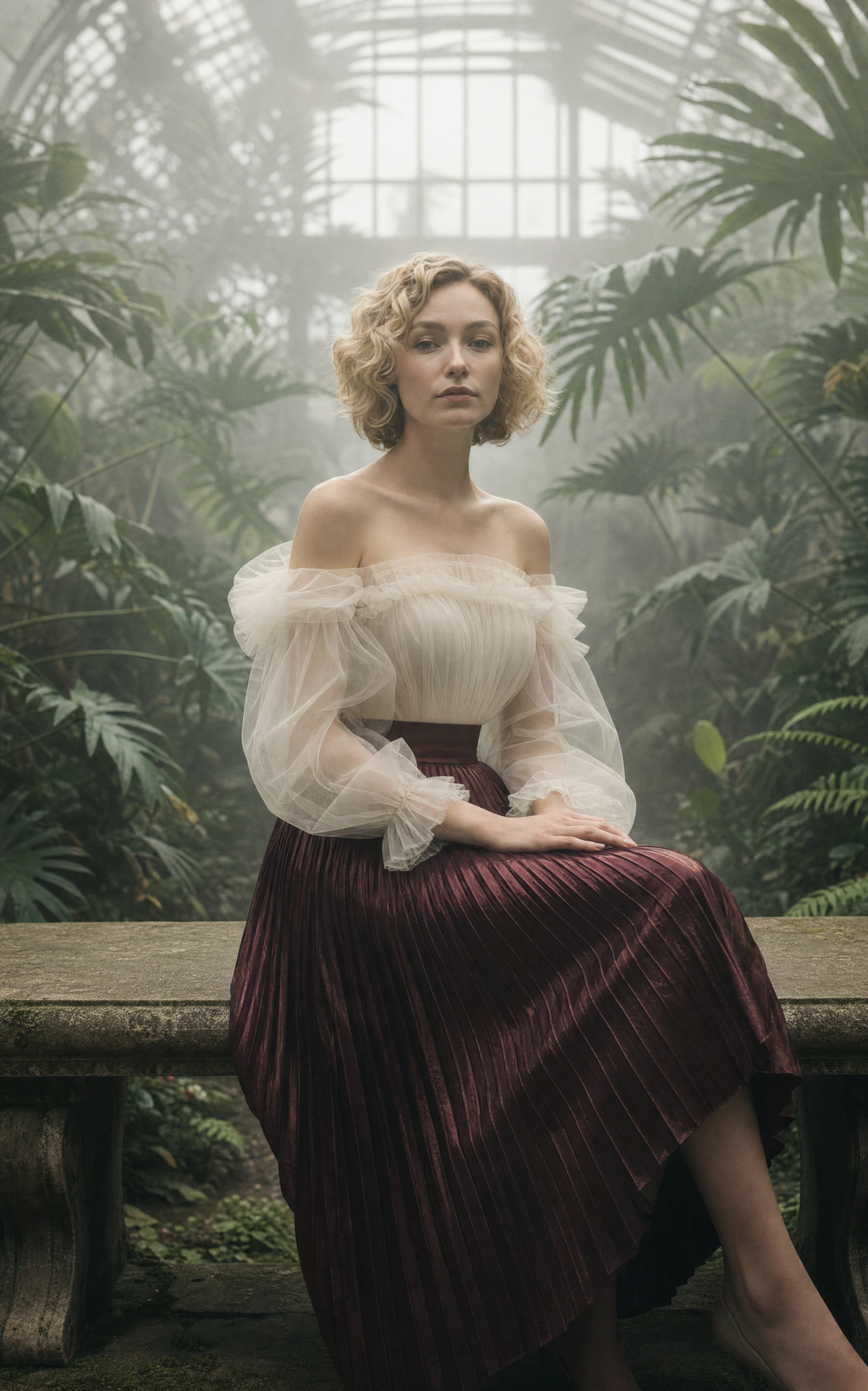
The romantic, misty mood comes from the specific combination of “drifting fog,” “soft diffused sunlight through glass,” and “hazy atmosphere,” while the “elegant neo-Victorian atmosphere” gives those effects a period-fashion tone. “Medium shot” keeps the seated figure and both garments readable, and “framed by dense tropical plants” creates a natural enclosure around her rather than leaving the conservatory as a distant backdrop. The palette language, “pale sage and warm ivory with muted umber accents,” softens the scene around the load-bearing “deep oxblood leather” skirt, whose “burnished sheen,” “weathered texture,” and “reflective highlights” provide the strongest visual contrast and material focus.
FAQ
→How do I make the oxblood skirt the central visual element?
Replace “medium shot” with “three-quarter fashion portrait, skirt occupying the lower half of the frame,” and change “pale sage and warm ivory palette with muted umber accents” to “pale sage and warm ivory background with deep oxblood as the dominant accent.” Add “focused highlights across the pleats and leather sheen” after “reflective highlights” to direct attention to the skirt.
→How do I make the portrait feel darker and more dramatic instead of softly romantic?
Replace “soft diffused sunlight through glass” and “hazy atmosphere” with “low directional side-light through rain-streaked glass, deep controlled shadows, and narrow highlights.” Change “pale sage and warm ivory palette” to “desaturated green-gray, charcoal, and oxblood,” and replace “gentle bokeh” with “larger, dimly glowing bokeh in the shadowed foreground.”
→How do I create a matching series with different garments or locations?
Keep the structural phrases “Editorial fashion portrait,” “medium shot,” “cinematic depth of field,” “hyperrealistic fabric detail,” and “elegant neo-Victorian atmosphere” unchanged. For each variation, replace the subject phrase “off-shoulder tulle blouse with structured ruffled sleeves and a pleated midi skirt in deep oxblood leather” with a new silhouette, then swap “misty Victorian conservatory” for settings such as “rain-darkened Edwardian library” or “overgrown winter orangery,” while assigning each version one anchor color in place of “deep oxblood.”
Learn the technique behind this
- Why can't AI spell, and how do I get readable text in an image? — Older diffusion models had no character-level representation of text, so they produced letterform-shaped texture instead of words.
- How should a prompt be structured, and does word order matter? — A prompt that behaves predictably names one subject first, then what it is doing, then where, then the light, then the lens or medium, then the style.
- Why does AI get hands and faces wrong, and how do I fix it? — Hands fail because they're small in frame, extremely variable in pose, and self-occluding — the model has less usable signal per pixel than for any other body part.
Related prompts

Teal fashion editorial in monster-filled lift
Cobalt Boots in Sleek Studio Edit
Silhouette Influencer by Sunlit Window
Sunlit editorial on striped beach towel