Why this works
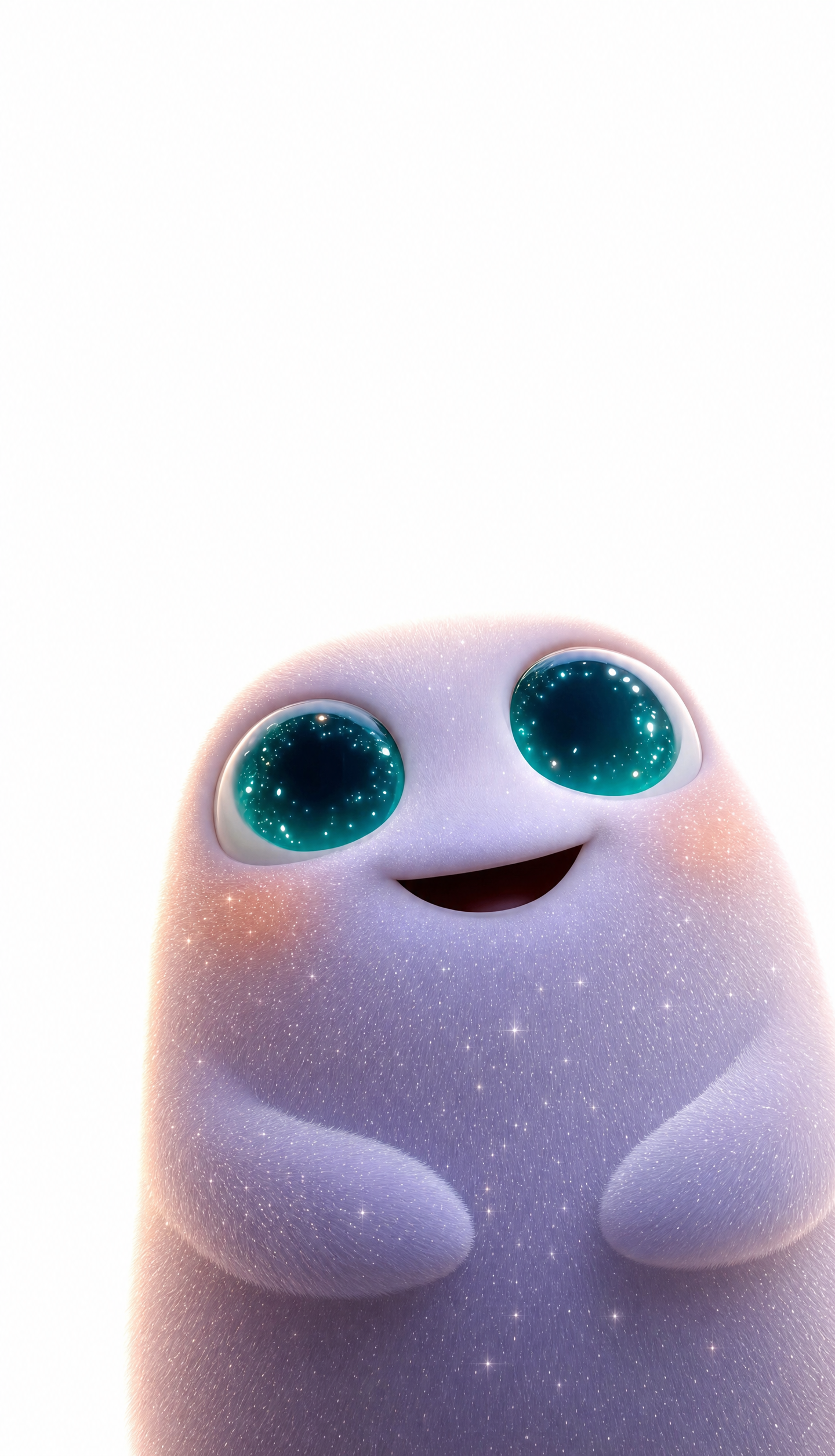
The full-body studio character framing keeps the rounded, chubby alien readable from its soft lavender fur through its tiny smiling mouth, while the pure white background gives the portrait composition clean separation. “Oversized glossy teal eyes” supplies the dominant focal point, and “soft pastel rim lighting (soft peach and pale violet)” reinforces the pink-purple-teal palette with a gentle dreamy mood. “Delicate, twinkling star-like particles embedded within the fur” adds texture and visual discovery without competing with the face, while “high-detail polished 3D character illustration” and “crisp edges” define the finished collectible-character look.
FAQ
→How do I make the alien’s face and eyes more central and prominent?
Keep “studio character framing, crisp focus on the full body,” but replace it with “medium close-up portrait framing, face and oversized eyes filling most of the image, crisp focus on the eyes.” Change “tiny smiling mouth” to “small joyful open smile” and add “catchlights sharply defined in the glossy teal eyes.”
→How do I make this prompt feel more magical and night-sky-like instead of clean and airy?
Replace “isolated on a clean, pure white background” with “deep indigo starfield background with a soft violet halo.” Change “soft pastel rim lighting (soft peach and pale violet)” to “cool moonlit rim lighting in electric violet and cyan,” while retaining “twinkling star-like particles embedded within the fur” for continuity.
→How do I create a series of matching alien variations from this design?
Preserve “rounded chubby body,” “high-detail polished 3D character illustration,” and “studio character framing, crisp focus on the full body” in every prompt. Swap “soft light-lavender fur with a subtle warm peach blush” for controlled variants such as “mint-green fur with lemon-yellow blush,” “powder-blue fur with coral blush,” or “soft rose-pink fur with pale gold blush,” and replace “oversized glossy teal eyes” with coordinated colors such as “glossy amber,” “violet,” or “ice-blue.”
Learn the technique behind this
- Why can't AI spell, and how do I get readable text in an image? — Older diffusion models had no character-level representation of text, so they produced letterform-shaped texture instead of words.
- How should a prompt be structured, and does word order matter? — A prompt that behaves predictably names one subject first, then what it is doing, then where, then the light, then the lens or medium, then the style.
- Do negative prompts work, and what should go in one? — Negative prompts work on models that support a separate negative conditioning channel — mainly Stable Diffusion and FLUX-family models.
Related prompts
Surprised Man Holding Mini Cartoon Self
Charcoal-blazer woman with art monsters
Laid-back 3D Caricature Portrait with Streetwear Style
Cozy woman with golden puppy companion