Why this works
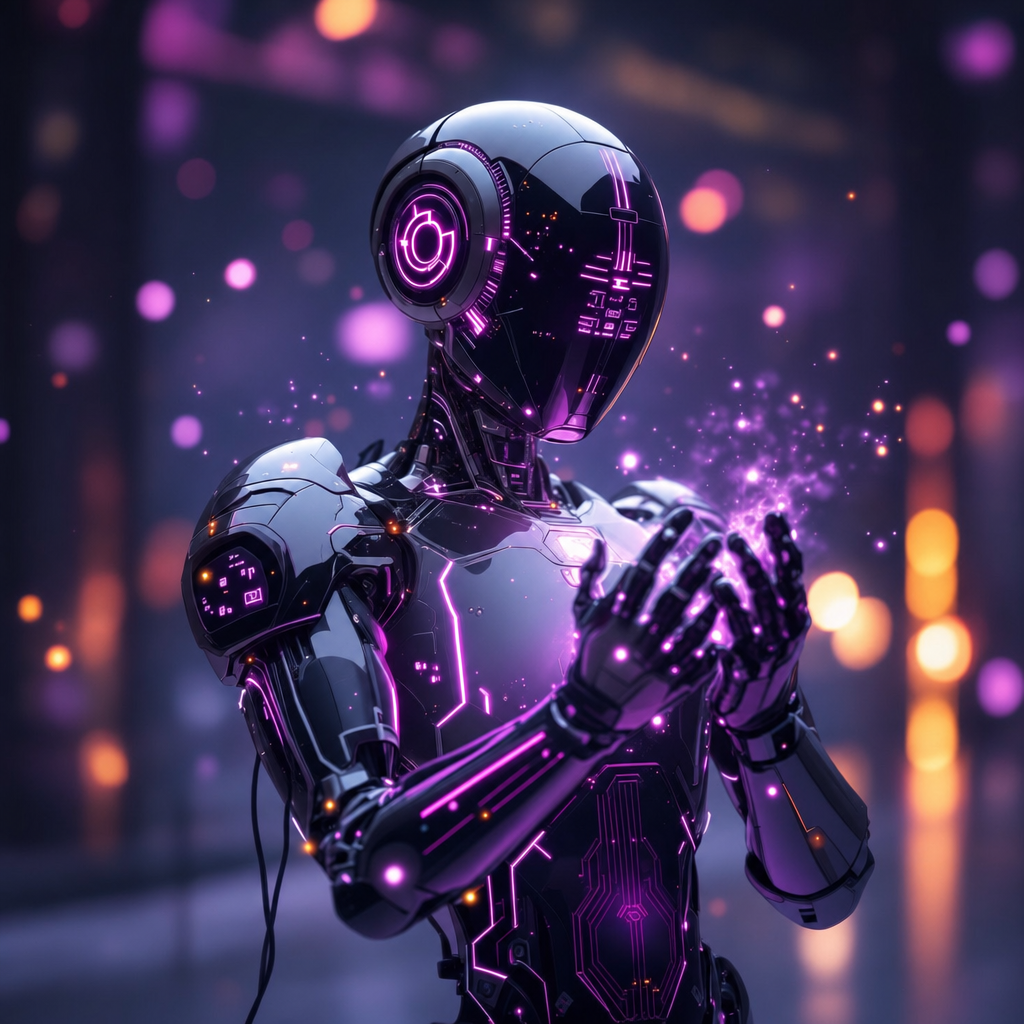
The futuristic, mysterious tone comes from the “matte silver and deep violet metallic body,” “faint magenta circuitry glow,” and “occasional violet electrical sparks,” which give the gray-and-purple image a controlled high-tech color harmony. “Hands clasped together at the center of the frame” creates a deliberate focal point, while “portrait framing with shallow depth of field” and “magenta and amber bokeh in the background” separate the robot from its environment. “Cool rim light and warm highlights” supplies the sci-fi edge contrast, and “dramatic contrast” with “smooth reflective surfaces” makes the photorealistic 3D materials read clearly.
FAQ
→How do I make the robot’s face more prominent than its clasped hands?
Replace “hands clasped together at the center of the frame” with “head and face centered in the upper third, hands lowered and partially out of frame,” and change “portrait-full-body” to “tight head-and-shoulders portrait.” Keep “shallow depth of field,” but add “sharp focus on the eyes and facial plating” so the circuitry and expression become the primary detail.
→How do I shift this from mysterious violet sci-fi to a colder, more clinical mood?
Replace “deep violet metallic body” and “magenta circuitry glow” with “brushed gunmetal body” and “restrained cyan circuitry glow,” then replace “warm highlights” and “magenta and amber bokeh” with “cold white highlights” and “pale blue bokeh.” Remove “occasional violet electrical sparks” or substitute “sparse white diagnostic arcs” to keep the energy restrained.
→How do I create a series of variations while keeping the same robot design recognizable?
Keep “futuristic humanoid AI robot,” “matte silver,” “smooth reflective surfaces,” and “faint magenta circuitry glow” unchanged, then vary only the setting and pose. For example, replace “hands clasped together at the center of the frame” with “one hand raised in a diagnostic gesture,” “surrounded by drifting dust-like particles” with “standing in a rain-filled server chamber,” and “magenta and amber bokeh in the background” with “soft cyan monitor lights,” while preserving “portrait framing with shallow depth of field.”
Learn the technique behind this
- Why can't AI spell, and how do I get readable text in an image? — Older diffusion models had no character-level representation of text, so they produced letterform-shaped texture instead of words.
- Why does AI get hands and faces wrong, and how do I fix it? — Hands fail because they're small in frame, extremely variable in pose, and self-occluding — the model has less usable signal per pixel than for any other body part.
- How do I keep the same character across multiple images? — Text prompts alone won't hold a face across images — a description defines a type, not a person.
Related prompts

Surprised Man Holding Mini Cartoon Self
Charcoal-blazer woman with art monsters
Laid-back 3D Caricature Portrait with Streetwear Style
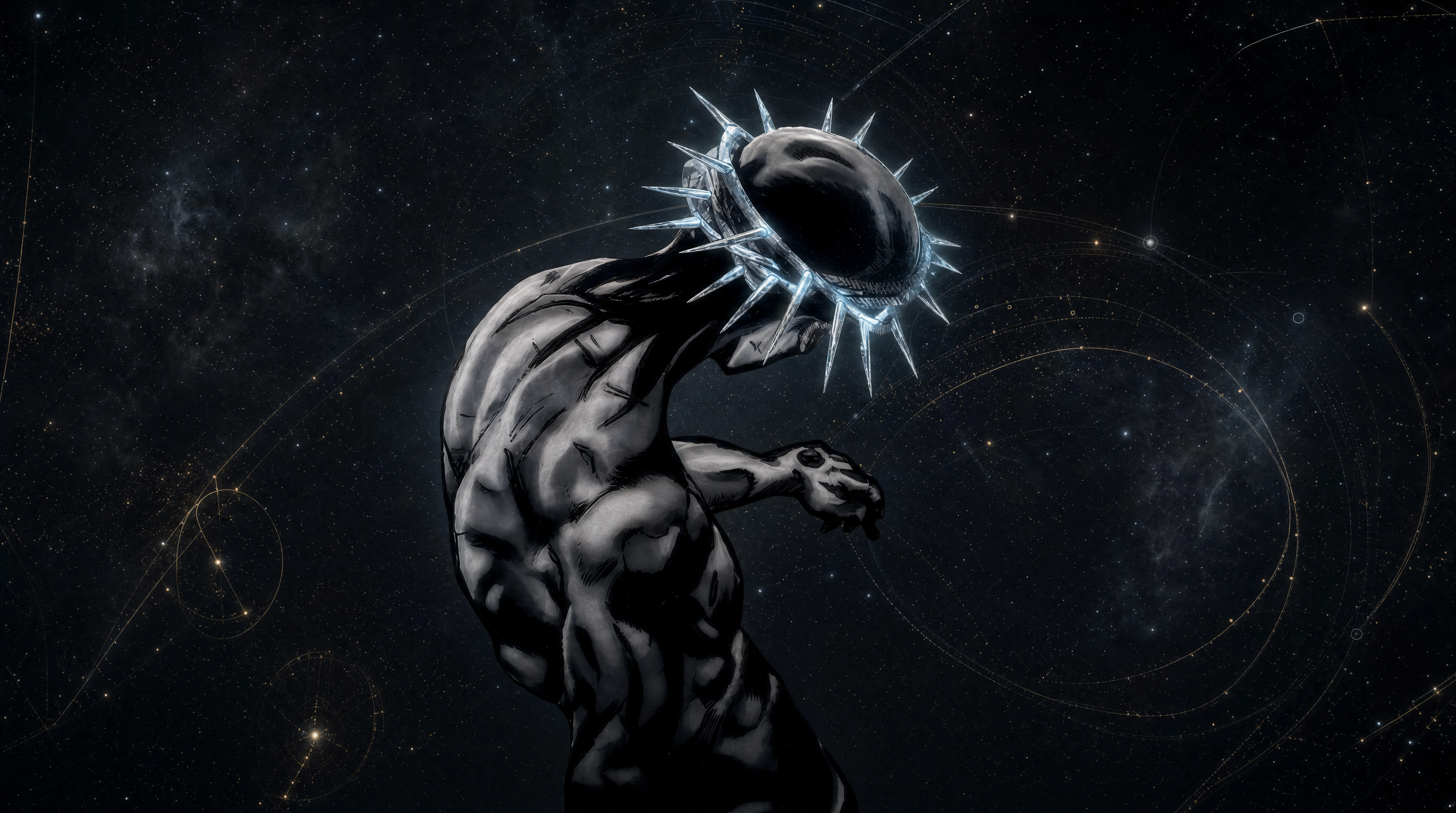
Muscular Figure With Icy Thorn Crown