Why this works
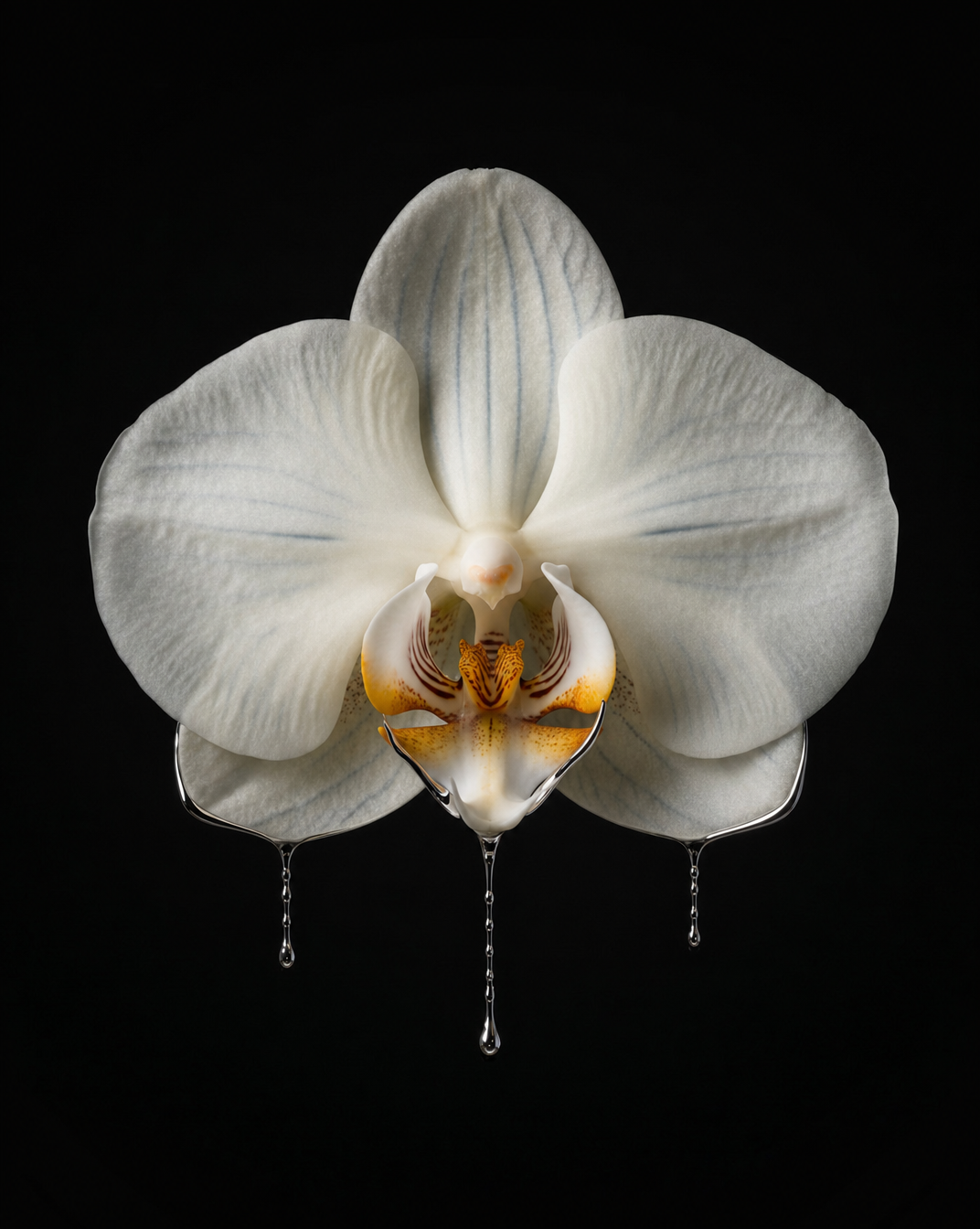
The centered single orchid against a “deep charcoal-black background” gives the image its controlled, gallery-like negative space, while “clean minimal composition” keeps the blossom dominant. “Slightly off-white (ivory) with delicate cool-blue veining” establishes the restrained cool palette, and “segmented liquid chrome ribbons” plus “sharper highlights” introduce the futuristic metallic contrast. The dramatic mood comes specifically from “dramatic studio lighting with strong rim light” and “high contrast,” while “hyperrealistic macro photography” and “crisp micro-texture detail” make the petals and chrome edges feel tangible.
FAQ
→How do I make the chrome transformation more prominent than the orchid petals?
Replace “lower petal edges transition into segmented liquid chrome ribbons that drip in thin streams” with “the lower half of the blossom transforms into long, highly reflective liquid-chrome ribbons,” and add “chrome occupying the lower two-thirds of the frame.” Keep “strong rim light” to preserve the metallic edge highlights.
→How do I shift this from dramatic and futuristic to soft and ethereal?
Replace “dramatic studio lighting with strong rim light, high contrast” with “diffused pearlescent light, soft halo illumination, and low contrast.” Change “deep charcoal-black background” to “misty pale gray-blue background” and replace “sharper highlights” with “gentle milky reflections” for a quieter finish.
→How do I create a series of variations without losing the core look?
Keep “centered single,” “hyperrealistic macro photography,” “clean minimal composition,” and “liquid chrome ribbons” unchanged. Vary one controlled element per version, such as replacing “orchid blossom” with “calla lily,” “magnolia,” or “iris,” or swapping “delicate cool-blue veining” for “violet veining” and “fine emerald veining,” while retaining the “deep charcoal-black background” and “strong rim light.”