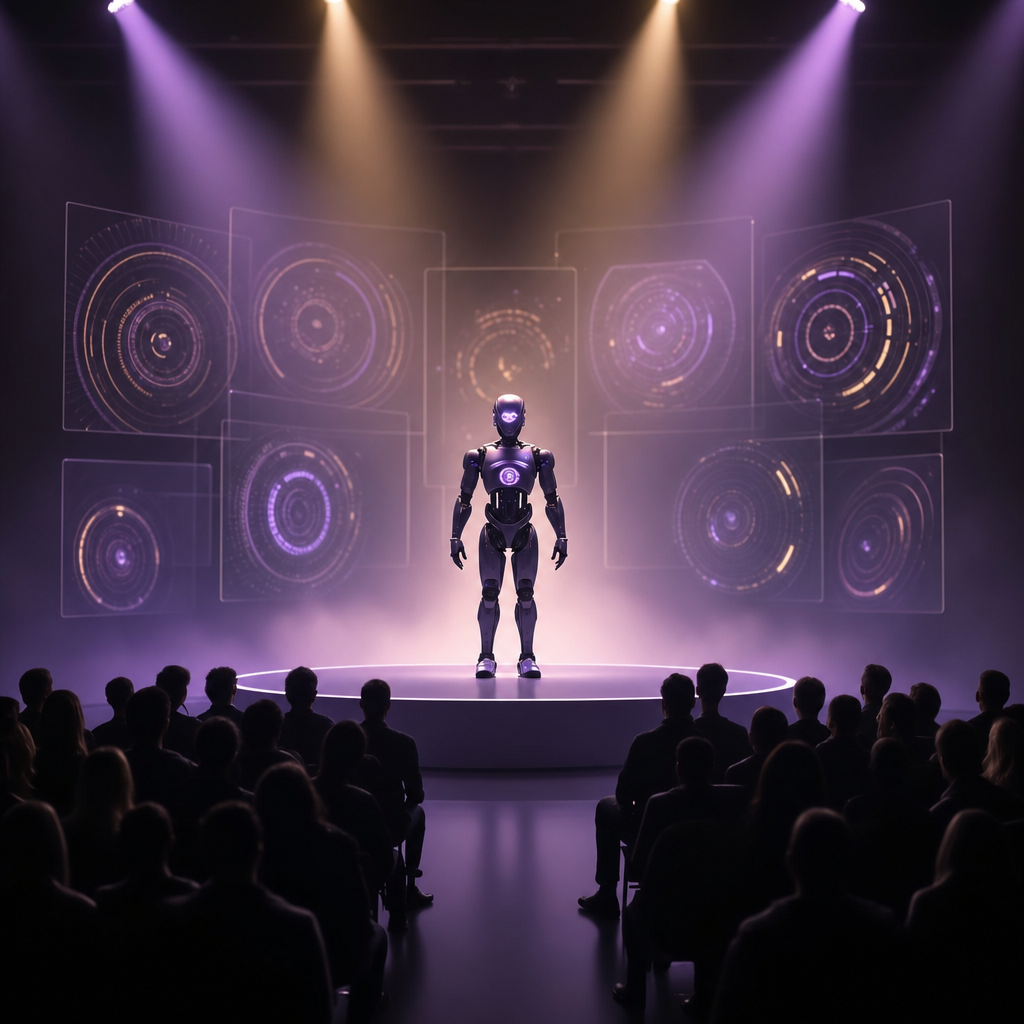
Why this works
The phrase “sleek humanoid robot standing centered on a circular stage” establishes a strong theatrical focal point, while “cinematic wide framing” preserves the auditorium and silhouetted audience as a sense of scale. “Dramatic violet spotlights plus warm amber accents” creates the purple-and-amber color contrast, and “high-contrast cinematic lighting with atmospheric haze” supplies the dramatic futuristic mood. “Sharp focus on the robot, soft falloff toward the audience” makes the robot visually dominant, while “glossy reflective stage floor” extends the lighting into controlled reflections.
FAQ
→How do I make the robot feel more imposing and central?
Replace “sleek humanoid robot standing centered on a circular stage” with “towering humanoid robot dominating the circular stage, viewed from a low angle,” and change “cinematic wide framing” to “low-angle wide shot with the robot filling the upper center of the frame.” Keep “sharp focus on the robot” and reduce “soft falloff toward the audience” to “audience heavily blurred and visually subdued.”
→How do I shift the mood from dramatic theatrical sci-fi to a colder, more ominous scene?
Replace “dramatic violet spotlights plus warm amber accents” with “cold cyan and pale blue spotlights with minimal warm light,” and change “faint misty atmospheric haze” to “dense low fog obscuring the stage edges.” Replace “seated in dark silhouette” with “silent audience reduced to indistinct shadow forms” to make the auditorium feel less ceremonial and more threatening.
→How do I create a series of variations while keeping the same visual identity?
Keep the fixed anchor phrases “photorealistic cinematic sci-fi,” “sleek humanoid robot,” “circular stage,” “glossy reflective stage floor,” and “semi-transparent holographic interface panels.” For each variation, change only the setting and lighting language, such as replacing “futuristic auditorium” with “orbital command center,” “subterranean research theater,” or “desert communications arena,” while swapping “violet spotlights plus warm amber accents” for a new two-color scheme.
Learn the technique behind this
- Why can't AI spell, and how do I get readable text in an image? — Older diffusion models had no character-level representation of text, so they produced letterform-shaped texture instead of words.
- How should a prompt be structured, and does word order matter? — A prompt that behaves predictably names one subject first, then what it is doing, then where, then the light, then the lens or medium, then the style.
- Do negative prompts work, and what should go in one? — Negative prompts work on models that support a separate negative conditioning channel — mainly Stable Diffusion and FLUX-family models.
Related prompts

DJ in neon haze at low angle

Glowing Fiber-Optic Cables With Purple Data Lines

Cyan Hologram, Sleek Robotic Hand

Cyborg head with magenta holograms and translucent skull