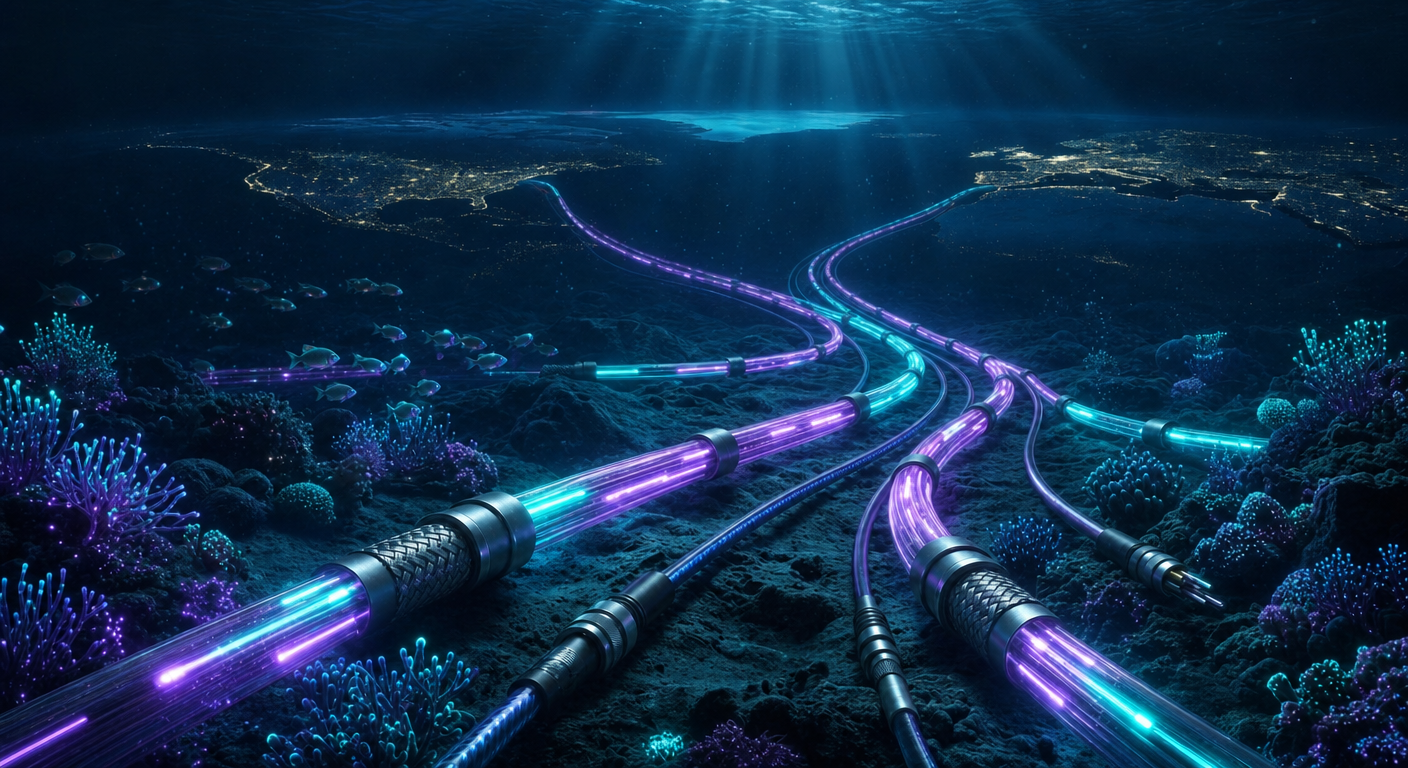
Why this works
The wide-angle view and “cable glow receding into distance” create strong leading lines and scale, while “dramatic depth of field” keeps the foreground technology legible against the black-blue seafloor. The futuristic, mysterious mood comes from the specific pairing of “electric-purple and teal data lines,” “moody blue lighting,” and “volumetric light rays,” with “drifting underwater particulate” making the sunbeams visible. “Ultra-sharp focus on the cable glow and surrounding marine textures” is load-bearing for the crisp fiber optics, coral, and fish details rather than relying on photorealism alone.
FAQ
→How do I make the cable network feel more central and imposing?
Replace “cinematic wide-angle view” with “low-angle ultra-wide establishing shot from directly beside the cables,” and change “small schooling fish cluster around the cable routes” to “dense schools of fish swirl around and frame the cables.” Add “cables dominate the foreground, occupying the lower two-thirds of the frame” to make the infrastructure visually primary.
→How do I shift this from mysterious and moody to brighter and more hopeful?
Replace “moody blue lighting” with “bright clear turquoise daylight,” and change “faint sunbeams filter down” to “strong golden sunbeams pour through the surface.” Swap “black” and “electric-purple” emphasis for “sunlit teal, warm gold, and soft coral pink,” while keeping “ultra-sharp focus on the cable glow” for technical clarity.
→How do I create a series of related scenes in different environments?
Keep the fixed core phrase “glowing fiber-optic internet cables with electric-purple and teal data lines” and replace “deep sea ocean floor” with locations such as “a volcanic underwater trench,” “a kelp forest canyon,” or “an Arctic seafloor beneath cracked sea ice.” Replace “bioluminescent coral and small schooling fish” with environment-specific elements such as “hydrothermal vent plumes and translucent shrimp” or “kelp fronds and drifting jellyfish,” while retaining “cable glow receding into distance” for consistent composition.
Learn the technique behind this
- Why can't AI spell, and how do I get readable text in an image? — Older diffusion models had no character-level representation of text, so they produced letterform-shaped texture instead of words.
- How should a prompt be structured, and does word order matter? — A prompt that behaves predictably names one subject first, then what it is doing, then where, then the light, then the lens or medium, then the style.
- Do negative prompts work, and what should go in one? — Negative prompts work on models that support a separate negative conditioning channel — mainly Stable Diffusion and FLUX-family models.
Related prompts

DJ in neon haze at low angle

Cyan Hologram, Sleek Robotic Hand
Cyborg head with magenta holograms and translucent skull
Blue-lit humanoid robot in lab